
The Studio Model
An organisational operating model for building continuous AI capability and progressing from AI-assisted work toward agent-mediated services and intelligent operations.
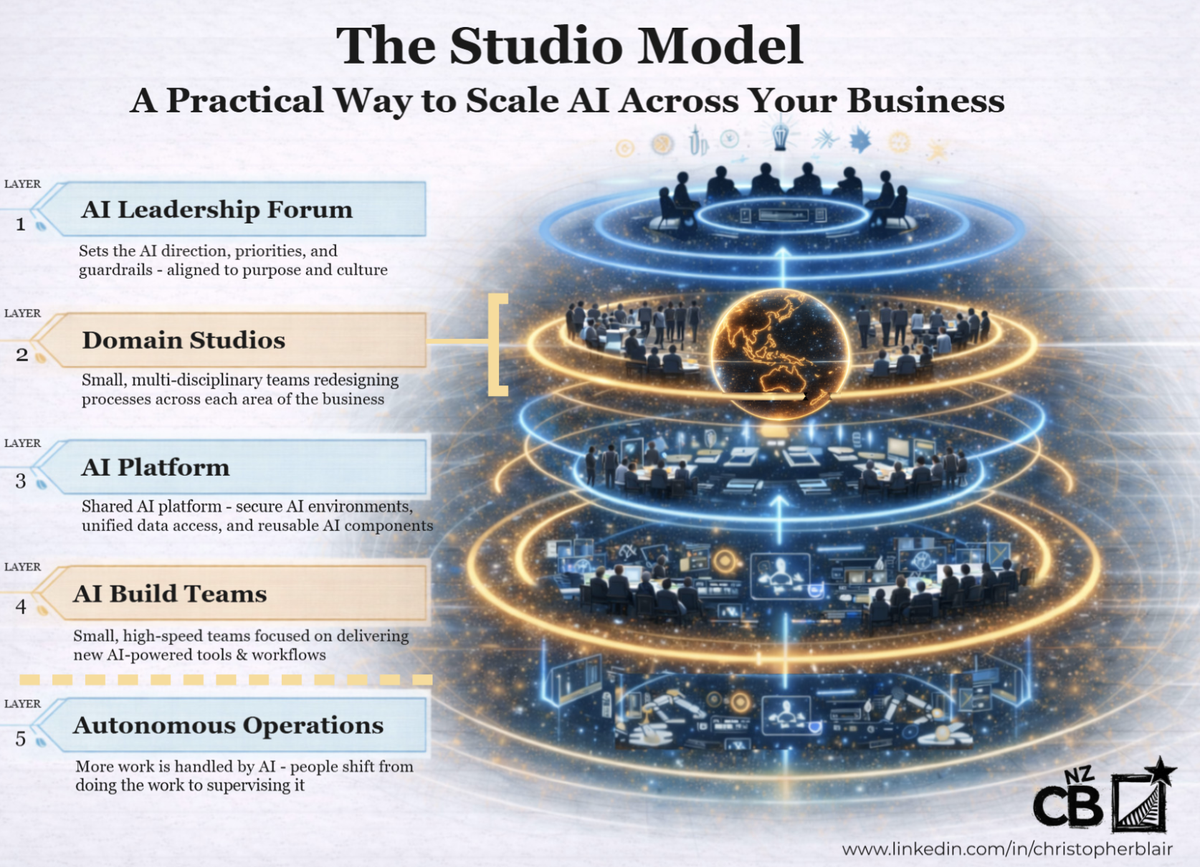
Redesigning work and organisations for an AI-shaped future
Framework by Chris Blair
Version 1.0 - Living Framework
Updated June 2026
The Studio Model is being progressively expanded as AI changes how work is designed, how services are delivered, and how organisations interact with people, platforms, and other intelligent systems. This includes a stronger focus on Value Dynamics: how new capability is converted into better work, stronger services, realised value, and readiness for changing markets.
Redesigning work for the next economic era
AI will change more than the tools people use.
It will reshape how work is organised, how decisions are made, how customers interact with organisations, how services are delivered, and how value moves between people, businesses, and institutions.
The immediate opportunity is to help people work more effectively - reducing unnecessary effort, improving access to knowledge, supporting better decisions, and creating more time for judgement, creativity, relationships, problem-solving, and meaningful contribution.
But time saved and effort reduced do not automatically become value.
Value depends on what the organisation does with the capacity, knowledge, and capability that AI creates.
Work needs to be redesigned. Higher-value activities need to be identified or created. People need authority, skills, and support. Services and market propositions need to evolve.
Without those changes, AI can make individual tasks more efficient while leaving the wider organisation largely unchanged.
But the wider systems transition does not stop at the boundaries of the organisation.
AI is beginning to move beyond assisting people inside individual tasks and workflows.
Organisations will serve customers represented by personal agents, operate services through organisational agents, and participate in wider systems where machines coordinate with other machines on behalf of people and institutions.
This creates a broader organisational challenge.
It is no longer enough to introduce AI tools or run isolated proofs of concept. Organisations need the leadership, trust, work-design capability, technology foundations, delivery systems, and human participation required to learn and evolve continuously.
The next phase of AI value is not individual tool adoption.
It is the redesign of work around human-AI teams, governed agents, trusted information foundations, and measurable business outcomes.
The Studio Model is a five-layer organisational operating model for helping organisations navigate this wider organisational challenge.
It connects leadership direction, domain-led redesign, shared technology capability, rapid delivery, and intelligent operations into one coordinated system.
Its purpose is not simply to automate more work.
It is to help organisations convert AI capability into better work, better services, stronger human and organisational capability, and more trustworthy ways of operating - while preparing for an economy in which AI acts between organisations as well as within them.
This conversion from technical possibility into realised human, organisational, strategic, and market value is the central concern of Value Dynamics within the Studio Model.
What the Studio Model is ultimately for
The Studio Model begins with an organisational challenge, but its purpose is wider than deploying AI, automating tasks, or increasing productivity.
The Studio Model therefore distinguishes between introducing capability and realising value.
AI may release time, improve access to knowledge, or automate part of a workflow. But value is only realised when those gains are deliberately converted into outcomes that matter.
Better work
Work in which AI reduces unnecessary effort, expands access to knowledge, supports sound judgement, and gives people more capacity for creativity, relationships, problem-solving, and meaningful contribution.
Stronger human capability and agency
People who are supported to learn, adapt, participate in redesign, and shape new ways of working — while retaining agency as roles, workflows, and decision responsibilities change.
Better customer and public experiences
Services that are easier to navigate, more responsive to individual needs, and designed for a future in which people interact directly or through trusted personal agents.
Trusted intelligent systems
AI systems with clear authority, accountability, oversight, provenance, security, and boundaries around the decisions and actions they are permitted to take.
Continuously adaptive organisations
Organisations able to redesign work, build new capability, learn from real use, and evolve as technology, customer expectations, and wider economic systems change.
Realised and compounding value
The ability to convert time saved, effort reduced, knowledge gained, and new technical capability into better work, stronger services, organisational learning, innovation, resilience, and future market opportunity.
This includes deciding where released capacity should be redeployed, what higher-value work must be created, and how successful capabilities can be reused and compounded across the organisation.
Readiness for an agent-mediated economy
The capability to interact safely and effectively with customer agents, supplier agents, platform agents, institutional systems, and wider networks of machine-mediated coordination.
The five layers of the Studio Model are not the final outcome.
They are the organisational machinery through which new capability can be converted into human, customer, operational, strategic, and market value — and through which that value can be sustained and compounded as the role of AI continues to evolve.
How the Studio Model connects purpose to delivery
The Studio Model creates a clear line of sight from human purpose and organisational ambition to the capabilities, structures, and measures required to deliver meaningful transformation.
Human purpose
Create work that expands people’s capability, supports meaningful contribution, and maintains agency through change.
Organisational ambition
Build a more capable, trusted, adaptive, and intelligence-enabled organisation that can create better outcomes for its people, customers, and communities.
Strategic mission
Connect leadership, work redesign, technology, delivery, governance, and continuous learning into one coordinated organisational system.
Operating model architecture
Bring together the five layers of the Studio Model:
- AI Leadership Forum
- Domain Studios
- Technology Enabling Platform
- AI Build Teams
- Autonomous Operations
Evolution pathway
Progress from AI-assisted work inside the organisation, through agent-mediated customer and service relationships, toward responsible participation in wider agent-coordinated economic networks.
Value-conversion pathway
Convert AI-enabled capacity and intelligence into redesigned work, redeployed human capability, better services, organisational learning, and stronger market position.
Measures of progress
Assess progress through better work, stronger services, trusted decisions and actions, reusable capability, faster organisational learning, realised and retained value, human capability, customer confidence, organisational resilience, and readiness for changing market conditions.
From AI tools to organisational capability
AI does not scale through tools alone. It scales through the systems around them.
Most organisations are experimenting with AI, but many struggle to move beyond individual tools, disconnected initiatives, and isolated proofs of concept.
Without a wider organisational system, promising applications remain detached from core workflows, difficult to govern consistently, and unable to generate sustained value at scale.
Even where tools produce measurable productivity gains, the value may remain unrealised.
Time savings can be fragmented across many people. Released capacity can be absorbed by additional low-value activity. Existing incentives and performance measures can keep people working in the same way. Higher-value work may not yet have been designed, funded, or authorised.
The problem is therefore not only how to deploy AI. It is how to convert new capability into outcomes the organisation genuinely values.
Technology is only one part of the challenge.
Leadership must set direction and establish the boundaries within which AI can operate. Business domains must redesign work rather than simply add AI to existing processes. Shared platforms must make trusted data, models, and reusable components available. Delivery teams must turn opportunities into working systems. People must be involved in shaping new roles, workflows, and decision responsibilities.
The Studio Model connects these capabilities into one coordinated operating model and provides the organisational conditions through which potential value can be converted into realised value.
It enables organisations to move from:
- disconnected experimentation to shared direction
- isolated use cases to redesigned workflows
- repeated one-off builds to reusable capability
- technology deployment to organisational transformation and human adaptation
- short-term projects to continuous learning and adaptation
- assisted work toward intelligent and agent-enabled operations
- time saved to capacity deliberately redeployed
- isolated productivity gains to sustained organisational value
- automation of existing work to the creation of higher-value work
- internal efficiency to readiness for changing customer and market requirements
This is the role of Value Dynamics within the model.
It asks not only whether an AI system works, but:
- what capability it creates
- what capacity it releases
- where that capacity will be redeployed
- what work, services, or decisions must be redesigned
- what higher-value outcomes are ready to receive the new capability
- where value will accumulate
- and whether the organisation is becoming better prepared for the next wave of market change
This is not only a systems and technology transition.
It changes how work is organised, where decisions are made, how authority is delegated, what capabilities people need, and how human judgement works alongside machine intelligence.
The Studio Model provides a structure through which organisations can:
- redesign core work and services
- build reusable and governed AI capability
- deliver and learn more rapidly
- scale AI safely and intentionally
- support human adaptation and agency as roles and ways of working change
- prepare for agent-mediated services and more autonomous operations
- define how released capacity will be redirected toward higher-value activity
- test whether intended value is being realised in practice
- build the capabilities required for future customer, platform, and agent relationships
Within the wider ChrisBlair.ai framework architecture, the Studio Model represents the organisational execution layer: the place where the broader shifts described through MI-ND, the Machine Room, and NZ-EOS are translated into changes in work, capability, services, and operations.
The organisational gap the Studio Model addresses
Most organisations are now experimenting with AI, but experimentation alone does not create lasting organisational capability.
Common patterns include:
- initiatives that remain fragmented across teams and functions
- proofs of concept that never progress into sustained use
- business teams that identify opportunities but remain disconnected from design and delivery
- technology teams that build solutions without sufficiently redesigning the work around them
- governance introduced too late, or applied in ways that create uncertainty and delay
- duplicated platforms, models, data pipelines, and delivery effort
- insufficient support for people whose roles, workflows, and responsibilities are changing
- limited mechanisms for learning from use and carrying that learning into the next cycle of change
- productivity benefits that are measured without a clear plan for redeploying released capacity
- automation initiatives that improve individual tasks but leave the wider workflow unchanged
- business cases that count time saved but do not identify the higher-value work that should follow
- value measures focused on cost and throughput while overlooking capability, customer, resilience, and market outcomes
- organisations becoming more efficient internally while remaining unprepared for changing channels, platforms, and agent-mediated markets
They are also value-conversion problems.
The organisation may have created technical capability without creating the structures, roles, incentives, workflows, and market propositions required to turn that capability into meaningful value.
They are signs that leadership, work redesign, technology, governance, delivery, and human adaptation are being treated as separate activities rather than as one connected system.
The Studio Model brings these activities together through a continuous organisational cycle:
Direction → Define Value → Redesign → Build → Deploy → Learn → Redeploy → Evolve
Define Value establishes the human, customer, operational, strategic, and market outcomes being pursued.
Redeploy ensures that capacity released through AI is deliberately redirected toward higher-value work, stronger services, innovation, learning, or future market capability.
Without these two steps, organisations risk moving efficiently from idea to deployment without ever resolving how value will actually be realised.
Leadership sets the direction and boundaries for change. Domain teams redesign work and services. Shared technology enables trusted and reusable delivery. Build teams turn opportunities into working systems. Real-world use generates evidence, learning, and new priorities.
That learning then returns to leadership and the Domain Studios, informing the next cycle of redesign and investment.
Instead of treating AI as a one-off transformation programme, the organisation develops an ongoing capacity to define value, redesign work, build capability, redeploy human and organisational capacity, govern change, and adapt as technology and the operating environment evolve.
From AI-assisted work to an agent-mediated economy
The Studio Model was initially developed to help organisations move beyond fragmented AI experimentation and build the capability to redesign work continuously.
That remains its most immediate role.
But the environment around the organisation is also changing.
AI is moving from helping people complete individual tasks, to operating across workflows, representing people and organisations, and coordinating activity between wider networks of economic actors.
The Studio Model therefore supports more than one fixed organisational end state. It provides a foundation for progression across three overlapping waves.
These waves are not rigid stages. They describe changing centres of gravity. Different functions, services, and industries may move through them at different speeds.
Value Dynamics changes across these waves.
In Wave 1, the central challenge is converting internal productivity and capability gains into better work and organisational performance.
In Wave 2, value depends on redesigning services, information, and customer relationships for people represented by personal agents.
In Wave 3, value is shaped by the organisation’s position within networks of agents — including who controls discovery, trust, coordination, customer access, data, and transaction flows.
Wave 1 - Redesigning work inside the organisation
The immediate focus is work performed within the organisation.
AI helps people research, analyse, create, communicate, make decisions, and execute tasks. As capability develops, the emphasis moves from improving individual productivity to redesigning complete workflows, services, and decision processes.
The organisational challenge is to move beyond isolated tools and personal experimentation toward:
- redesigned work and service flows;
- trusted access to organisational knowledge and data;
- reusable AI capability;
- clear governance and accountability;
- measurable organisational value;
- active participation by the people whose work is changing.
From a Value Dynamics perspective, the key question is not simply how much time AI saves.
It is what happens to the released capacity.
The organisation must determine:
- which higher-value activities should receive it;
- whether roles and workloads have been redesigned;
- whether people have the authority and capability to work differently;
- whether customer, quality, innovation, or learning outcomes improve;
- and whether the gain can be sustained beyond the individual task.
People remain directly involved in most decisions and activities. AI assists, recommends, generates, and performs defined tasks within boundaries established by the organisation.
Wave 2 - Serving people through agents
The centre of gravity begins to move beyond the organisation.
Customers, employees, suppliers, and citizens will use personal agents to search, compare, negotiate, purchase, schedule, complete forms, manage services, or communicate with organisations on their behalf.
The organisational challenge is no longer only to provide a better website, application, or chatbot. Services must also become understandable and accessible to authorised machines.
This requires:
• machine-readable products, policies, services, and terms
• trusted identity and delegated authority
• transparent pricing and decision criteria
• agent-accessible processes and service interfaces
• secure APIs and structured information
• verifiable outputs and transaction records
• clear paths for human review, intervention, and escalation
Customer experience does not disappear, but part of it becomes agent experience.
The organisation must be able to serve both the person and the trusted digital representative acting on that person’s behalf.
This changes the value case.
Internal efficiency remains important, but it is no longer sufficient. Organisations must redirect some of the capability created in Wave 1 toward:
- machine-readable services and information;
- trusted identity and delegated authority;
- new service and channel design;
- stronger transparency and explainability;
- protection of direct customer relationships;
- and differentiated human experiences where personal connection still creates value.
An organisation can become more efficient in Wave 1 while becoming less relevant in Wave 2 if it does not reinvest its gains in these emerging capabilities.
Wave 3 - Participating in networks of economic agents
The centre of gravity shifts further toward coordination between intelligent systems.
Organisational agents will interact with customer, supplier, platform, financial, infrastructure, regulatory, and government agents across wider economic networks.
Routine coordination could include:
• discovery and comparison
• negotiation and purchasing
• scheduling and fulfilment
• identity and credential verification
• compliance and reporting
• resource optimisation
• payment and settlement
• monitoring and exception management
At this stage, Value Dynamics also becomes a question of market position.
The organisation must understand:
• whether it owns valuable coordination capability or merely supplies another platform
• who controls discovery and recommendation
• where customer and transaction data accumulate
• who owns the trusted relationship
• where margins and learning effects are captured
• whether the organisation is moving toward a stronger or weaker position in the network
This does not mean removing people from all important decisions.
The human or organisation remains the principal. The agent operates within delegated authority, defined objectives, and explicit boundaries. People set intent, determine acceptable trade-offs, retain intervention rights, and remain accountable for the systems they authorise.
Participation in this wave requires stronger organisational capability in:
- digital identity and machine-readable authority;
- provenance and verifiable information;
- delegated decision rights;
- interoperability and common standards;
- monitoring and auditability;
- explainability and accountability;
- fail-safe behaviour and human override;
- trust between organisations, platforms, and institutions.
The systems transition across these waves will be gradual and uneven.
An organisation may still be redesigning internal work in one domain while beginning to serve personal agents in another. More advanced operations may coordinate with external agents while high-consequence decisions remain firmly under human control.
The purpose of the Studio Model is not to push every process toward maximum autonomy.
It is to help organisations decide where assistance, delegation, automation, or agent interaction creates genuine value; how released capability should be redeployed; what higher-value work and services must be created; and which future market capabilities need to be built.
Each change should be introduced with the appropriate level of trust, participation, governance, human oversight, and clarity about where value is expected to emerge and accumulate.
The five layers of the Studio Model provide the organisational architecture for navigating this progression — from leadership direction and work redesign through to trusted delivery and increasingly intelligent operations.
The Studio Model Layers
The Studio Model is a five-layer organisational operating model for redesigning work, building continuous AI capability, converting that capability into realised value, and preparing for increasingly intelligent and agent-mediated operations.
The layers operate as one connected system within the organisation:
- AI Leadership Forum — defines the value priorities, strategic direction, authority, and guardrails.
- Domain Studios — identify where value can be created and redesign work, services, journeys, and decisions.
- Technology Enabling Platform — makes trusted capability reusable and reduces the cost of creating value repeatedly.
- AI Build Teams — turn value hypotheses and redesigned workflows into working systems.
- Autonomous Operations — release and coordinate capacity through appropriate assistance, delegation, and bounded autonomy.
Value Dynamics runs across all five layers.
It connects the initial value hypothesis to work redesign, delivery, adoption, capacity redeployment, operational learning, and future market readiness.
Each layer depends on the others.
Leadership without redesign remains abstract. Redesign without technology and delivery remains conceptual. Technology without domain direction produces disconnected tools. Delivery without governance creates risk and duplication. Autonomous operation without human authority, oversight, and trust can scale the wrong outcomes.
Together, the layers create a continuous flow from strategic intent and value definition through redesign, delivery, capacity redeployment, real-world learning, and organisational evolution.
1. AI Leadership Forum
Sets the direction, priorities, authority, and guardrails for AI across the organisation.
It aligns investment, risk, opportunity, human impact, organisational transformation, and value realisation with the organisation’s wider purpose and strategy.
Who is involved
Brings together the leadership perspectives required to set direction, govern risk, align investment, and guide organisational transformation and human adaptation.
- Executive leadership
- Business and domain leaders
- Technology and data leadership
- Risk, legal, security, and governance representatives
- People, workforce, and transformation leadership
- Customer or public-service leadership where relevant
- Finance, investment, or value-realisation leadership
What it does
Establishes the conditions within which AI can be adopted, developed, and operated responsibly across the organisation.
- Defines the organisation’s AI ambition and transformation priorities
- Identifies where AI can create meaningful human, customer, operational, and strategic value
- Allocates investment across use cases, shared capabilities, organisational learning, and the higher-value activities required to absorb newly released capacity
- Establishes governance guardrails, decision rights, and risk appetite
- Defines the levels of authority that may be delegated to AI systems
- Aligns AI initiatives with organisational purpose and strategic priorities
- Removes organisational blockers and resolves cross-functional dependencies
- Guides organisational transformation and supports human adaptation as roles, decisions, and ways of working change
- Monitors realised value, emerging risks, and evidence from real-world use
- Reprioritises investment as the organisation learns
- Defines what value means across human, customer, operational, strategic, and market dimensions
- Distinguishes immediate efficiency benefits from longer-term capability and option value
- Determines where released capacity should be redeployed
- Identifies the higher-value work, services, and market capabilities the organisation needs to build
- Establishes value hypotheses and measures before major investments proceed
- Reviews whether realised value is appearing where expected
- Monitors whether value is being retained by the organisation or shifting to external platforms and intermediaries
- Directs investment toward capabilities required for Wave 2 and Wave 3 readiness
What this enables
Moves AI from fragmented experimentation toward coordinated organisational capability.
- Clear leadership direction and accountability
- More confident and timely investment decisions
- Focus on the most meaningful opportunities
- Better balance between innovation, trust, risk, and control
- Clear boundaries for human and machine decision-making
- More deliberate support for people affected by change
- Stronger leadership through uncertainty, organisational transformation, and changing workforce needs
- A feedback loop between strategy, delivery, use, and learning
- Clearer distinction between technical success and realised organisational value
- Deliberate redeployment of human and organisational capacity
- Investment decisions that balance short-term returns with future capability
- Stronger preparation for emerging customer, platform, and agent requirements
- Better understanding of where value will accumulate across the wider ecosystem
Organisational shift
Without this layer: AI initiatives remain fragmented, ownership is unclear, investment is dispersed, and people experience change without a coherent direction.
With this layer: AI becomes a coordinated organisational priority with clear purpose, authority, accountability, value priorities, and deliberate plans for human adaptation, capability redeployment, and future market readiness.
The direction established by the AI Leadership Forum is translated into practical redesign through the Domain Studios.
2. Domain Studios
Cross-functional teams that redesign work, services, journeys, and decision processes using AI.
They bring together the people who understand the domain with the design, data, technology, and delivery capability required to identify where value is being lost, redesign how value is created, and determine how new capability should be used.
As AI capability becomes more agentic, Domain Studios also help define how people and AI agents should work together.
This includes deciding which parts of a workflow should remain human-led, which can be AI-assisted, which can be delegated to bounded agents, and how outputs should be reviewed, measured, governed, and improved over time.
Who is involved
Combines domain knowledge, lived operational experience, customer understanding, design capability, and technical expertise.
- Business and domain leaders
- Subject-matter experts and frontline practitioners
- Process and service-design specialists
- Customer or citizen-experience specialists
- Data and AI practitioners
- Product and delivery leads
- Risk, policy, legal, or compliance specialists where relevant
- People, capability, and organisational-change representatives where roles are materially affected
- Finance, performance, or value-realisation specialists where appropriate
What it does
Translates strategic direction into high-value opportunities within specific organisational domains.
- Identifies points of friction, unmet need, avoidable effort, and unrealised value
- Maps existing workflows, journeys, decisions, and dependencies
- Redesigns the work rather than simply adding AI to current processes
- Determines where human judgement, relationships, creativity, and accountability remain essential
- Identifies where AI should assist, recommend, generate, automate, or act within defined boundaries
- Considers how roles, capability needs, workloads, and decision responsibilities will change
- Involves the people affected in shaping new ways of working
- Prototypes AI-enabled workflows and service experiences
- Tests assumptions with users, workers, customers, and stakeholders
- Defines expected human, customer, operational, strategic, and market value — including where the value should emerge, who should benefit, and how it will be measured
- Validates the technical opportunity, work redesign, capacity-redeployment plan, and value hypothesis before committing to scaled delivery
- Maps how value currently flows through the domain
- Identifies where effort, delay, friction, rework, risk, or unmet need reduce value
- Distinguishes between task-level efficiency and end-to-end workflow value
- Estimates what capacity may be released through redesign or automation
- Identifies whether that capacity will be consolidated, redeployed, or absorbed
- Designs the higher-value work or service improvements that will receive released capacity
- Examines how incentives, measures, roles, and decision rights may need to change
- Tests whether proposed redesigns improve human, customer, operational, strategic, or market outcomes
- Identifies capabilities required for personal-agent and external-agent interaction
What this enables
Moves AI from abstract ambition into practical organisational and service transformation.
- Clear connection between AI and real human or organisational needs
- Better-quality opportunities grounded in domain knowledge
- Stronger participation by the people whose work is changing
- Alignment across business, technology, risk, and delivery
- Better protection of human judgement and accountability
- Movement from task automation toward end-to-end work redesign
- Earlier validation of value, feasibility, trust, and unintended consequences
- Stronger foundations for adoption and sustained use
- A clear destination for capacity released through AI
- Better-designed higher-value work
- Earlier identification of value that might otherwise leak or remain unrealised
- Stronger connection between internal redesign and future market requirements
- Value cases that extend beyond productivity and cost reduction
Organisational shift
Without this layer: AI remains disconnected from real work, customer needs, and domain context. Existing processes are automated without being meaningfully redesigned.
With this layer: people, processes, services, decisions, and value pathways are redesigned together, allowing AI capability to be converted into better work, stronger services, and more valuable organisational and market outcomes.
The opportunities developed by the Domain Studios depend on a trusted Technology Enabling Platform that can support reuse, governance, and delivery at scale.
3. Technology Enabling Platform
Provides the shared technology, data, security, and governance capabilities required to build, deploy, operate, and evolve AI safely.
It enables trusted access to models, organisational knowledge, data, tools, interfaces, and reusable components.
By making trusted capabilities reusable, the Platform also allows value created in one domain to be extended and compounded across the organisation.
Who is involved
Brings together the technical and governance capabilities required to support AI across the organisation.
- Platform and cloud engineering
- Data engineering and architecture
- AI and machine-learning engineering
- Software architecture and integration teams
- Cybersecurity, privacy, identity, and risk teams
- Model-governance and assurance specialists
- Service management and operational support
- Enterprise architecture and technology leadership
What it does
Creates the shared foundation through which AI solutions can be developed consistently and reused across domains.
- Provides secure AI environments and governed access to models
- Establishes trusted access to organisational data and knowledge
- Develops a Semantic Data Layer, helping organisational data, knowledge, metrics, relationships, rules, and context become understandable and reusable across AI systems, workflows, dashboards, and agents
- Supports identity, permissions, delegated authority, and access control
- Provides reusable components, tools, connectors, agents, and workflow patterns
- Enables integration with existing organisational systems
- Supports secure APIs and machine-readable service interfaces
- Establishes evaluation, testing, monitoring, and assurance capabilities
- Records provenance, system activity, decisions, and relevant audit information
- Supports model and application lifecycle management
- Enables human review, intervention, escalation, and override
- Provides common patterns for reliability, resilience, and fail-safe behaviour
- Makes successful capabilities easier to reuse across multiple domains
- Captures reusable capabilities created through successful implementations
- Provides data and observability required to measure adoption, capacity released, service performance, and realised value
- Supports the structured data and interfaces required for agent-mediated services
- Enables common identity, authority, provenance, and transaction patterns for organisational agents
- Reduces the marginal cost of extending successful capability into additional domains
- Preserves organisational learning in reusable technical and operational assets
What this enables
Moves AI from isolated technical builds toward trusted, repeatable organisational capability.
- Faster and more consistent delivery
- Reduced duplication and lower long-term delivery cost
- Trusted access to data, knowledge, and models
- Governance and assurance embedded into delivery
- Reusable patterns across business domains
- Greater interoperability between systems and services
- Stronger monitoring, provenance, and accountability
- Technical readiness for organisational agents and external agent interaction
- A stable foundation for continuous improvement
- Compounding value as successful capabilities are reused
- Better evidence about whether expected benefits are being realised
- Reduced time between validated opportunity and scaled impact
- Lower dependence on external platforms for core organisational capability
- Stronger readiness for machine-readable services and external agent networks
- Greater retention of data, learning, intellectual property, and operational knowledge
Organisational shift
Without this layer: AI development remains fragmented, duplicated, difficult to govern, and dependent on one-off technical solutions.
With this layer: teams can build on trusted, reusable foundations, allowing technical capability, organisational learning, and realised value to be extended across domains while maintaining security, governance, interoperability, and operational control.
With the Technology Enabling Platform in place, AI Build Teams can turn validated opportunities into working systems more rapidly and reliably.
4. AI Build Teams
Small, cross-functional teams that design, build, test, deploy, and improve AI-enabled systems.
They translate redesigned workflows and validated value hypotheses into usable capabilities through rapid iteration and close collaboration with the domain.
Who is involved
Combines the skills required to build production-ready AI systems while remaining connected to the people, work, and outcomes they are intended to support.
- Software and AI engineers
- Product and delivery leads
- UX, service, and workflow designers
- Data and integration specialists
- Domain experts and frontline contributors
- Evaluation, assurance, and risk specialists
- Human adaptation, capability, and change practitioners where needed
- Value, performance, or benefits-realisation specialists where needed
What it does
Develops AI-enabled systems through iterative cycles of design, delivery, evaluation, and learning.
- Translates redesigned workflows into working solutions
- Builds AI assistance, decision support, workflow automation, and agent capabilities
- Designs the interaction between people and AI systems
- Establishes appropriate human review and intervention points
- Develops interfaces, integrations, and operational processes
- Iterates through build, test, validate, and learn cycles
- Evaluates quality, reliability, safety, usability, adoption, capacity redeployment, and realised value
- Tests for unintended consequences and failure conditions
- Embeds provenance, monitoring, accountability, and operational controls
- Works with affected teams to prepare for new roles and ways of working
- Uses evidence from real-world use to improve both the system and the redesigned workflow
- Builds instrumentation required to observe adoption, workflow change, capacity released, and realised value
- Tests whether the higher-value work identified by the Domain Studio is actually occurring
- Distinguishes technical performance from workflow, human, customer, and market outcomes
- Tests whether productivity gains are usable, fragmented, displaced, or absorbed elsewhere
- Feeds evidence back into the value hypothesis and work redesign
- Builds machine-readable interfaces and agent capabilities where future service models require them
What this enables
Turns ideas and prototypes into real systems that people can use, trust, and improve.
- Faster delivery of valuable AI-enabled capability
- Stronger connection between technical delivery and domain need
- Continuous learning through real-world use
- Practical integration of AI into day-to-day work and services
- More reliable movement from experimentation into production
- Better-designed human–AI collaboration
- Evidence about value, adoption, risk, and performance
- Growing organisational confidence and delivery capability
- Evidence that value is being created rather than merely assumed
- Earlier correction when technical success does not produce operational or human benefit
- Measurable links between system delivery, work redesign, and value realisation
- Learning that improves future value hypotheses and implementation choices
- Progressive development of Wave 2 and Wave 3 technical capability
Organisational shift
Without this layer: opportunities remain conceptual, prototypes do not become reliable services, and learning is lost between strategy and implementation.
With this layer: redesigned work and value hypotheses become usable capability embedded in real workflows, with people, technology, governance, measurement, and learning developed together.
As solutions mature, some activities move toward higher levels of AI assistance, delegation, and bounded autonomy within Autonomous Operations.
5. Autonomous Operations
Enables processes and services to operate with appropriate levels of AI assistance, delegated action, and bounded autonomy.
Its purpose is not only to reduce human effort. It is to release and coordinate capacity in ways that improve outcomes, strengthen resilience, and enable forms of value that were previously difficult or uneconomic to create.
Levels of operation
Autonomous Operations can include several different operating modes:
AI-assisted work
AI provides information, generates content, recommends actions, or supports decisions while a person remains directly responsible for execution.
Delegated tasks
AI completes defined tasks on behalf of a person or team within clear instructions, permissions, and limits.
Bounded autonomous processes
AI manages a workflow or decision process within predetermined objectives, thresholds, policies, and escalation rules.
Organisational agents
AI systems represent the organisation in defined interactions, such as responding to requests, coordinating services, purchasing, scheduling, or managing operational activity.
External agent interaction
Organisational agents interact with authorised customer, supplier, platform, financial, regulatory, or government agents across organisational boundaries.
Each level creates a different value profile.
Assistance may improve judgement or quality. Delegation may release individual capacity. Bounded autonomy may remove coordination effort across a workflow. Organisational agents may enable new service models or economic relationships.
The appropriate level should therefore be selected according to both trust requirements and the type of value being pursued.
The appropriate mode depends on the consequence, complexity, reversibility, trust requirements, and need for human judgement.
Who is involved
Extends existing operational teams with AI systems and agents that can take on defined levels of execution and coordination.
- Operational and business teams
- Service owners and domain leaders
- AI systems and organisational agents
- Technology, platform, and integration teams
- Risk, legal, security, and governance oversight
- Human operators responsible for supervision and exception handling
- External partners, platforms, and institutions where agents interact across boundaries
What it does
Moves selected work from fully human-led execution toward carefully designed combinations of human and machine operation.
- Assists people within complex workflows
- Performs defined tasks under delegated authority
- Coordinates multi-step processes across systems
- Supports predictive and adaptive operations
- Enables organisational agents to act within explicit boundaries
- Interacts with external systems or agents where authority can be verified
- Monitors performance, confidence, risk, and policy compliance
- Escalates exceptions, uncertainty, and high-consequence decisions
- Maintains clear intervention and override mechanisms
- Records decisions, actions, sources, and relevant provenance
- Detects failure conditions and moves into safe states
- Learns from outcomes while remaining within approved change controls
- Measures the human and organisational capacity released through assistance, delegation, and autonomy
- Directs exceptions and high-value decisions toward the people best equipped to handle them
- Creates operational capacity for higher-value customer, innovation, oversight, and relationship work
- Coordinates with external agents where this improves service, market access, or network position
- Monitors whether automation is creating value or merely increasing activity and throughput
- Identifies where new forms of work emerge as routine coordination moves to machines
Trust and authority requirements
Increasing autonomy requires stronger, not weaker, organisational control.
Each autonomous or agent-enabled process should make clear:
- who owns the process and remains accountable;
- what the system is authorised to decide or do;
- what information and credentials it may use;
- what objectives and constraints guide its actions;
- when human approval is required;
- how decisions and actions can be explained or reconstructed;
- how activity is monitored and audited;
- when the system must escalate, pause, or fail safely;
- how a person can intervene, reverse, or override an action;
- how external agents prove their identity and authority
- how value objectives are balanced against customer, human, ethical, and operational constraints;
- how the organisation will detect when optimisation is producing the wrong outcome;
- who benefits from the value created and where that value accumulates;
- how released human capacity will be used
What this enables
Creates a more responsive and adaptive operating model without removing human purpose, judgement, or accountability.
- Reduced manual coordination and avoidable administrative effort
- Faster operational response
- More consistent execution of defined processes
- Services that can operate across longer hours and greater volume
- Earlier identification of risks, needs, and opportunities
- Continuous monitoring and operational improvement
- More effective coordination across systems and organisational boundaries
- Better use of human attention for judgement, relationships, creativity, and exceptions
- Readiness for agent-mediated customer and economic activity
- Deliberate redeployment of capacity toward higher-value human contribution
- New services that could not be delivered economically through manual coordination alone
- Greater organisational option value and responsiveness
- Participation in agent-mediated services and wider economic networks
- Stronger understanding of where coordination value is being created and captured
Organisational shift
Without this layer: AI remains primarily an advisory tool, while people continue to carry the burden of routine execution, coordination, and movement of information between systems.
With this layer: selected activities can be assisted, delegated, or operated autonomously within explicit authority, trusted controls, and clear human accountability.
The goal is not an organisation without people, nor is it automation for its own sake.
It is an organisation in which human and machine capabilities are deliberately combined — allowing intelligent systems to take on appropriate forms of execution and coordination while human capacity is redirected toward judgement, relationships, creativity, innovation, oversight, and other forms of higher-value contribution.
Value is realised only when that redeployment is deliberate and supported by redesigned work, clear authority, appropriate capability, and meaningful measures of success.
How the Layers Work Together
The Studio Model operates as a connected system in which each layer reinforces and informs the others.
- The AI Leadership Forum defines strategic value priorities and directs investment.
- Domain Studios redesign work and identify how released capacity will be used.
- The Technology Enabling Platform turns successful capabilities into reusable organisational assets.
- AI Build Teams test both technical performance and the value hypothesis.
- Autonomous Operations release and coordinate capacity through appropriate assistance, delegation, and bounded autonomy.
- Operational evidence reveals whether value is being realised, displaced, lost, or transferred elsewhere.
- Learning returns to leadership and the Domain Studios, informing the next cycle of value definition and redesign.
Together, the layers create a continuous organisational cycle:
Direction → Define Value → Redesign → Build → Deploy → Learn → Redeploy → Evolve
This is not a one-way delivery pipeline.
It is also not a simple productivity pipeline.
Each cycle should strengthen the organisation’s ability to convert technical capability into better outcomes, redeploy human effort deliberately, reuse what works, and prepare for changing market conditions.
Evidence from delivery and real-world operation flows back through the model:
- operational use reveals new opportunities and risks;
- people identify where workflows, roles, or controls need further redesign;
- Build Teams improve systems and interaction patterns;
- the Platform turns successful approaches into reusable capability;
- the AI Leadership Forum adjusts priorities, investment, policy, and delegated authority.
Each cycle strengthens organisational capability, improves services and performance, and informs the next round of change.
The result is an organisation with a continuous capacity to define value, redesign work, build trusted capability, redeploy human and organisational capacity, support adaptation and agency, learn from real use, and prepare for the next wave of customer and market change.
Human Capability and Adaptation Across the Studio Model
AI capability is not developed through standalone training programmes alone.
It develops through participation in real redesign, delivery, governance, and operational learning — supported by targeted education, clear leadership, and safe opportunities to build confidence through use.
The Studio Model therefore treats human capability, participation, adaptation, and agency as part of the operating model itself.
This is sometimes described as artificial collective intelligence: people and AI agents working together as a designed system of work.
In the Studio Model, the practical question is not whether humans or AI should do the work. It is how human judgement, domain knowledge, AI assistance, governance, and measurement are brought together around work that matters.
Value Dynamics adds a further requirement: people need a credible destination for the capacity and capability that AI creates.
It is not enough to tell people that AI will free them for “higher-value work.” That work must be identified, designed, authorised, supported, and connected to outcomes the organisation genuinely values.
This includes helping people:
- understand how AI is changing their organisation and work;
- participate in redesigning roles, workflows, services, and decisions;
- develop the judgement required to work effectively with AI;
- understand where responsibility and accountability remain human;
- supervise, evaluate, and intervene in AI-enabled processes;
- adapt as some tasks are assisted, delegated, or automated;
- retain agency, dignity, and meaningful contribution through change;
- learn from real-world use rather than training in isolation.
- understand how released capacity is expected to be used;
- contribute to defining what higher-value work means in their domain;
- develop capability for new customer, service, oversight, and agent-related responsibilities;
- recognise where value is being created, lost, or transferred through new workflows.
Capability develops differently across the five layers.
AI Leadership Forum — Leadership, Governance, and Transformation Capability
Leaders need enough understanding to guide organisational transformation, make informed investment decisions, and establish the conditions in which AI can be used responsibly.
This includes:
- understanding AI’s strategic possibilities and limitations;
- identifying where AI may create meaningful organisational and human value;
- setting risk appetite, decision rights, and delegated authority;
- understanding the operating-model implications of AI;
- overseeing increasingly autonomous and agent-enabled operations;
- interpreting evidence about adoption, performance, value, and risk;
- communicating clearly through uncertainty;
- supporting people as roles and expectations change.
- defining a balanced value portfolio across efficiency, human, customer, capability, resilience, growth, and market outcomes;
- determining how capacity released through AI should be reinvested;
- avoiding business cases that equate time saved directly with value realised.
This enables leaders to guide AI-enabled change with greater confidence, realism, and accountability.
Domain Studios — Work Redesign and Human–AI Collaboration
Domain teams develop capability by actively redesigning the work they understand.
This includes:
- mapping current workflows, journeys, decisions, and pain points;
- identifying where AI should assist, recommend, generate, automate, or act;
- redesigning work around outcomes rather than existing task structures;
- protecting the places where human judgement, relationships, empathy, or accountability remain essential;
- shaping new roles and responsibilities;
- testing new ways of working with the people affected;
- evaluating whether proposed changes create genuine human, customer, and organisational value;
- developing practical confidence through prototyping and use.
- designing the higher-value work that will receive released capacity;
- considering whether incentives, measures, and decision rights support the intended redeployment;
- involving people in determining where human capability can create greater value.
This enables people within the domain to become active designers of change rather than passive recipients of new technology.
Technology Enabling Platform — Trusted Technical and Operational Capability
Platform, data, security, and governance teams develop the shared expertise required to make AI safe, reusable, and operationally sustainable.
This includes:
- secure model and data access;
- identity, permissions, and delegated authority;
- evaluation, assurance, and monitoring;
- provenance and auditability;
- reusable workflow, integration, and agent patterns;
- lifecycle management;
- reliability and fail-safe behaviour;
- human intervention, escalation, and override mechanisms.
- measuring and preserving value-related evidence across implementations;
- making successful capability reusable so value can compound;
- supporting agent-ready interfaces and machine-readable services.
This creates the trusted technical foundation on which wider organisational capability can grow.
AI Build Teams — AI Delivery and Evaluation Capability
Build Teams develop production capability through repeated cycles of design, delivery, testing, and learning.
This includes:
- AI solution and workflow architecture;
- human–AI interaction design;
- agent and orchestration patterns;
- evaluation and guardrail design;
- testing for quality, reliability, safety, and unintended consequences;
- deployment, monitoring, and operational support;
- rapid experimentation without bypassing governance;
- measuring adoption, realised value, and user experience;
- carrying learning from one implementation into the next.
- instrumenting systems to test value hypotheses;
- measuring whether released capacity is usable and redeployed;
- distinguishing technical adoption from meaningful workflow and outcome change.
This enables teams to move from isolated prototypes to reliable, trusted, and reusable systems.
Autonomous Operations — Supervision, Judgement, and Agent Oversight
As systems take on greater levels of execution and coordination, people require new capabilities in supervision and control.
This includes:
- understanding the boundaries of delegated authority;
- monitoring automated and agent-enabled activity;
- recognising uncertainty, anomalies, and failure conditions;
- handling exceptions and escalations;
- reviewing and challenging machine-generated decisions;
- intervening, pausing, reversing, or overriding actions;
- maintaining accountability across human and machine activity;
- managing interactions with external agents and systems.
- directing human attention toward exceptions and higher-consequence decisions;
- supervising optimisation against broader value objectives;
- understanding how agent-enabled activity changes roles, customer relationships, and market position.
This enables greater operational intelligence without weakening human oversight or responsibility.
Learning Through the Operating Model
Capability development does not end when a system is deployed.
Each cycle of redesign, delivery, and operation generates new evidence about:
- how people actually use the system;
- where confidence or resistance emerges;
- how roles and workloads are changing;
- which decisions require stronger human judgement;
- whether the intended value is being realised;
- where new risks or opportunities are appearing;
- what the organisation should redesign next.
- whether capacity released by AI is being redeployed as intended;
- whether higher-value work is actually occurring;
- whether benefits are concentrated, distributed, or transferred outside the organisation;
- whether the organisation is becoming more prepared for agent-mediated services and markets.
This learning flows back through the Studio Model.
The result is not simply a workforce trained to use AI tools.
It is an organisation in which people can participate in redesign, understand how new capability creates value, move into more meaningful and higher-value forms of contribution, and help shape the organisation’s continuing evolution.
Organisational Impact
The Studio Model enables organisations to move from fragmented AI activity toward coordinated, trusted, and continuously developing organisational capability.
Its impact can be understood across six connected dimensions. Together, they show that value is broader than productivity and must be converted, measured, retained, and reinvested.
1. Better Work and Stronger Human Capability
- Reduce unnecessary effort and administrative burden
- Improve access to knowledge and decision support
- Redesign complete workflows rather than automate isolated tasks
- Create more capacity for judgement, creativity, relationships, and problem-solving
- Support people to participate in shaping new ways of working
- Develop new capabilities through practical use and learning
- Maintain human agency and accountability as work changes
- Create credible destinations for capacity released through AI
- Develop higher-value work rather than assuming it already exists
2. More Responsive Customer and Public Services
- Make services easier to access and navigate
- Improve response speed, consistency, and personalisation
- Create AI-enabled products, services, and support
- Connect information and processes across organisational boundaries
- Provide clearer paths for human assistance and escalation
- Prepare services for people interacting directly or through trusted personal agents
- Redesign services for both direct human access and trusted personal-agent interaction
- Protect meaningful human relationships where they remain a source of value and trust
3. Trusted and Reusable AI Capability
- Move beyond isolated proofs of concept
- Build shared platforms, components, data access, and delivery patterns
- Reduce duplication and repeated technical investment
- Embed governance, security, evaluation, and assurance into delivery
- Improve provenance, monitoring, and accountability
- Scale successful capabilities across multiple workflows and domains
- Turn organisational learning into reusable assets that allow value to compound
- Preserve strategic control over core data, knowledge, and interaction patterns
4. Continuously Adaptive Operations
- Move from one-off transformation programmes to ongoing organisational learning
- Respond more quickly to new needs, risks, and opportunities
- Use real-world evidence to improve systems and workflows
- Enable appropriate forms of assistance, delegation, and bounded autonomy
- Reduce manual coordination across complex processes
- Strengthen organisational resilience and the ability to adapt
- Redeploy released capacity toward emerging priorities
- Use evidence to redirect investment where intended value is not being realised
5. Readiness for Agent-Mediated Services and Markets
- Make products, services, policies, and terms understandable to authorised machines
- Establish machine-readable identity, permissions, and delegated authority
- Interact with customer, supplier, platform, and institutional agents
- Support verifiable transactions and information exchange
- Maintain human intervention, oversight, and accountability
- Participate safely in wider networks of intelligent economic coordination
- Understand who controls discovery, recommendation, coordination, and customer access
- Strengthen the organisation’s position within emerging agent ecosystems
- Avoid surrendering higher-value coordination layers by default
6. Realised, Retained, and Compounding Value
- Convert time saved into usable organisational capacity
- Redirect capacity toward higher-value work, services, innovation, and learning
- Distinguish technical efficiency from realised organisational outcomes
- Reuse successful capabilities across domains
- Retain valuable data, learning, intellectual property, and customer relationships
- Understand where value moves across platforms, partners, and agent networks
- Balance short-term returns with longer-term capability and option value
- Reinvest realised value into the next cycle of transformation
Across all six dimensions, value depends on more than deploying technology or calculating time saved.
It depends on whether capacity is genuinely released, whether higher-value work is ready to receive it, whether workflows and incentives are redesigned, whether people can adapt and participate, whether customer and market capability improves, and whether the resulting value is retained and reinvested by the organisation.
Value Dynamics makes these conversion choices visible.
Where the Studio Model Can Be Applied
The Studio Model is designed to operate across organisational boundaries rather than within a single technology team or department.
It can support organisational and service transformation across areas such as:
- operations and service delivery;
- customer service and customer experience;
- corporate and shared services;
- finance, procurement, and commercial functions;
- people, workforce, and human resources;
- supply chains and logistics;
- sales and marketing;
- product and service development;
- regulatory, risk, and compliance functions;
- strategy, policy, and planning;
- government and public services;
- professional and knowledge-based services;
- frontline and field operations.
In each context, the value pathway will differ.
In some areas the priority may be efficiency or risk reduction. In others it may be service quality, innovation, resilience, human capability, growth, or preparation for agent-mediated markets.
The Studio Model does not assume a single definition of value. It provides the structure through which the organisation can define, test, realise, and learn from the value that matters in each domain.
Its focus is the workflow, service, journey, or decision system being redesigned — not the organisational boundary within which individual tasks happen to sit.
This matters because the greatest opportunities frequently cross teams, systems, roles, and formal reporting lines.
The Studio Model is therefore not a one-off AI transformation.
It is an operating model for continuously defining value, redesigning work, building trusted capability, redeploying capacity, supporting human adaptation and agency, and learning as the organisation and its markets evolve.
A Whole-System Perspective
The Studio Model is not simply a collection of teams, tools, AI initiatives, or productivity programmes.
It is a connected organisational system for repeatedly turning purpose and strategy into value priorities, redesigned work, trusted technology, working capability, capacity redeployment, and operational learning.
No single layer is sufficient on its own.
Value is lost when any part of this chain is missing.
Leadership may fund technology without defining the intended outcome. Domain teams may identify opportunities without redesigning how released capacity will be used. Build Teams may deliver technically successful systems without evidence of workflow or customer benefit. Autonomous Operations may reduce effort without creating a credible destination for human capability.
Leadership can set ambition, but cannot deliver transformation without domain participation. Domain Studios can redesign work, but cannot scale their ideas without shared technology and delivery capability. Build Teams can create working systems, but cannot sustain them without governance, operational ownership, and feedback from use. Autonomous Operations cannot be trusted without clear authority, accountable people, and reliable foundations beneath them.
When all five layers operate together, the organisation becomes capable of:
- setting shared direction;
- redesigning work and services around real needs;
- building on trusted and reusable foundations;
- delivering and evaluating new capability;
- introducing appropriate levels of assistance and autonomy;
- learning continuously from people, systems, and outcomes.
- defining and testing value across multiple dimensions;
- redirecting released capacity toward higher-value priorities;
- retaining and compounding data, knowledge, learning, and reusable capability;
- adapting products and services for emerging agent-mediated markets.
The organisation shifts from disconnected AI activity toward an intelligence-enabled operating model in which human and machine capabilities are deliberately combined.
AI becomes part of how the organisation learns, decides, delivers, adapts, and creates value — without displacing the human purpose, authority, participation, and accountability that guide it.
Value Dynamics ensures that the model remains focused not only on what AI can do, but on what the organisation becomes capable of doing because of it.
The Outcome
The ultimate outcome is not simply more AI, more automation, greater productivity, or more autonomous systems.
It is an organisation with a greater capacity to understand change, redesign itself, convert capability into value, redeploy human effort deliberately, and create better outcomes for people, customers, and the wider communities it serves.
Through the Studio Model, organisations can move from:
- isolated AI experiments → coordinated organisational capability
- technology-led adoption → purpose-led work and service redesign
- one-off projects → continuous delivery and organisational learning
- duplicated solutions → trusted and reusable foundations
- passive workforce adoption → active participation in redesign
- manual coordination → appropriate assistance, delegation, and bounded autonomy
- unclear machine decisions → explicit authority, oversight, and accountability
- direct digital channels alone → readiness for agent-mediated relationships
- short-term productivity gains → sustained human, customer, operational, strategic, and market value
- time saved → capacity deliberately redeployed
- assumed benefits → tested and realised value
- local efficiency → wider organisational capability
- static business cases → continuously tested value hypotheses
- value leakage → stronger retention of data, learning, relationships, and market position
- current operations → readiness for the next wave of customer and economic coordination
AI becomes more than a tool added to existing work.
It becomes part of a continuously evolving organisational capability — guided by human purpose, shaped through participation, supported by trusted systems, and connected to a deliberate process for converting new capacity and intelligence into realised value.
The organisation is not only more efficient. It is more capable of redesigning itself, creating higher-value work and services, responding to new market requirements, and determining where value will accumulate as the economy becomes agent-mediated.
When to Use the Studio Model
The Studio Model is most useful when organisations:
• Want to move beyond AI experimentation
• Have many proofs of concept but no path to scale
• Want to operationalise AI
• Need business-led organisational and service transformation
• Need to support human adaptation and agency as roles and ways of working change
• Need governance with innovation
• Want faster AI delivery
• Need reusable AI infrastructure
• Want to build long-term AI capability
- Have identified productivity gains but do not yet know how released capacity will be used
- Need to redesign higher-value work rather than simply automate existing tasks
- Struggle to convert proofs of concept into measurable organisational outcomes
- Need a broader value case covering people, customers, capability, resilience, growth, and market readiness
- Need to prepare products and services for personal-agent and organisational-agent interaction
- Need to understand where value may shift as new platforms and coordination layers emerge
- Want to retain and compound organisational learning, data, intellectual property, and customer relationships
Relationship to Other AI Approaches
The Studio Model complements:
• AI Centers of Excellence
• Product operating models
• Agile delivery frameworks
• Digital transformation programmes
But it differs by:
• embedding AI into business domains
• focusing on process redesign
• enabling reusable AI capability
• creating continuous organisational learning and evolution
• integrating human adaptation and participation into the operating model
• preparing organisations for agent-mediated services and operations
- treating value realisation as a continuous organisational design challenge rather than a final benefits calculation;
- requiring a credible plan for redeploying capacity released through AI;
- connecting internal transformation to changing customer, platform, and agent-mediated market requirements;
- examining where value is created, retained, transferred, or lost across the wider ecosystem;
- balancing efficiency with human, customer, capability, resilience, strategic, and option value.
Value Dynamics is not a separate delivery method or benefits framework sitting beside the Studio Model.
It is the cross-cutting lens through which the organisation defines why a change matters, redesigns the work around it, tests whether value is being realised, and decides how new capability should be redeployed and reinvested.
Related Frameworks and Concepts
MI-ND
The global framework exploring how intelligence, infrastructure, capital, trust, capability, and power are evolving as a connected system.
The Machine Room
The infrastructure and capability substrate supporting the transition into the intelligence economy.
New Zealand Economic Operating System (NZ-EOS)
The national framework for navigating New Zealand’s systems transition and building the capabilities required to create, retain, and distribute more value through shared prosperity in the intelligence economy.
Value Dynamics
A cross-cutting concept exploring how new technological capability is converted into human, organisational, strategic, and economic value through work redesign, capacity redeployment, organisational learning, and market positioning.
It connects the Studio Model’s organisational operating model with NZ-EOS’s wider concern for value creation, retention, participation, and national capability.
Explore the Framework
Supporting essays explore how the Studio Model can be applied, extended, and evolved across different organisational contexts - including how organisations can convert AI capability into realised value and prepare for agent-mediated services and markets.
The Studio Model (Primary Essay)
The original articulation of the model and its core ideas
The Leadership Mindset for Scaling Intentional Innovation and AI Across the Organisation
The leadership mindset required to scale AI and intentional innovation
AI-Native Software Development Lifecycle
How to design and deliver AI-native software and capability
About the Author
Chris Blair is an AI economy and organisational transformation strategist exploring how countries, organisations, and people can navigate the systems transition into an intelligence-enabled economy.
His work connects AI operating models, infrastructure, trust, capability, economic development, Value Dynamics, and the human adaptation required as work, organisations, and institutions evolve.
The Studio Model is part of a broader body of work exploring how organisations can redesign work, develop trusted AI capability, support human agency, convert new capability into realised value, and prepare for agent-mediated services and economic systems.
Versioning & Framework Metadata
Framework: The Studio Model
Author: Chris Blair
Version: 1.0
Status: Canonical Living Framework
Published: March 2026
Framework Type: Organisational AI Operating Model
Geographic Focus: Global
Scope: Work Redesign + Organisational Transformation + Human Adaptation + Value Dynamics + Trusted AI Capability + Agent-Mediated Operations
Primary Use Case: Helping organisations move from fragmented AI experimentation to coordinated work redesign, trusted capability, deliberate capacity redeployment, realised value, continuous learning, and readiness for agent-mediated operations
Update Model: Iterative Versioning
This is Version 1.0 of a living framework. Future iterations will expand practical implementation patterns, human adaptation approaches, Value Dynamics methods, delivery models, agent-enabled operating patterns, and real-world applications. The framework may also evolve as organisational practice, value measurement, and the wider intelligence economy develop.
Citation
Blair, C. (March 2026).
The Studio Model: The Studio Model: Redesigning Work, Building Capability, and Realising Value in an AI-Shaped Future. Version 1.0
ChrisBlair.ai.
chrisblair.ai/studio-model/