
New Zealand Economic Operating System (NZ-EOS)
A national framework connecting economic growth, innovation, trust, infrastructure, and human capability to build shared prosperity and long-term resilience in Aotearoa New Zealand.
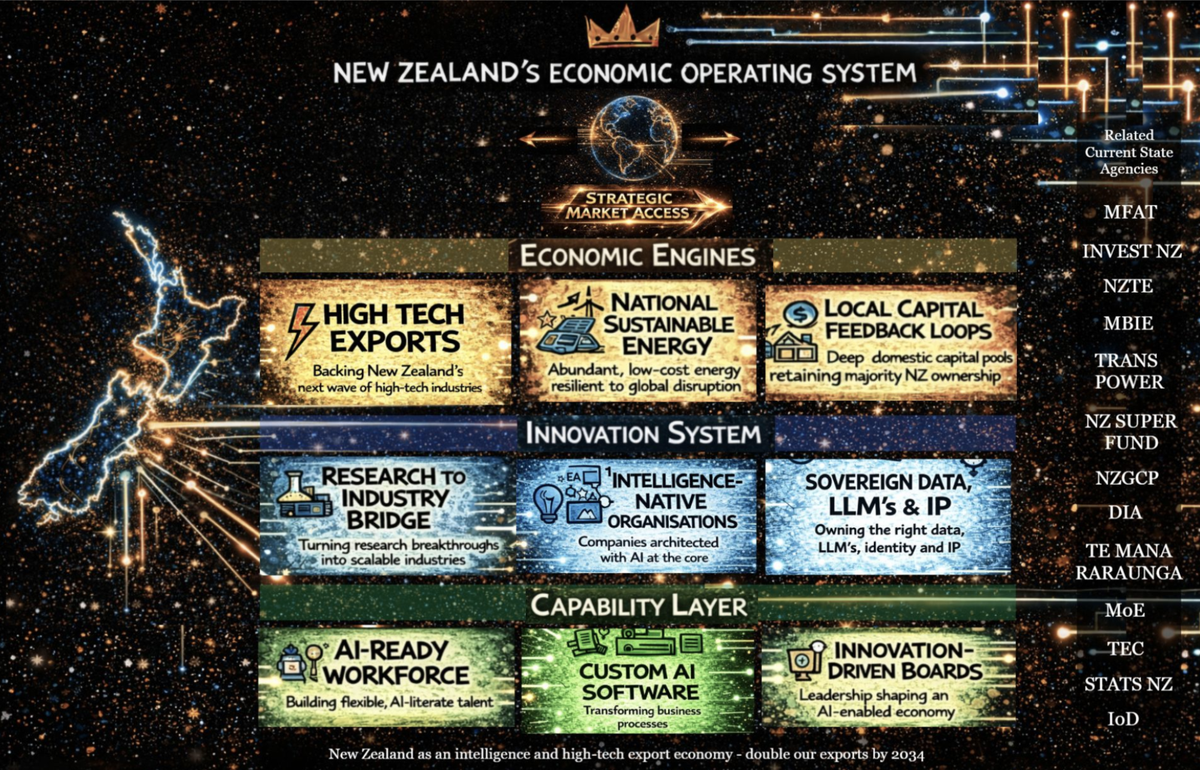
Framework by Chris Blair
Version 1.0 - Living Framework
Last updated June 2026 - reflecting developments in government digital delivery, regulatory stewardship, trust infrastructure, research-system reform, and the wider human purpose of NZ-EOS.
This framework will continue to evolve through additional system mappings, institutional roles, and execution pathways.
Building an economy that enables New Zealanders to thrive
The next economic era will change more than the technologies organisations use. It will shape where opportunity is created, what kinds of work people do, which regions and industries prosper, who owns the companies and knowledge being built, and how much of the resulting value remains in New Zealand.
As AI moves from tools into agents and agent-mediated services, this question becomes more important.
New Zealand will need businesses, public services, infrastructure, data systems, trust mechanisms, and institutions that are ready to operate in an economy where people, organisations, platforms, and agents coordinate activity together.
The deeper opportunity is to build an Aotearoa New Zealand in which people can live well, contribute through meaningful work, participate confidently in a changing global economy, and share more fully in the value created here.
In an agent-mediated global economy, New Zealand also needs to remain trusted and discoverable.
That means our companies, public services, data environments, identity systems, standards, and sector capabilities need to be understandable, reliable, and accountable to people, organisations, and the intelligent systems that act on their behalf.
That future will not emerge from AI adoption alone. It will depend on whether New Zealand can connect its energy, capital, research, infrastructure, data, workforce capability, industries, and institutions around a clearer national direction.
The New Zealand Economic Operating System - or NZ-EOS - is a strategic framework for understanding and building that connected system.
It brings together the economic engines, innovation pathways, and national capabilities required to:
- create higher-value industries and better opportunities;
- help established industries adapt and move up the value chain;
- support people through changes in work and capability;
- strengthen regional and community prosperity;
- govern data and technology in trusted and distinctly New Zealand ways;
- retain more ownership, knowledge, and economic value here; and
- build resilience and prosperity across generations.
Growing exports remains an important part of this ambition. Export performance provides income, investment, employment, capability, and access to global markets. But export growth is not the final purpose of NZ-EOS. It is one measure of whether New Zealand is developing the capacity to create better lives, stronger communities, and a more resilient future.
Rather than presenting isolated initiatives, NZ-EOS describes the wider system New Zealand will need to build - spanning industry, capital, energy, research, data, trust, workforce capability, leadership, and institutional coordination.
It is intended to support:
• people and communities seeking a meaningful place in the changing economy
• businesses and exporters building new sources of value
• workers, educators, and industry bodies navigating changes in work
• iwi, Māori organisations, and data-governance leaders shaping trusted and enduring systems
• regions developing their own industries and capabilities
• government and policy leaders aligning national priorities
• boards and investors making long-term decisions
• institutions responsible for infrastructure, capability, trust, and delivery
NZ-EOS is not a policy or a fixed prediction of New Zealand’s future.
It is a systems-level map of the conditions required for more people, organisations, regions, and future generations to prosper in an intelligence-shaped world.
What NZ-EOS is ultimately for
NZ-EOS begins with an economic question, but its purpose is wider than economic growth alone.
It asks how New Zealand can build the foundations for:
Good lives
People and whānau with greater security, opportunity, agency, and confidence about the future.
Good work
Technology that expands human capability, supports meaningful contribution, and creates credible pathways into new roles and industries.
Strong communities and regions
More places able to develop distinctive industries, retain talent, attract investment, and participate in national prosperity.
Trusted participation
Data, identity, digital services, and AI systems that people can use with confidence and that reflect New Zealand’s responsibilities, cultures, and values.
Intergenerational prosperity
An economy that strengthens the productive, social, cultural, and environmental foundations inherited by future generations.
The infrastructure and institutions described below are not the final outcome. They are the machinery required to make these human and national outcomes possible.
How NZ-EOS connects purpose to delivery
Human purpose
A country where people can live well, contribute meaningfully, participate confidently, and share in the value created here.
National ambition
A more trusted, capable, resilient, and prosperous Aotearoa New Zealand.
Strategic mission
Build the energy, capital, knowledge, trust, workforce, technology, and coordination required to create and retain more value.
Systems transition
Move from a largely resource- and volume-led economy toward one that combines New Zealand’s established strengths with knowledge, technology, trust, human capability, and higher-value industries.
Framework architecture
The economic engines, innovation system, capability layer, and institutional landscape through which that mission can be delivered.
Measures of progress
Exports, productivity, new industries, workforce readiness, trusted systems, regional opportunity, resilience, participation, and wellbeing.
Mātauranga Māori within NZ-EOS
Mātauranga Māori encompasses Māori knowledge, understanding, skills, values, practices, creativity, and ways of interpreting relationships between people, communities, culture, and te taiao.
Within NZ-EOS, mātauranga Māori is recognised as a living knowledge system with relevance to research, innovation, environmental stewardship, health, education, technology, enterprise, and long-term economic development.
It should not be treated simply as an input available for extraction or commercialisation. Mātauranga Māori remains connected to Māori authority, identity, whakapapa, tikanga, and responsibilities of stewardship. Its application must therefore be shaped through appropriate relationships with iwi, hapū, Māori organisations, knowledge holders, and other relevant contributors - including agreement about access, protection, attribution, governance, and the sharing of resulting benefits.
Framework Structure
NZ-EOS is composed of three connected layers:
Economic Engines - where value is created
The industries, markets, and export opportunities through which New Zealand can create new economic value, meaningful work, and stronger regional and national prosperity.
Innovation System - how ideas become industries
The pathways that convert research, intellectual property, technology, entrepreneurial capability, and local knowledge into scalable companies, products, services, and new export categories.
Capability Layer - how value is created, scaled, and retained
The shared national capabilities that enable industries and communities to emerge, adapt, and compete - including energy, compute, trust, capital, research, workforce capability, advanced manufacturing, data, infrastructure, leadership, and institutional coordination.
The distinction is important. Industries describe what New Zealand produces and takes to the world. Capability systems determine whether those industries can turn ideas into products, support human adaptation as work and capability needs change, scale production, reach markets, and retain more of the resulting value in New Zealand.
Some fields sit across both. Advanced manufacturing, for example, can be an export industry in its own right, but it is also a cross-cutting national capability supporting health and biotechnology, aerospace, agritech, energy technologies, defence, robotics, and other high-value sectors.
Together, these layers form a national economic operating system - connecting economic performance with trusted institutions, human capability, and long-term wellbeing.
ECONOMIC ENGINES
These are the industries and economic foundations through which New Zealand can create higher-value work, stronger companies, regional opportunity, export income, and long-term prosperity.
1. High Tech Exports
Creating new industries, better opportunities, and higher-value exports
High-tech exports provide a pathway for New Zealand to create higher-value, globally competitive industries. These opportunities extend beyond the conventional technology sector. They include software and AI, aerospace, biotechnology, advanced manufacturing, environmental systems, and the application of science and technology to transform New Zealand’s established strengths in food and fibre.
This pillar includes:
• Digital, Software & AI
SaaS, vertical AI companies, AI-native startups, digital platforms, global software, decision-intelligence products, and industry-specific digital services
• Aerospace & Space
launch services, satellites, advanced aviation, remote sensing, space data, aerospace engineering, and supporting software and manufacturing
• Health, Medtech & Biotechnology
health technology, medical devices, diagnostics, therapeutics, digital health, biopharmaceuticals, regenerative medicine, synthetic biology, and biotechnology platforms
• Advanced Manufacturing & Robotics
robotics, automation, autonomous systems, precision engineering, additive manufacturing, advanced materials, electronics, industrial software, and technology-enabled production. Advanced manufacturing also acts as a cross-cutting capability supporting health and biotechnology, aerospace, agritech, energy technologies, defence, robotics, and other high-value sectors
• Modern Food, Fibre & the Bioeconomy
agritech, food technology, high-value nutrition and ingredients, precision agriculture, aquaculture technologies, forestry and engineered wood, biomaterials, bioenergy, biomanufacturing, and technology-enabled systems spanning production through processing and provenance
• Environmental Systems & Clean Technology
environmental intelligence, climate and earth observation, water technology, biodiversity and ecosystem monitoring, biosecurity systems, renewable-energy technologies, circular-economy solutions, emissions reduction, resource recovery, and resilience technologies
• Deep Tech & Frontier Technologies
science-led ventures built around defensible intellectual property, including quantum technologies, photonics, advanced sensing, nanotechnology, next-generation materials, synthetic biology, and other emerging scientific fields
• Convergent Technology Ventures
export businesses combining capabilities across multiple fields, such as AI and biotechnology, space and environmental intelligence, robotics and food production, or advanced manufacturing and health technology
These groupings are informed by New Zealand’s current sector strategies and science, innovation and technology priorities, but are intentionally more forward-looking. NZ-EOS reorganises them around emerging export opportunities, converging technologies, and the cross-cutting capabilities that will shape New Zealand’s future economic advantage.
What this enables
High-value, technology-enabled industries allow New Zealand to create more prosperity from its knowledge, creativity, science, trusted data, specialist capability, and productive strengths - not simply from producing greater physical volume.
These industries can create new forms of skilled and meaningful work, give regional economies additional pathways for development, and help New Zealand retain more intellectual property and ownership.
By connecting emerging technologies with established strengths in food and fibre, environmental science, health, manufacturing, and primary production, New Zealand can create new export categories while improving the resilience, sustainability, and value of the industries communities already depend upon.
2. National Sustainable Energy
Reliable, sustainable energy for communities, industry, and future growth
Energy becomes a strategic economic advantage in an AI-driven world. Compute, datacenters, manufacturing, and logistics all depend on reliable energy.
This pillar includes:
• renewable energy expansion
• geothermal scale development
• hydro capacity optimisation
• wind and offshore wind potential
• grid modernisation and expansion
• industrial electrification
• energy storage systems
• green hydrogen and process heat
• energy for AI data centers
• energy security for exports
What this enables
Energy is not only an input into the economy. It supports households, public services, transport, local industry, advanced manufacturing, digital infrastructure, and the resilience of communities.
In an intelligence-shaped economy, countries with reliable, renewable energy will have greater freedom to develop industry, host compute, reduce exposure to global disruption, and create new economic opportunities.
Energy and infrastructure decisions also occur within relationships between people, whenua, wai, ecosystems, and future generations. Mātauranga Māori and the place-based knowledge of iwi and hapū can contribute to understanding environmental change, cumulative impacts, seasonal and ecological patterns, culturally significant places, and the long-term responsibilities associated with development. Its inclusion should occur through early and enduring partnerships - not simply consultation after projects have already been designed.
Energy choices must therefore balance affordability, resilience, environmental stewardship, community and Māori interests, local legitimacy, and the productive capability required by future generations.
3. Local Capital Feedback Loops
Keeping more ownership, wealth, and decision-making in New Zealand
This pillar focuses on building New Zealand-owned growth rather than exporting value offshore.
This includes:
• sovereign investment vehicles
• venture capital scale-up funding
• growth capital for NZ companies
• KiwiSaver deployment into innovation
• NZ Super strategic investment
• domestic institutional capital mobilisation
• IPO pathways for NZ tech firms
• private market liquidity
• co-investment mechanisms
What this enables
When promising New Zealand companies must move offshore to access capital, the country can lose ownership, intellectual property, skilled work, future tax revenue, and influence over the direction of its emerging industries.
Stronger domestic capital pathways allow more New Zealanders to participate in long-term national growth and help successful companies remain anchored in the communities and economy that helped create them.
The objective is not to exclude international investment, but to ensure New Zealand enters those relationships with sufficient capability, ownership, and bargaining power to retain a meaningful share of the value.
INNOVATION SYSTEM
How ideas become industries
This layer describes how New Zealand turns research, creativity, mātauranga Māori, intellectual property, local and specialist knowledge, and entrepreneurial initiative into industries that improve lives, create good work, and compete internationally.
These sources of knowledge are not interchangeable and should not all be governed in the same way. In particular, innovation involving mātauranga Māori should be developed through Māori-led or genuinely partnered approaches that recognise appropriate authority, relationships, cultural context, protection, attribution, and benefit sharing.
4. Research to Industry Bridge
Helping New Zealand ideas become companies, products, and enduring industries
New Zealand produces strong research but often struggles to commercialise at scale. This pillar focuses on closing the gap between research and industry.
This includes:
• university commercialisation pipelines
• startup spin-out pathways
• Māori-led research, science, innovation, and commercialisation pathways
• applied research programmes
• industry research partnerships
• long-term partnerships between iwi, hapū, Māori organisations, researchers, government, and industry
• innovation districts and clusters
• IP commercialisation support
• governance for authority, consent, attribution, protection, and benefit sharing
• translational research funding
• national research missions
• recognition of mātauranga Māori within research design and investment decisions
• deep tech incubation
• support for Māori researchers, innovators, entrepreneurs, trusts, incorporations, and collectively owned enterprises
• prototype development and engineering validation
• pilot production and manufacturing scale-up
• shared advanced-manufacturing facilities and testbeds
• pathways from scientific IP to commercially manufacturable products
• pathways connecting mātauranga Māori with environmental science, food systems, health, technology, and place-based economic development where appropriate
What this enables
Countries that convert research into companies - and companies into scalable production systems - create new industries.
Research commercialisation does not end when intellectual property is licensed or a startup is formed. For many high-value sectors, it also requires prototyping, engineering validation, pilot production, regulatory pathways, and access to advanced manufacturing capability.
Strengthening this bridge would help New Zealand convert more of its research and intellectual property into exportable products, companies, and industries before that value moves offshore.
A stronger bridge would also give researchers, founders, engineers, students, and communities more credible pathways to contribute to New Zealand’s future without needing to leave the country or transfer the most valuable parts of their work offshore.
Mātauranga Māori can contribute distinctive knowledge, insight, innovation, and capability across areas such as te taiao, food and biological systems, health, climate adaptation, resource management, design, and emerging technologies.
Realising that potential requires more than inviting Māori participation in research designed elsewhere. It requires Māori leadership, enduring relationships, appropriate investment, stronger Māori research and innovation capability, and governance arrangements that protect the integrity of the knowledge and ensure that benefits flow back to the people and communities with whom it is held and developed.
A stronger Research to Industry Bridge should therefore help Māori organisations pursue their own aspirations, build and retain intellectual property, develop enterprises, and determine whether, when, and how mātauranga Māori contributes to research, innovation, or commercial activity.
5. Intelligence-Native Organisations
Organisations redesigned around intelligence, people, and better outcomes
This pillar describes organisations that use AI, data, and automation to redesign how value is created - not simply to insert new tools into existing structures. Intelligence-native organisations combine technological capability with human judgement, domain expertise, responsible governance, and deliberate support for human adaptation as work, roles, and decision responsibilities change.
This includes:
• human-centred work redesign
• pathways for participation, learning, role adaptation, and new forms of contribution
• responsible allocation of decisions between people and automated systems
• mechanisms for sharing productivity and capability gains
• transparent accountability for AI-supported decisions
• AI-first operating models
• autonomous business processes
• decision intelligence systems
• AI embedded across workflows, decisions, and operations
• agent-driven workflows
• services designed for interaction with trusted personal and organisational agents
• intelligence platforms
• digital twins and simulation
• AI-native service delivery
• automated operational systems
What this enables
Intelligence-native organisations can operate faster, learn more continuously, and scale new services and products. But speed and cost reduction are not sufficient measures of success.
The larger opportunity is to redesign organisations so that technology improves services, expands human capability, reduces low-value work, creates new forms of contribution, and delivers value to customers, workers, communities, and the wider economy.
Organisations that approach this transformation with trust, participation, and clarity - while supporting human adaptation and agency - will be more resilient than those that treat AI primarily as a labour-reduction programme.
6. Sovereign Data, LLMs & IP
Governing data, identity, knowledge, and intellectual property with trust
Data, identity, knowledge, and intellectual property are becoming strategic national assets. Their value depends not only on ownership, but on whether they are governed legitimately, used fairly, protected appropriately, and trusted by the people and communities they concern.
This includes:
• national data frameworks
• identity infrastructure
• trusted data sharing
• data trusts and governance
• sovereign AI models
• domain-specific LLMs
• secure AI infrastructure
• Māori data sovereignty
• protection and governance of mātauranga Māori and taonga-derived knowledge
• authority over whether culturally significant knowledge may be digitised, used in datasets, or incorporated into AI systems
• traceability, provenance, attribution, and agreed access conditions
• protection against unauthorised reuse, extraction, or commercialisation
• benefit-sharing arrangements where knowledge contributes to products, models, services, or intellectual property
• Māori-controlled digital repositories, datasets, models, and knowledge infrastructure where appropriate
• IP retention strategies
What this enables
Trusted data and identity systems can improve services, support research, enable innovation, and help New Zealand industries compete internationally.
But these systems also affect autonomy, privacy, collective rights, cultural interests, and public confidence. New Zealand’s advantage will therefore depend on developing governance arrangements that people can trust - including substantive recognition of Māori data sovereignty, authority, consent, provenance, stewardship, and long-term accountability.
This is particularly important where mātauranga Māori or knowledge relating to taonga may be digitised, incorporated into datasets, used to train AI systems, or translated into commercial intellectual property. Technical access to knowledge does not by itself create legitimate authority to use it. Trusted systems must preserve provenance, respect the authority of relevant knowledge holders, establish appropriate conditions of access and reuse, and ensure that resulting benefits are not separated from the people and relationships from which the knowledge originates.
Without this capability, New Zealand organisations may generate valuable data and knowledge while offshore platforms control how that value is used and accumulated.
CAPABILITY LAYER
This layer describes the shared national capabilities that allow economic value to be created, scaled, and retained.
These capabilities do not belong to one industry. They operate across the economy - supporting multiple sectors, connecting research to production, and determining whether New Zealand companies can turn ideas and intellectual property into globally competitive products and services.
They also determine whether technological and economic change expands participation and opportunity, or leaves more people and regions outside the emerging economy.
7. AI-Ready Workforce
Helping people learn, adapt, contribute, and retain agency
This pillar focuses on helping people participate confidently in industries and workplaces being reshaped by AI.
Readiness is not only technical literacy. It includes access to learning, credible pathways into changing roles and industries, meaningful involvement in work redesign, practical support as people adapt, and the ability to maintain dignity, identity, and agency through change.
This includes:
• accessible lifelong-learning pathways
• education system alignment
• AI literacy across industries
• technical AI skill development
• vocational AI pathways
• retraining and reskilling programmes
• pathways into new roles, responsibilities, industries, and forms of contribution
• support for workers and communities affected by disruption
• employee participation in the redesign of work
• regional access to training and new industry pathways
• stronger pathways connecting rangatahi Māori with research, innovation, digital technology, and entrepreneurship
• support for Māori researchers, technologists, data practitioners, founders, and knowledge holders
• industry learning ecosystems
• AI adoption support for SMEs
• adaptation and capability support for small businesses and self-employed people
• leadership capability uplift
• capability for organisations to work appropriately at the interface of mātauranga Māori, science, data, and technology
• reciprocal capability-building so that institutions learn how to work responsibly with Māori—not only expecting Māori to learn how to enter existing systems
• measurement of job quality and human outcomes, not only skill supply
What this enables
AI will change tasks, roles, and the nature of expertise. Whether those changes lead to wider benefit will depend on whether people can see a credible place for themselves, participate in shaping new ways of working, and access practical pathways into new forms of contribution.
Countries that combine technological capability with inclusive learning, worker participation, and practical support for human adaptation will navigate the wider systems transition more successfully - and will be more likely to retain public trust while developing new industries.
Building capability at the interface of mātauranga Māori, science, technology, and enterprise is not solely a matter of increasing Māori participation in existing institutions. It also requires institutions to develop the relationships, cultural capability, governance practices, and capacity to support Māori-led priorities that make genuine partnership possible.
8. Custom AI Software
Building technology around New Zealand’s real needs and strengths
This pillar focuses on building New Zealand-specific AI systems across industries.
This includes:
• vertical AI software
• industry-specific AI platforms
• automation of export sectors
• supply chain intelligence
• logistics optimisation
• agricultural AI systems
• manufacturing AI systems
• government AI platforms
• decision intelligence tools
What this enables
New Zealand-specific AI systems can improve productivity, public services, environmental management, logistics, health, manufacturing, agriculture, and other areas of everyday and economic life.
Building more of this capability locally also helps retain specialist knowledge, create skilled work, strengthen local companies, and ensure that systems reflect New Zealand conditions rather than importing assumptions embedded elsewhere.
The objective should not be automation for its own sake, but better outcomes, stronger organisations, and wider public value.
9. Innovation-Driven Boards
Leadership responsible for technology, people, and long-term value
This pillar focuses on how governance must evolve as technology, work, economic systems, and public expectations change.
This includes:
• stewardship of workforce and community impacts
• participation in major transformation decisions
• measurement of human, organisational, and economic value
• intergenerational and environmental considerations
• accountability for how productivity gains are distributed
• AI-aware board governance
• innovation strategy leadership
• leadership through organisational transformation and changing workforce needs
• long-term capital allocation
• risk vs opportunity mindset
• technology literacy at board level
• industry transformation oversight
• ecosystem collaboration
• energy, compute, and infrastructure as strategic board-level decisions
What this enables
Boards shape investment, organisational purpose, risk, workforce decisions, and the distribution of value.
In an AI-shaped economy, decisions about technology, capital, energy, people, data, infrastructure, and organisational design become increasingly connected. Boards must therefore consider not only whether transformation is commercially possible, but what it means for employees, customers, communities, trust, and long-term national capability.
Innovation-driven governance should combine commercial ambition with stewardship, responsible transformation, human agency, and a wider understanding of value.
Strategic Market Access
NZ-EOS sits within global market access. New Zealand must:
• build trade relationships
• secure digital trade pathways
• expand services exports
• enable cross-border AI delivery
• strengthen export partnerships
• support global scaling companies
Market access is the outward-facing edge of NZ-EOS. It allows New Zealand organisations to connect local capability with global demand.
The purpose is not merely to sell more abroad, but to build durable relationships through which New Zealand companies, workers, regions, knowledge, and trusted products can participate in higher-value global markets while retaining meaningful ownership and capability at home.
Institutional Landscape
NZ-EOS is not a single organisation, programme, or project. Nor can it be delivered by central government alone.
It is a blueprint for aligning the institutions, businesses, iwi and Māori organisations, regions, researchers, educators, investors, infrastructure providers, workers, and communities whose decisions collectively shape New Zealand’s economic future.
The entities below represent the institutional backbone around that blueprint - spanning national direction, system coordination, and delivery enablement.
They operate across three core tiers:
Tier 1 - System Architects & Core Institutions
Set national direction, allocate public capital, shape foundational infrastructure, establish regulatory settings, and build long-term national capability.
Tier 2 - System Shapers & Coordinators
Influence direction through strategy, foresight, standards, sector leadership, research, investment coordination, and industry alignment.
Tier 3 - System Enablers & Delivery Layer
Translate national direction into regional, sector, organisational, and operational delivery.
Together, these tiers form the institutional backbone of NZ-EOS.
They should not, however, be read as the only protagonists in the system. NZ-EOS ultimately comes to life through the people, relationships, businesses, communities, and delivery coalitions that act within and across these institutions.
A further layer - the builders and participants - sits across and beyond these tiers: workers, founders, researchers, educators, iwi and Māori organisations, companies, communities, regional coalitions, infrastructure developers, investors, and delivery partnerships. These are the people and groups that will ultimately translate system architecture into lived change.
Decision-making capability is also part of the operating system. New Zealand’s long-term performance depends not only on the quality of individual strategies, investments, institutions, or delivery coalitions. It also depends on the system through which decisions are connected, sequenced, governed, reviewed, adapted, and translated into long-term public and economic value.
People across the system
Institutions establish important conditions, but the wider systems transition is shaped, experienced, and enacted by people.
Workers decide whether new systems feel enabling or threatening. Researchers and founders convert knowledge into application. Teachers and trainers build confidence and capability. Communities shape whether development earns local legitimacy. Iwi and Māori organisations exercise authority and stewardship over data, knowledge, resources, and long-term interests. Businesses turn capability into products, services, jobs, and relationships.
Communities are not only recipients of policy, infrastructure, services, or economic change. They are sources of intelligence, trust, local memory, early signals, relationships, and implementation capability. A stronger national operating system needs ways to connect institutional expertise with community intelligence so that decisions are better informed, locally grounded, and more likely to translate into lasting public and economic value.
NZ-EOS therefore depends on both institutional coordination and the meaningful participation, adaptation, and agency of people across the system.
TIER 1: System Architects & Core Institutions
Core agencies and institutions that define national direction, system settings, infrastructure, capital flows, data systems, and capability.
These entities define what the system is trying to achieve and create the conditions for it to work.
How Tier 1 Operates
These institutions operate across a small number of core system functions:
- Direction - setting national priorities and system settings
- Production - shaping what New Zealand produces and exports
- Access - enabling entry into global markets
- Capital - funding growth and infrastructure
- Coordination - aligning capability, infrastructure, and delivery
MBIE
Agency: Ministry of Business, Innovation and Employment
NZ-EOS relevance
(Direction)
Sets the national economic direction and system settings - including the explicit goal to double export value within 10 years (to 2034), linking trade, investment, and productivity.
Defines the policy environment, priorities, and growth settings that shape how the broader economic system operates and scales.
MBIE also holds an important system role through Vision Mātauranga and related research and innovation investment. This includes strengthening Māori research capability, supporting Māori-led innovation, connecting Māori organisations with the research system, and ensuring that New Zealand’s science and innovation architecture can respond more effectively to Māori knowledge, resources, and aspirations.
Related Sources
• Going for Growth
• New Zealand's AI Strategy: Investing with Confidence
• Vision Mātauranga Policy
• Research, Science and Innovation Strategy
• Digital Strategy for Aotearoa
MPI
Agency: Ministry for Primary Industries
NZ-EOS relevance
(Production)
Shapes the production system that underpins New Zealand’s export economy - including the resilience, sustainability, and performance of primary industries, New Zealand’s dominant export engine.
Governs biosecurity, food systems, land use, and sector productivity - directly influencing the scale, quality, and global trust of exports, and enabling the transition toward higher-value, technology-enabled export systems.
Related Sources
• MPI Strategy 2030
• Biosecurity System Action Plan
• Biosecurity in New Zealand (System Overview)
NZTE
Agency: New Zealand Trade and Enterprise
NZ-EOS relevance
(Execution)
Drives exporter growth and global scaling - acting as the primary delivery arm that translates national growth ambition into export revenue and globally anchored value.
Works directly with firms to expand into global markets - converting capability into export performance and turning strategy into commercial outcomes.
Mandate shift (important new context)
NZTE’s role has shifted toward a clear export-first focus, with foreign investment attraction and broader economic functions increasingly separated (e.g. Invest New Zealand).
Within NZ-EOS, this positions NZTE as the frontline execution layer - orchestrating the connection between firms, markets, and system capability to enable scalable export growth.
Related Sources
• NZTE Mandate and Role in Export Growth
• New Zealand Story - National Export Positioning Framework
• New Zealand Trade & Export System (NZ Inc Approach)
MFAT
Agency: Ministry of Foreign Affairs and Trade
NZ-EOS relevance
(Access)
Enables global market access - securing trade agreements, diplomatic relationships, and international positioning required for New Zealand exports to compete, scale, and secure market presence.
Shapes the external conditions of the system - determining where and how New Zealand firms can enter, operate, and grow in international markets.
Related Sources
• New Zealand Free Trade Agreements
• Trade and Economic Diplomacy
Invest New Zealand
Agency: Invest New Zealand
NZ-EOS relevance
(Capital)
Attracts strategic capital into the system - directing foreign investment into priority sectors to support growth, infrastructure development, and global competitiveness.
Enables capital formation at scale - connecting global capital to New Zealand growth opportunities and enabling the development of high-value export sectors.
Related Sources
• Invest New Zealand - Mandate and Role
• Invest New Zealand - Investment Pathways
• Establishment of Invest New Zealand
The Treasury
Agency: The Treasury
NZ-EOS relevance
(Measurement / System Performance)
Defines how national success is measured - establishing frameworks such as the Living Standards Framework and Wellbeing Budget that expand performance beyond GDP.
Shapes the system’s definition of value - integrating economic, social, environmental, and cultural outcomes into national decision-making.
Within NZ-EOS, this wider measurement frame helps ensure that export growth and productivity remain connected to the lives people experience, the distribution of opportunity, environmental foundations, cultural wellbeing, and the prospects inherited by future generations.
Related Sources
• Living Standards Framework (LSF)
• New Zealand Budget and Wellbeing Budget Process
• Wellbeing Budget 2023 - Support for Today, Building for Tomorrow
Public Service Commission (PSC)
Agency: Public Service Commission
NZ-EOS relevance
(System Coordination / Capability Direction / Investment Alignment)
Establishes centralised oversight of government capability - shaping investment, procurement, and operating models across the public service.
Coordinates the public service as a system - aligning agencies, capability, and investment across government. While this coordination is currently bounded to the public sector, it reflects the type of system-level alignment required across the wider NZ-EOS.
Drives system-wide coordination - reducing fragmentation and enabling a more unified, scalable approach to digital, capability, and service delivery.
Delivery and system leadership connection
The Government Digital Delivery Agency operates within the Public Service Commission and incorporates the Government Chief Digital Officer function.
Related Sources
• Driving down the cost (overview)
• Driving down the cost (implementation)
• Government Digital Delivery Agency
Government Digital Delivery Agency (GDDA)
Agency: Government Digital Delivery Agency - part of the Public Service Commission
NZ-EOS relevance
(Digital System Leadership / Shared Platforms / Delivery Capability)
Provides government-wide leadership for digital investment, procurement, infrastructure, shared platforms, service modernisation, data-enabled delivery, and public-sector digital capability.
The GDDA was established on 1 April 2026 and assumed the functions of the Government Chief Digital Office. It brings together system leadership, delivery support, and capability functions to accelerate the development of more connected, reusable, and effective digital public services.
Within NZ-EOS, the GDDA provides an important bridge between national direction and practical digital delivery—helping government agencies align investment, adopt shared infrastructure, apply common standards, and reduce fragmentation across the public system.
Its responsibilities also make it an important contributor to government-wide AI adoption, digital identity, interoperability, assurance, and the development of reusable digital components.
Related Sources
• Government Digital Delivery Agency
• Driving down the cost of digital in government
• Service Modernisation Roadmap v2
• Public Service AI Framework
• Public Service AI Work Programme
Ministry for Regulation
Agency: Ministry for Regulation — Te Manatū Waeture
NZ-EOS relevance
(Regulatory Stewardship / System Quality)
Acts as the central steward of New Zealand’s Regulatory Management System—providing system leadership, setting expectations for good regulatory practice, and helping agencies improve the performance of the regulatory systems they administer.
Within NZ-EOS, the Ministry helps shape whether regulation can protect people and public interests while remaining sufficiently adaptive, coherent, and proportionate to support innovation, investment, new industries, and technological change.
Its role becomes increasingly important as AI, data-driven services, autonomous systems, digital identity, biotechnology, and other emerging technologies create new regulatory questions that cross traditional agency and sector boundaries.
The Ministry’s Responsible AI in Action guidance also provides an early example of how regulators can use AI while retaining human judgement, accountability, transparency, and responsible practice.
Related Sources
• Ministry for Regulation - Our Role
• The Regulatory Management System
• Regulatory Stewardship
• Responsible AI in Action — Guidance for Regulators
Department of Internal Affairs (DIA)
Agency: Department of Internal Affairs
NZ-EOS relevance
(Identity Services / Public Information / Statutory and Community Infrastructure)
Provides statutory, identity, information, community, and public-facing services that form part of New Zealand’s wider trust and administrative infrastructure.
DIA’s responsibilities include areas such as identity and life-event services, citizenship, passports, public records, charities, local government relationships, community capability, and the stewardship of significant public information and cultural collections.
Within NZ-EOS, these functions contribute to the trusted administrative foundations through which people, organisations, and communities interact with government and establish important aspects of identity, status, authority, and public record.
DIA also remains an important operational partner within New Zealand’s wider digital ecosystem, while government-wide digital system leadership and the former Government Chief Digital Office functions now sit with the Government Digital Delivery Agency within the Public Service Commission.
Related Sources
• Department of Internal Affairs — Our Role
• Identity and Life Event Services
• Digital Identity Services
• Archives New Zealand
• National Library of New Zealand
• Trust Framework for Digital Identity (National identity layer)
• Identification Standards
• Digital Strategy for Aotearoa (National digital system direction)
• Service Modernisation Roadmap v2 (Reusable digital components and API standards)
Stats NZ
Agency: Statistics New Zealand
NZ-EOS relevance
(Data Infrastructure / Measurement)
Provides the national data infrastructure and measurement backbone - enabling evidence-based decision-making across government, industry, and research.
Supports system visibility - ensuring the ability to understand performance, track outcomes, and inform policy and investment decisions.
Related Sources
• Integrated Data Infrastructure (IDI)
• Government Data Strategy and Roadmap
• Algorithm Charter for Aotearoa New Zealand
Office of the Privacy Commissioner
Entity: Independent Crown Entity
NZ-EOS relevance
(Privacy / Data Rights / Regulatory Trust)
Oversees New Zealand’s privacy system and promotes compliance with the Privacy Act and Information Privacy Principles.
Within NZ-EOS, the Office provides an important part of the trust environment governing how personal information is collected, stored, used, disclosed, and protected across government and the wider economy.
Its role becomes increasingly important as AI systems, automated decisions, digital identity, data sharing, and high-assurance digital services create new questions about consent, purpose, transparency, human oversight, and individual rights.
Related Sources
• Privacy Act 2020 and Information Privacy Principles
• Artificial Intelligence and the Information Privacy Principles
• Generative Artificial Intelligence - Privacy Commissioner Expectations
• Joint Statement on Trustworthy Data Governance for AI
Te Mana Raraunga
Entity: Māori Data Sovereignty Network
NZ-EOS relevance
(Trust / Sovereign Data)
Provides leadership on Māori data sovereignty - helping ensure that data-governance frameworks reflect Māori rights and interests, authority, perspectives, and responsibilities of long-term stewardship.
Anchors the system in trust by supporting the development of data, identity, and AI systems that are governed ethically, reflect appropriate authority and consent, and are grounded in the distinctive context of Aotearoa New Zealand.
Te Mana Raraunga does more than advocate for Māori data sovereignty. It provides influential principles and guidance for the governance architecture New Zealand needs to operate as a trusted participant in the global intelligence economy.
This role becomes increasingly important as mātauranga Māori, cultural knowledge, language, environmental information, and taonga-derived data encounter large datasets, digital repositories, foundation models, and other AI systems.
Te Mana Raraunga should not, however, be understood as the sole authority over all Māori data or mātauranga Māori. Authority and decision-making may reside with particular iwi, hapū, whānau, Māori organisations, communities, or knowledge holders, depending on the knowledge, data, relationships, and context involved.
Related Sources
• Te Mana Raraunga - Māori Data Sovereignty Network
• Māori Data Sovereignty Principles (Canonical)
• Te Mana Raraunga Charter (Te Tiriti grounding)
• CARE Principles for Indigenous Data Governance (Global interoperability)
Transpower
Agency: Transpower New Zealand
NZ-EOS relevance
(Energy Infrastructure)
Operates the national electricity grid - providing the energy backbone required for industrial growth, electrification, and AI and data centre compute demand.
Determines the system’s capacity to scale - enabling or constraining future economic expansion through energy availability, transmission capability, and resilience.
Energy has historically been invisible in economic strategy - until it becomes a constraint.
Transpower doesn’t just operate infrastructure - it defines the energy boundary conditions of New Zealand’s participation in the global intelligence economy. In an AI-driven economy, it effectively sets the upper limit of national growth. Without sufficient, reliable, and scalable energy infrastructure, the system cannot support high-value industry, advanced manufacturing, or globally competitive compute capability.
Related Essays
• The Invisible Pillar of AI (ChrisBlair.ai)
Related Sources
• Net Zero Grid Pathways (National grid expansion and electrification programme)
• Transmission Tomorrow (Strategic grid roadmap - PDF)
• Whakamana i Te Mauri Hiko (Energy system strategy)
NZ Super Fund
Agency: New Zealand Superannuation Fund
NZ-EOS relevance
(Sovereign Capital)
Deploys long-term sovereign capital into strategic assets - supporting national wealth creation and economic resilience.
Acts as a stabilising capital layer - investing across generations to strengthen system-level capability and long-term growth.
Related Sources
• Investment Strategy
NZ Growth Capital Partners (NZGCP)
Agency: New Zealand Growth Capital Partners
NZ-EOS relevance
(Venture & Growth Capital)
Provides venture and growth capital - enabling New Zealand companies to scale and compete globally.
Strengthens the domestic capital ecosystem - supporting innovation, company formation, and the development of high-growth export businesses.
Related Sources
• Growth Capital Strategy
Ministry of Education (MoE)
Agency: Ministry of Education
NZ-EOS relevance
(Foundational Capability)
Shapes the foundational education system - building long-term workforce capability and national skill development.
Establishes the baseline for future talent - influencing the system’s ability to adapt, learn, and evolve over time.
Its role is not simply to supply labour to industry, but to help people develop the confidence, adaptability, judgement, creativity, and learning capability required to participate meaningfully in a changing society.
Related Sources
• Education System Strategy
Tertiary Education Commission (TEC)
Agency: Tertiary Education Commission
NZ-EOS relevance
(Workforce Alignment)
Aligns tertiary education and training with industry needs - supporting the development of an AI-ready and export-capable workforce.
Translates system demand into capability supply - ensuring skills, training, and education pathways meet evolving economic requirements.
This includes ensuring that learning and employment pathways are accessible across regions and stages of life - not restricted to people already working inside advanced technology sectors.
Related Sources
• Tertiary Education Strategy
Institute of Directors (IoD)
Entity: Governance Membership Body
NZ-EOS relevance
(Governance Capability)
Builds governance capability at the board level - enabling organisations to lead through transformation and long-term strategic decision-making.
Shapes leadership behaviour - influencing how organisations allocate capital, manage risk, and pursue innovation.
Related Sources
• IoD Governance Framework
TIER 2: System Shapers & Coordinating Bodies
Forums, think tanks, and industry bodies that influence strategy, foresight, standards, and alignment across the system.
These entities do not directly control the system - but they influence how it evolves.
BusinessNZ
Entity: National Business Advocacy Network
NZ-EOS relevance
Represents business interests and influences economic policy, labour markets, and productivity settings across the economy.
Related Sources
• BusinessNZ Policy Platform
NZTech / TechNZ
Entity: Technology Industry Association
NZ-EOS relevance
Drives growth of the technology sector, shaping digital capability, innovation ecosystems, and international competitiveness.
Related Sources
• NZTech Strategy
AI Forum New Zealand
Entity: Industry AI Forum
NZ-EOS relevance
Provides leadership on AI adoption, strategy, and ethics, influencing how AI capability develops across the economy.
Related Sources
• AI Forum New Zealand
• AI Forum New Zealand — AI Principles
Digital Identity New Zealand
Entity: Digital Identity Industry and Policy Network
NZ-EOS relevance
Convenes organisations and practitioners working across digital identity, credentials, trust frameworks, assurance, privacy, and interoperable digital services.
Within NZ-EOS, it helps connect government direction, industry capability, technical standards, service providers, and wider public discussion around trusted digital identity.
Related Sources
• Digital Identity New Zealand
• Digital Identity Services Trust Framework
• New Zealand Identification Standards
Infrastructure Commission (Te Waihanga)
Agency: New Zealand Infrastructure Commission
NZ-EOS relevance
Provides long-term infrastructure strategy and planning across transport, energy, water, and digital systems.
Related Sources
• National Infrastructure Plan: 30-Year Infrastructure Strategy
Te Puna Whakaaronui
Entity: Food and Fibre Sector Think Tank
NZ-EOS relevance
Provides foresight, strategic insights, and transformation guidance for the food and fibre sector, supporting export growth and system evolution.
Related Sources
• Te Puna Whakaaronui Reports
Universities & Public Research Organisations
Entity: Research, Education & Innovation Institutions
NZ-EOS relevance
Generate research, knowledge, specialist capability, intellectual property, and skilled talent across fields central to New Zealand’s future economy.
Connect foundational and applied research with education, industry partnerships, public-policy priorities, commercialisation pathways, and long-term national capability.
Within NZ-EOS, these institutions form a critical bridge between knowledge creation and the development of new products, companies, services, industries, and public capabilities.
They also have responsibilities to build enduring research relationships with Māori, recognise the relevance of mātauranga Māori, support Māori-led research and innovation, and establish appropriate arrangements for knowledge governance, intellectual property, attribution, protection, and benefit sharing.
Their role is not only to transfer knowledge into industry, but to develop the people, relationships, research infrastructure, and institutional capability required for innovation to remain anchored in New Zealand.
As the science, innovation, and technology system is restructured, some functions previously delivered through Callaghan Innovation - including technical services, product development, testing, commercialisation support, and connections between businesses and research capability - are being transferred across MBIE and the emerging Public Research Organisation system. Within NZ-EOS, the priority is to preserve and strengthen these capabilities, regardless of the particular institutional form through which they are delivered.
Related Sources
• Refocusing the Science, Innovation and Technology System
• Research Organisations
• Vision Mātauranga Policy
Public Service Commission (cross-system role)
In addition to Tier 1 responsibilities, PSC also plays a coordination role across agencies - aligning delivery and capability.
Future-focused Industry & Policy Forums
Entity: Cross-sector Coordination Forums: GrowNZ, Business councils
NZ-EOS relevance
Support alignment between public and private sectors, helping translate national strategy into coordinated action and sector-level execution.
TIER 3: System Enablers & Delivery Layer
Regional bodies, industry groups, and operational institutions that activate the system in practice.
These entities are critical to the “how” of NZ-EOS - where strategy becomes implementation.
Regional Economic Development Agencies (EDAs)
Entity: Regional development bodies
NZ-EOS relevance
Drive regional growth initiatives, investment attraction, sector development, and local capability-building.
Regional EDAs help translate national economic priorities into place-based opportunities by connecting local businesses, councils, iwi and Māori organisations, education providers, investors, infrastructure partners, and communities.
Within NZ-EOS, their role is to help regions identify and develop distinctive economic strengths, create pathways into emerging industries, retain talent and ownership, and ensure that national growth is reflected in meaningful local outcomes.
They are also important to building local legitimacy - helping communities understand, shape, and participate in the economic transitions affecting their regions.
Chambers of Commerce
Entity: Regional Business Networks, such as Canterbury Chamber of Commerce, Business South, Auckland Unlimited
NZ-EOS relevance
Support businesses with capability building, networking, and export readiness.
Related Sources
• Chamber Strategies
Regional Councils & Local Government
Entity: Local Authorities
NZ-EOS relevance
Enable the infrastructure, land-use planning, consenting environments, public services, and regional investment conditions that support long-term economic development.
Regional councils and local government help translate national strategy into place-based delivery. Their decisions shape where housing, transport, energy, water, digital infrastructure, industry, and community facilities can develop - and whether regions are prepared for new forms of economic activity.
Within NZ-EOS, their role is to help create the conditions for regions to build on their distinctive strengths, attract and support investment, connect people with emerging opportunities, and ensure that development reflects local priorities, environmental responsibilities, and community wellbeing.
They are also important to local legitimacy and participation, providing pathways through which communities, businesses, iwi and Māori organisations, and regional partners can help shape the economic transitions affecting their places.
Related Sources
• Long-Term Plans (LTPs)
Public Trust
Entity: Autonomous Crown Entity
NZ-EOS relevance
Provides independent supervision and governance across financial and investment structures, supporting trust and integrity in capital markets. Acts as an enabling institution within the capital and governance layer of NZ-EOS.
Related Sources
• Corporate Trustee Services
Industry Clusters & Sector Groups
Entity: Sector Coordination Bodies
NZ-EOS relevance
Enable collaboration, innovation, and capability development within industries, supporting practical implementation of growth strategies.
Together, these tiers represent a connected system - not a hierarchy.
NZ-EOS does not necessarily require a new central institution. Its immediate priority is stronger alignment across existing and emerging organisations - connecting strategy, capital, capability, infrastructure, research, trust, and execution into a more coherent operating system.
Some institutional mandates, coordination mechanisms, and delivery arrangements will need to evolve as the system develops.
This blueprint defines the system.
Institutions help shape its conditions.
The builders and participants - people, companies, iwi and Māori organisations, researchers, regions, communities, and delivery coalitions - will ultimately bring it to life.
What NZ-EOS makes visible
NZ-EOS helps people, organisations, and decision-makers:
• connect economic growth with human and societal purpose
• see the whole system rather than isolated initiatives
• understand where new industries and forms of work are emerging
• identify missing infrastructure and shared capabilities
• recognise where people and communities need practical support, new capability, and credible pathways through change
• align industry, education, research, capital, energy, and public policy
• strengthen trusted approaches to data, identity, and AI
• create more opportunities for regions and established industries
• retain more ownership, knowledge, and value in New Zealand
• coordinate action across institutional boundaries
• assess progress through wellbeing, resilience, participation, capability, productivity, and export performance
Its central contribution is not a single policy prescription. It is a shared map through which different participants can better understand their roles, dependencies, and opportunities.
Measures of progress
Progress should not be assessed through export growth or productivity alone.
NZ-EOS should also be evaluated through:
• the creation of new industries and higher-value work
• workforce readiness and credible pathways into changing roles, industries, and forms of contribution
• stronger regional participation and opportunity
• trusted data, identity, and AI systems
• greater retention of ownership, intellectual property, and economic value
• stronger research and commercialisation pathways
• resilient energy and infrastructure capacity
• Māori authority, knowledge, and stewardship being substantively reflected
• public confidence, participation, and institutional trust
• long-term environmental, social, cultural, and economic wellbeing
From architecture to lived outcomes
NZ-EOS describes a national system, but systems only matter through the futures they make possible.
Its success would not be visible only in export statistics, productivity measures, investment flows, or the number of AI-enabled organisations. It would also be visible in whether:
• people can find meaningful pathways into new work
• regions can create and retain distinctive sources of prosperity
• New Zealand companies can remain locally anchored as they grow
• communities have confidence in the technologies shaping their lives
• Māori authority, rights, knowledge, and stewardship are substantively reflected
• public and private institutions can coordinate around long-term outcomes
• economic gains strengthen social and environmental foundations
• future generations inherit greater capability, resilience, and freedom to act
Mātauranga Māori is recognised, protected, and able to contribute to innovation under the authority and stewardship of Māori knowledge holders.
The framework provides the architecture. Its purpose is to help Aotearoa New Zealand build a future in which more people can prosper, participate, and belong.
Related Frameworks
The Studio Model
The organisational operating system for building and scaling AI capability
Explore the Framework
Supporting essays explore how this system can be designed, activated, coordinated, and evolved over time.
NZ-EOS Framework (Primary Essay)
An executive overview of how the system fits together
The Structural Shift in New Zealand
Why recent government structural changes create a window to establish NZ-EOS
Intervention Points for AI Impact
Where leaders can act to accelerate system-level transformation
Browse related essays
These essays explore key dimensions of the system:
• Building AI Advantage on Sovereign Data and Trust
• New Zealand’s Missing AI Infrastructure
• Scaling AI with the Dual Speed Model
Browse all essays
About the Author
Chris Blair works at the intersection of AI, digital transformation, and innovation systems. His work explores how technology, infrastructure, trust, leadership, and human capability can be brought together to support stronger organisations, a more resilient New Zealand economy, and better futures for people and communities.
The NZ-EOS framework is part of a broader body of work exploring how New Zealand can navigate the systems transition into an intelligence-shaped economy, build trusted national capability, create and retain more value, and help people participate with confidence as work and institutions evolve.
Versioning & Framework Metadata
Framework: New Zealand Economic Operating System (NZ-EOS)
Author: Chris Blair
Version: 1.0
Status: Initial Canonical Release
Published: March 2026
Updated: June 2026
Framework Type: National Economic and Innovation Systems Framework
Geographic Focus: New Zealand
Scope: Economic Development + Innovation Systems + National Capability + Trust + Human Adaptation + Institutional Coordination
Primary Use Case: Helping leaders understand and coordinate the economic engines, innovation pathways, institutions, and shared capabilities required for New Zealand to prosper through the systems transition into the intelligence economy
Update Model: Living Framework with Iterative Versioning
This is Version 1.0 of a living framework. Future iterations will expand institutional mappings, implementation pathways, measures of progress, regional and sector applications, and the relationship between systems transition, organisational transformation, and human adaptation.
Citation
Blair, C. (March 2026).
New Zealand Economic Operating System (NZ-EOS). Version 1.0
chrisblair.ai/nzeos/