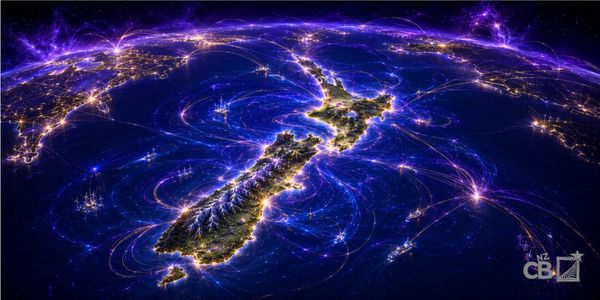
The Structural Shift in New Zealand
Digital capability is moving to the centre of government. Coordination, interoperability, and infrastructure are becoming critical to national scale - reshaping how New Zealand operates in an AI-enabled economy.

Part of a broader body of work on how AI, infrastructure, and capability are reshaping New Zealand’s future.
Digital is moving to the centre - but transformation depends on how it is used
Something important is happening in New Zealand.
And it may signal a much bigger shift than most people realise.
Digital is being moved closer to the centre of government.
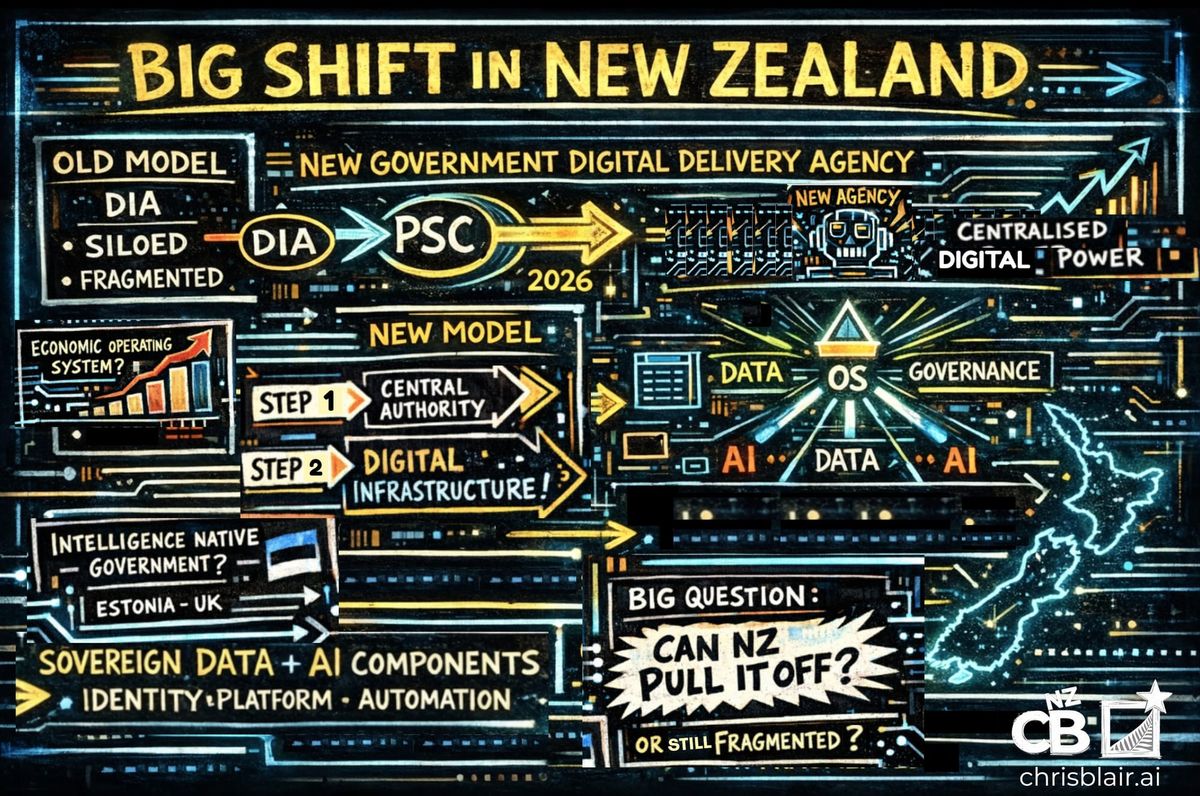
The Government Chief Digital Officer function is shifting from DIA to the Public Service Commission (PSC). Alongside this, a Government Digital Delivery Agency is being established [New Zealand Government - Digital Transformation Accelerates].
This sounds administrative.
It isn’t.
It’s a structural signal.
It suggests digital is starting to be treated less like departmental agency capabilities - and more like core public infrastructure.
Other countries have taken this path.
Estonia did it with X-Road.
A national data exchange layer.
Distributed. Secure. Interoperable.
Now handling billions of transactions every year.
It took nearly 20 years.
Digital became national infrastructure.
The UK followed a similar direction with Government Digital Service -centralising standards, platforms, and delivery capability.
But it wasn’t smooth.
Identity programmes struggled.
Departments pushed back.
Centralisation proved difficult.
Which is why this shift in New Zealand matters.
Because once digital moves to the centre - it stops being just technology.
It becomes:
• an operating model shift
• a governance shift
• a national capability shift
And New Zealand already has many of the pieces: Digital Strategy for Aotearoa, Digital Public Service Strategy, Digital Identity Trust Framework and a National AI Strategy.
Individually these are useful. Together they could become something more powerful.
An operating system.
The shift progresses through 3 stages:
• Stage 1: Digital platforms
• Stage 2: Digital infrastructure
• Stage 3: National operating system
This is how countries become intelligence-native governments.
And when that happens - it doesn’t just change government.
It changes the economy.
Which starts to look very similar to the heart of what I’ve been calling New Zealand’s Economic Operating System. (chrisblair.ai/nzeos)
But here’s the slightly uncomfortable truth…
Centralising digital capability is hard.
It challenges agency autonomy.
It creates governance tension.
And it demands capability - not just structure.
Estonia took decades to build X-Road into national infrastructure. The UK struggled with fragmentation and closed its first national identity programme.
So the question is:
Can New Zealand actually pull this off?
Because if we can - this becomes one of the most important structural shifts in decades.
If we can’t - it becomes another reshuffle.
What do you think we need to watch out for here?
#DoubleExportsBy2034
#TrueStructuralTransformation
#AIforReimaginingEntireWorkflows
How this connects
This essay is part of a broader body of work:
New Zealand Economic Operating System (NZ-EOS)
System-level design shaping New Zealand’s future
The Studio Model
Organisational AI capability and execution
Related Essays
Redesigning the System for Growth
NZ-EOS Framework (Primary Essay)
Building AI Advantage on Sovereign Data and Trust