Framework for New Zealand's Economic Operating System
New Zealand’s growth challenge isn’t an AI problem - it’s a system design problem. The New Zealand Economic Operating System reframes growth as alignment across energy, infrastructure, capital, and capability.

Primary Essay - Foundation of NZ-EOS
Starting point for economic system
This essay represents the initial articulation of the New Zealand Economic Operating System (NZ-EOS).
The latest version of the framework is maintained at:
chrisblair.ai/nzeos
Part of a broader body of work on how AI, infrastructure, and capability are reshaping New Zealand’s future.
New Zealand’s economic future will be shaped by the system - not technology alone
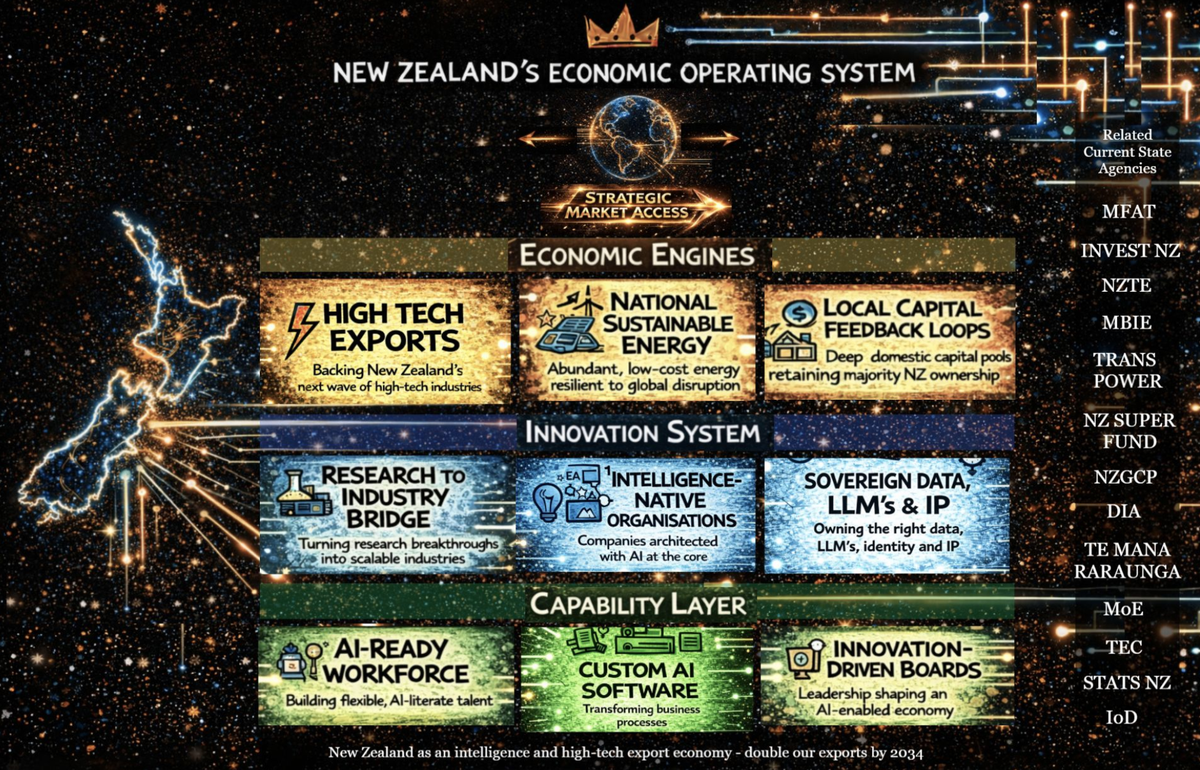
My draft NZ-EOS framework for success. Yes, AI is likely to create a lot of new roles for people inside both large and small businesses, around setting-up, maintaining, and validating the recommendations from the new AI-tools and custom AI-software.
Yes, AI will help us build a new wave of Intelligence-Native organisations, with AI as a collaborative core in decision making and new work-flow processes.
But all this good stuff may not actually make our country more prosperous.
That's because the real challenge is not solely about technology - it's also about the system our economy runs on.
In my previous post I discussed the challenge of doubling New Zealand’s exports by 2034 - a goal sitting behind much of our government’s economic strategy. [Intervention Points for AI Impact]
The more you work with this challenge, the clearer one thing becomes - this isn’t just a technology challenge. It’s a system design challenge.
If we want to materially change our economic trajectory, we need to rethink the economic operating system itself.
Interestingly, there is one country whose economic structure once looked very similar to New Zealand’s. Ireland. Over the past 20 years Ireland managed to triple its high-tech exports through a deliberate structural transformation strategy.
They didn’t just rely on innovation or new technology. They redesigned the system around it.
But here’s the uncomfortable reality:
Economists point out that doubling exports in 10 years is historically difficult for New Zealand.
Our export growth has typically averaged 2–3% per year, well below what would be required.
The University of Canterbury recently published an opinion piece highlighting exactly this challenge for New Zealand. [Canterbury University - NZ export goals require more than aspiration]
However, looking at what has worked in countries like Ireland, Singapore and Israel - and applying a modern AI lens - I’ve been sketching out a new map.
Not a policy.
Not a political slogan.
But a systems blueprint.
Something that translates the ambition of doubling exports into a coherent, pragmatic architecture.
In other words:
An economic operating system designed for an AI-era export economy.
Here’s the framework I’ve been sketching. Let me know what part of New Zealand’s economic system you think needs to change first?
#DoubleExportsBy2034
#TrueStructuralTransformation
#AIforReimaginingEntireWorkflows
How this connects
This framework outlines a system for New Zealand’s long-term growth:
New Zealand Economic Operating System (NZ-EOS)
System-level design shaping New Zealand’s future
The Studio Model
Organisational AI capability and execution
Related Essays
Redesigning the System for Growth
The Structural Shift in New Zealand
Building AI Advantage on Sovereign Data and Trust