Redesigning New Zealand’s System for AI-Enabled Growth
AI isn’t the answer - it’s a force multiplier. New Zealand’s future growth depends on redesigning the system around it - aligning infrastructure, capability, and capital to turn that force into sustained national advantage.

Part of a broader body of work on how AI, infrastructure, and capability are reshaping New Zealand’s future.
New Zealand’s growth depends on aligning the system around AI
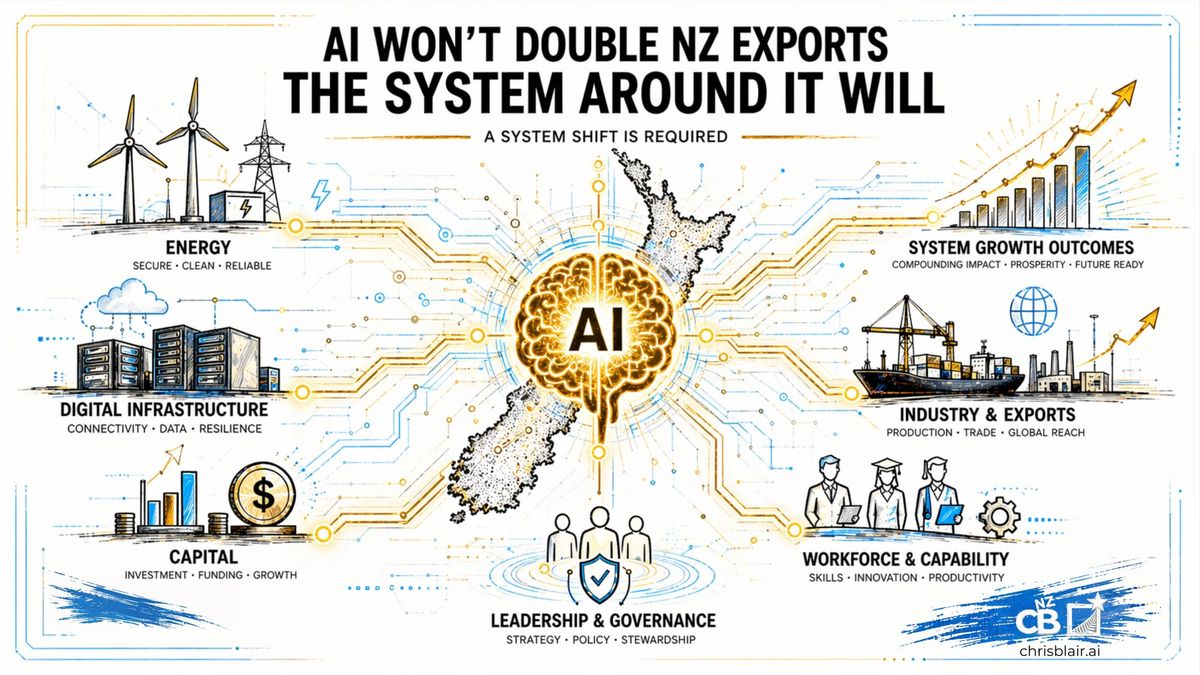
AI won’t double New Zealand’s exports.
The system around it will.
If doubling exports is a system problem…
and infrastructure fundamentally determines what’s possible…
what does this actually mean for New Zealand?
It means the next wave of growth won’t come from isolated initiatives.
It will come from alignment.
Alignment across New Zealand between:
• industry strategy
• energy strategy
• digital infrastructure
• AI capability
• leadership capability
• capital allocation
When these move together - growth compounds.
When they don’t -
progress stalls.
The uncomfortable truth is:
Across New Zealand, most organisations are still optimising inside the current system - rather than changing the system itself.
Improving workflows.
Reducing costs.
Automating tasks.
All good things.
But when the system itself is the constraint - optimisation doesn’t change the outcome. It just makes the existing system run slightly better.
Real shifts don’t come from doing the same things better.
They come from redesigning the system those things sit inside.
And we’re already seeing the impact of that gap.
New Zealand lags OECD peers in areas like digital adoption, connectivity, and AI readiness - all of which directly affect how organisations scale and compete globally. [OECD - Foundations for Growth and Competitiveness - 2026 Report]
The shift we need is:
From:
isolated AI use cases
to system-wide capability
From:
incremental improvement
to structural growth
And this is where the real leverage sits.
Not in AI alone.
But in the system that surrounds it.
Because when New Zealand’s system is aligned:
• Energy becomes a strategic asset.
• Digital connectivity becomes a scaling layer.
• Institutional design becomes an enabler of speed and trust.
And AI?
AI becomes a force multiplier.
We’re already seeing what this could look like.
Some estimates suggest New Zealand could unlock tens of billions in new export value through energy-enabled digital infrastructure like data centres - if the underlying system is designed for it. [BCG - Energy to Grow - Securing New Zealand’s Future]
It’s not about improving what already exists -
it’s about amplifying what’s possible through a new system blueprint.
That’s the difference between:
Incremental progress and compounding growth.
Yes - this requires organisational shifts.
But the real opportunity, and the window we’re in, is a New Zealand system design shift.
This thinking connects to a broader framework I’ve been exploring around how New Zealand can design for long-term, AI-enabled growth - bringing energy, infrastructure, capability, and capital into one aligned model. (chrisblair.ai/nzeos)
If we get the system right -
AI won’t just improve New Zealand’s economy.
It will reshape what we’re capable of.
#DoubleExportsBy2034
#TrueStructuralTransformation
How this connects
This essay is part of a broader body of work:
New Zealand Economic Operating System (NZ-EOS)
System-level design shaping New Zealand’s future
The Studio Model
Organisational AI capability and execution
Related Essays
New Zealand’s Missing AI Infrastructure
The Structural Shift in New Zealand
NZ-EOS Framework (Primary Essay)