
New Zealand’s Missing AI Infrastructure
AI won’t scale in New Zealand without the right systems. The real gap isn’t AI models - it’s infrastructure: energy, connectivity, and capability - the foundations that determine whether growth and export potential can actually scale.

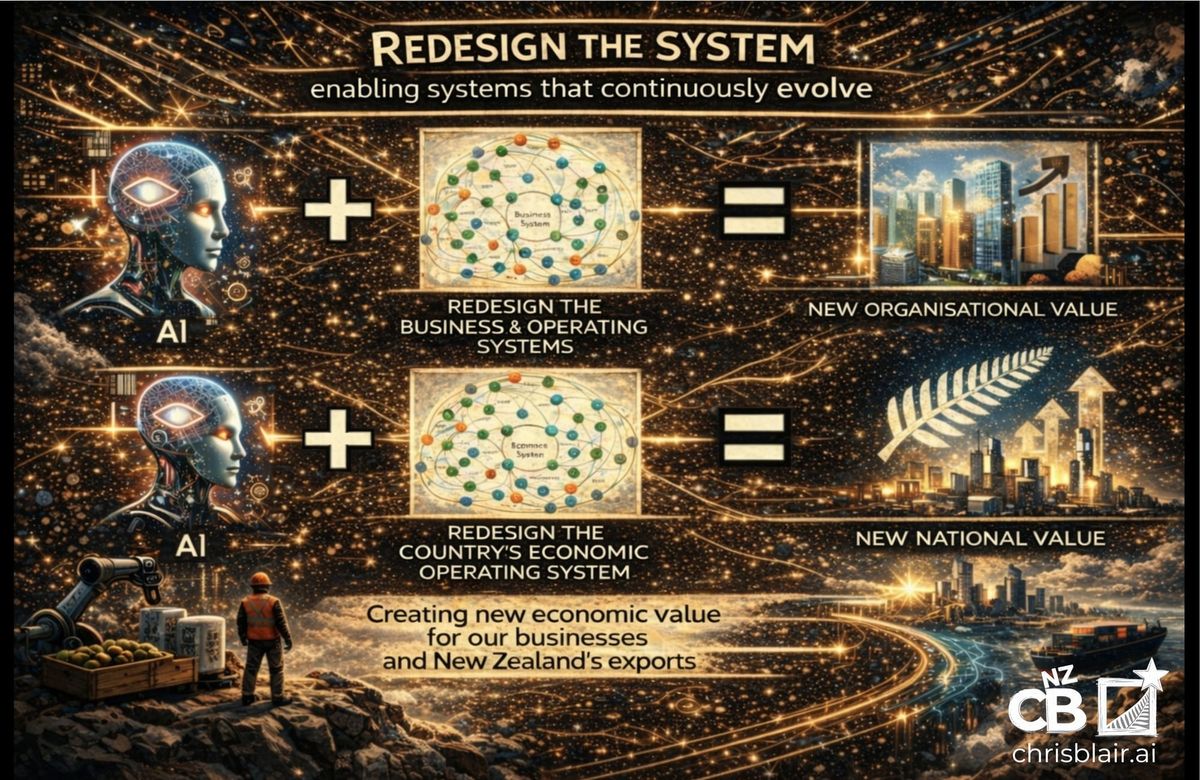
Part of a broader body of work on how AI, infrastructure, and capability are reshaping New Zealand’s future.
AI can’t scale without the infrastructure that supports it
If doubling exports is a system problem…
will AI make the biggest difference?
It turns out it’s not where most people are looking.
It’s infrastructure.
Not just roads and ports.
But the invisible infrastructure that quietly determines whether companies can scale globally.
Things like:
• Energy availability
• Energy cost
• Digital infrastructure
• Data interoperability
• Identity and trust
• AI capability
• Leadership capability
These don’t usually show up in growth conversations.
But they will ultimately shape the outcome. [OECD - Infrastructure and Growth Report]
Because when energy costs rise,
everything becomes more expensive to produce, move, and export.
When digital infrastructure is fragmented,
companies don’t just slow down - they struggle to integrate, partner, and scale across borders.
When capability is uneven,
AI can't become a true force multiplier - instead it stalls in pockets.
And when capital, talent, and industry aren’t aligned,
you don’t get momentum - you get fragmentation.
The uncomfortable truth is this:
Export growth isn’t just about building more companies.
It’s about building the conditions that allow those companies to scale - and stay anchored.
And most of those conditions are invisible…
until they stop functioning the way they need to…
That’s when they become constraints:
• Energy becomes a competitiveness tax
• Digital fragmentation becomes friction
• Capability gaps become bottlenecks
And suddenly, growth slows - or leaks offshore.
This is why the conversation needs to start shifting both inside organisations and at a national level:
From:
“How do we adopt AI?”
To:
“What kind of system allows AI-enabled organisations to scale?”
And that raises a bigger question I’ve been thinking about:
Is this something we wait for government to solve?
Or does the private sector need to start shaping this more actively as well?
Because if the system is the constraint…
then it needs to be redesigned - not just adopted into.
The countries moving fastest right now aren’t just adopting AI.
They’re aligning infrastructure, capability, capital, and policy over decades to support it. [Norwegian Government - Industry competitiveness for a new time]
For New Zealand, and many countries - AI will not be the constraint.
The system around it will be the problem.
And once you see that - you start to realise:
Infrastructure isn’t a background topic.
It’s the end game.
#DoubleExportsBy2034
#TrueStructuralTransformation
#AIforReimaginingEntireWorkflows
How this connects
This essay is part of a broader body of work:
New Zealand Economic Operating System (NZ-EOS)
System-level design shaping New Zealand’s future
The Studio Model
Organisational AI capability and execution
Related Essays
The AI Realisation
The Invisible Pillar of AI
AI Is Becoming Core Infrastructure