The Invisible Pillar of AI
Energy is becoming a defining constraint in the AI economy. Cost, availability, and infrastructure now shape competitiveness and export scale - positioning energy as a core pillar of the New Zealand Economic Operating System.

Part of a broader body of work on how AI, infrastructure, and capability are reshaping New Zealand’s future.
Energy is becoming the constraint on AI-driven growth
Energy has always been invisible in New Zealand.
AI changes that.
Most leadership teams treat energy as a power bill.
But something is shifting and it goes straight to the heart of New Zealand’s export growth strategy. [MFAT - NZ Trade Policy]
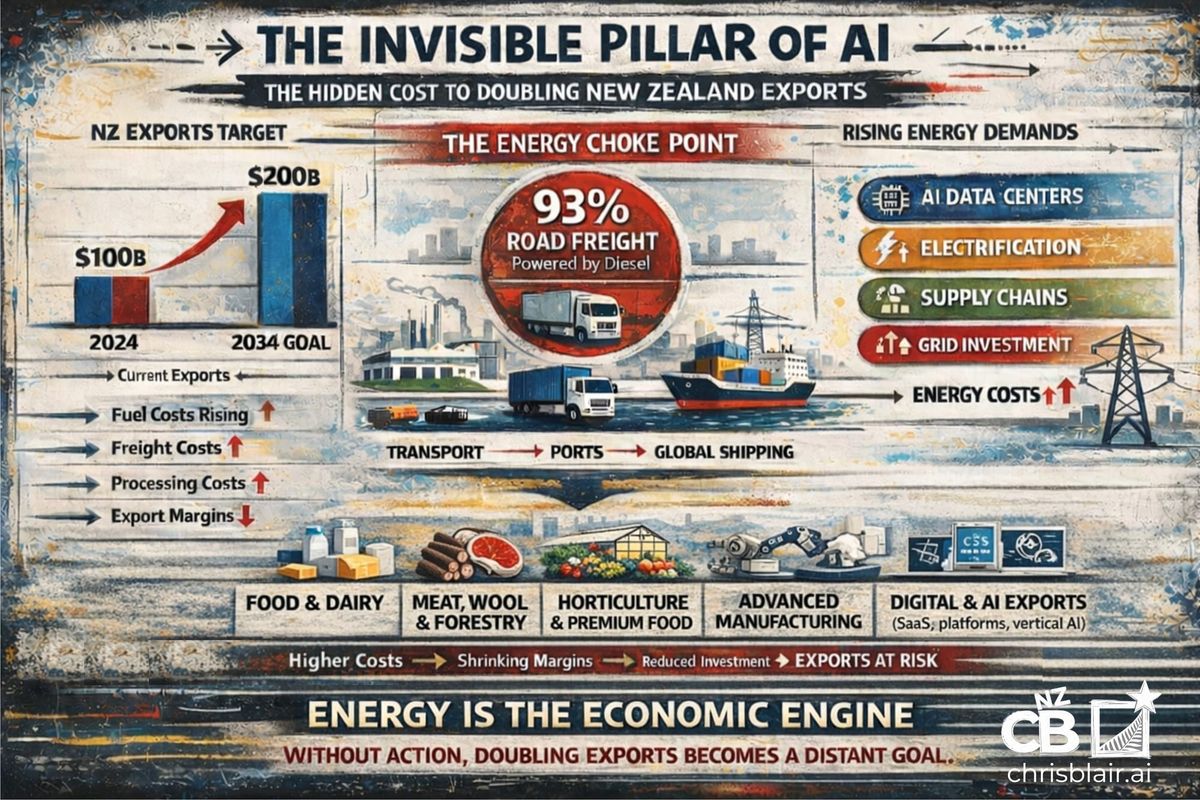
New Zealand wants to double exports by 2034.At the same time, energy inputs are rising across fuel, freight, and electricity networks.
That’s not just a cost-of-living issue.
It’s an export competitiveness issue.
It’s also becoming a growth constraint.
Yes, AI will unlock new productivity, new industries, and new ways of working.
But none of that scales without energy.
The more I look at this, the clearer it becomes - energy is both a direct cost and embedded across the export economy - tourism transport, logistics, heat, refrigeration, manufacturing utilities, and now compute and data infrastructure.
When energy rises… everything rises.
And New Zealand is particularly exposed.
We import 100% of refined fuels now Marsden Point has closed.
Domestic freight is ~93% road-based.
Diesel now sits under almost every supply chain.
*Which means our exports are effectively embedded energy products*
And consider demand is about to increase all at once: [Transpower - Report - Progress Towards A Highly Electrified Future]
1. Industrial electrification and new energy-intensive industry
2. Transport and logistics electrification
3. AI infrastructure, data centres, and sovereign compute
4. National digital infrastructure (identity, Te Mana Raraunga)
5. Export growth and grid expansion
Which creates a collision.
As I suggest in the New Zealand Economic Operating System…Energy isn’t a background utility. [chrisblair.ai/nzeos]
It’s a foundational economic engine.
No abundant energy - no competitive processing
No competitive processing - no competitive exports
No competitive exports - no export growth
*In an AI economy, energy availability determines which companies can scale*
Some small countries are already treating energy as economic infrastructure:
- Iceland built geothermal abundance.
- Norway leveraged hydro.
Energy determines economic scale.
And here’s the uncomfortable truth for New Zealand businesses and leadership teams…
The companies that incorporate energy into their strategy and move early will secure supply, electrify logistics, co-invest in generation, and lock in lower-cost production.
The ones that don’t will inherit rising embedded costs.
This isn’t just about sustainability.
It’s about who can grow and who can’t.
Most boards are not discussing energy strategy.
Yet energy may become the single biggest constraint.
Energy isn’t just an input anymore.
It’s becoming the invisible foundation that determines whether New Zealand’s Economic Operating System can actually scale.
#DoubleExportsBy2034
#TrueStructuralTransformation
#AIforReimaginingEntireWorkflows
How this connects
This essay is part of a broader body of work:
New Zealand Economic Operating System (NZ-EOS)
System-level design shaping New Zealand’s future
The Studio Model
Organisational AI capability and execution
Related Essays
New Zealand’s Missing AI Infrastructure
AI Is Becoming Core Infrastructure
Redesigning the System for Growth