Building AI Advantage on Sovereign Data and Trust
In an AI economy, trust becomes infrastructure. Sovereign data, identity, and governance create long-term advantage - linking national capability with scalable organisational systems.

Part of a broader body of work on how trust, data, and AI infrastructure enable secure, scalable growth.
Trust will define New Zealand’s AI advantage
The other week I got back to academyEX for a great panel discussion on why trust - not technology - will define our AI future of identity.
Thanks to Digital Identity NZ and Tech NZ for hosting, and to Paula Gair, Dr Karaitiana Taiuru and Andy Higgs for a thoughtful discussion. [Digital Identity New Zealand - Why trust, not technology, will define our AI future]
It reinforced something I’ve been exploring in what I call New Zealand’s Economic Operating System - particularly the pillar around sovereign data, LLMs and intellectual property. [NZ-EOS Framework (Primary Essay)]
MBIE’s AI Strategy estimates Generative AI could add ~$76B to NZ GDP by 2038 (≈15% of GDP). [MBIE - New Zealand's Strategy for Artificial Intelligence]
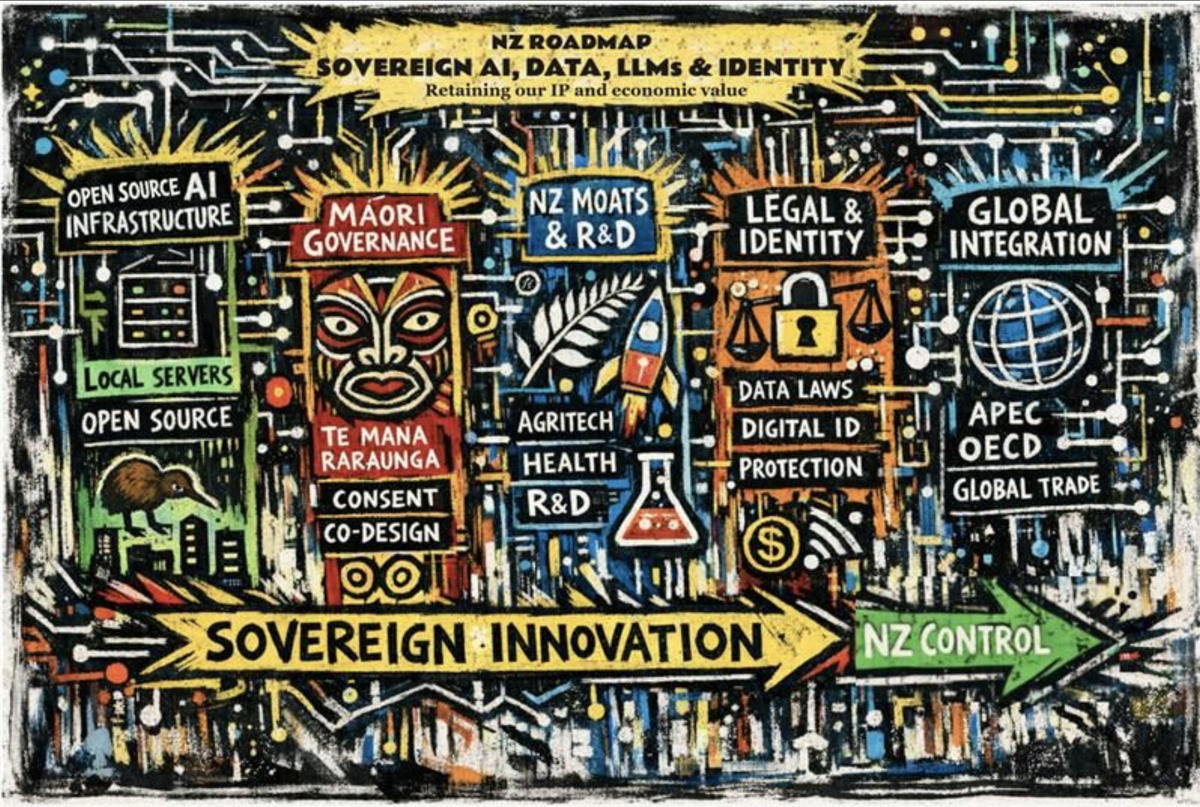
If Aotearoa wants to build meaningful AI capability, we will need to understand the Reality Fracture, as Steve Swallow discusses. We also likely need a pragmatic roadmap. I have created 5 key principals that might help drive this forward:
1. Open-source AI infrastructure
Prioritise open models and on-premise deployment (e.g. LLaMA, Mistral) so NZ data and IP remain under local control - alongside sovereign NZ cloud providers and emerging OpenCLAW-style AI stacks.
2. Māori governance in AI systems
Embed Te Mana Raraunga principles, ensuring Māori data sovereignty, consent and iwi co-design are foundational to AI development.
3. Invest in NZ’s natural AI moats
Agritech, biosecurity, renewable energy, healthcare and cultural sectors - supported by stronger R&D and research-to-industry bridges.
4. Strengthen identity and legal frameworks
Ensure digital identity and critical data infrastructure remain governed under New Zealand law. This makes good sense for identity protection as much as it does for corporate IP protection.
5. Strategic global integration
Work with APEC, OECD and global standards so NZ firms can integrate to global AI without surrendering data or IP ownership.
However here’s the uncomfortable part:
This opportunity is bigger than building individual AI products. It’s about creating AI-powered companies built on sovereign data.
New Zealand won’t win the race to build the largest foundation models or hyperscale AI infrastructure. But we can win in vertical intelligence sectors where we already have expertise.
The next generation of NZ export companies may not look like SaaS platforms.
They may look more like AI capability factories - organisations that continuously generate new software and intelligence internally, and export that capability to the world. [OpenClaw Architecture Overview]
The real question is: what else beyond governance - do we need to get right so these capabilities remain sovereign, trusted, and uniquely New Zealand?
This is where trust, sovereignty, and system design converge - forming a core pillar of what I’ve been calling New Zealand’s Economic Operating System.
#DoubleExportsBy2034
#TrueStructuralTransformation
#AIforReimaginingEntireWorkflows
How this connects
This essay is part of a broader body of work:
New Zealand Economic Operating System (NZ-EOS)
System-level design shaping New Zealand’s future
The Studio Model
Organisational AI capability and execution
Related Essays
AI Is Becoming Core Infrastructure
The Structural Shift in New Zealand
NZ-EOS Framework (Primary Essay)