
Intervention Points for AI Impact
If AI is to shift economic outcomes, where should we intervene? The highest-leverage points sit across boards, infrastructure, and capability - defining where system redesign creates the greatest impact.

Part of a broader body of work on how AI, infrastructure, and capability are reshaping New Zealand’s future.
AI impact depends on where you intervene in the system
Where should we focus if we want to improve NZ’s economic engine?
Yes, AI will help, but what is the pillar that is rarely discussed…
Building on earlier systems discussions with Michael Sharpe in Redesigning Systems in the Age of AI four of the economic-system pillars most likely requiring redesign are:
· Identifying and backing the right growth industries
· Connecting research more effectively to industry
· Maintaining sovereign data and IP building local capital feedback loops
· Upskilling our workforce so they are AI-literate and flexible
I’ve spent quite a bit of time doing systems thinking with Leyla Acaroglu [https://unschools.co]. One of the ideas we discuss in system thinking is identifying the intervention points in a system where change can have the greatest impact.
Yes, the system is complex, and if we want to reignite our NZ economic engine (...and not be reliant on our Dali-crutch, the housing market) and design and build a system where we can double exports by 2034, we will likely need to intervene in multiple places.
Which leads to a slightly uncomfortable question:
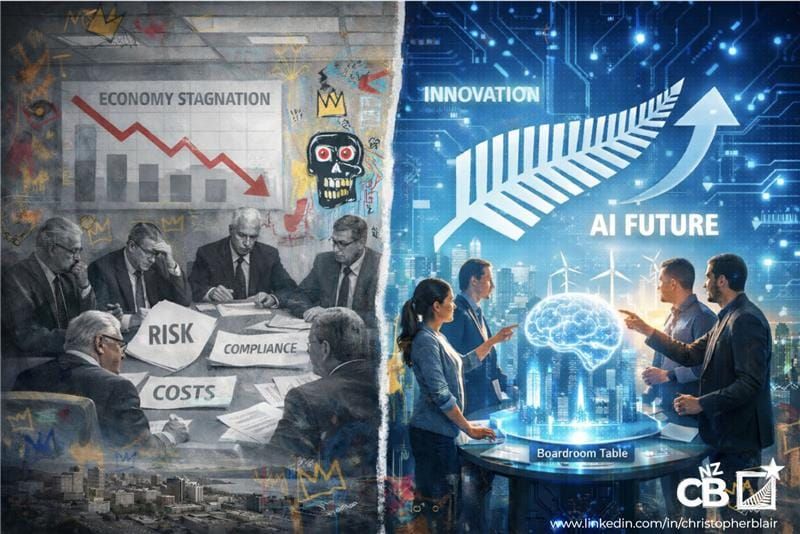
One pillar that is rarely discussed and potentially one of the most powerful starting points might be sitting right inside our boardrooms...
Economist Cameron Bagrie recently argued [The New Zealand Herald - Poor governance is stalling NZ productivity growth by Cameron Bagrie] that many New Zealand boards may actually be holding our companies back. Their focus is often heavily weighted toward risk management and governance, which are important - but not enough time is spent on innovation, growth strategies, and what can be re-imagined for the business now we have new AI capabilities.
Even The NZ Institute of Directors has highlighted a similar tension. The insights show [New Zealand Institute of Directors - Forecasting the future board] New Zealand companies often respond to pressure by cutting costs and staff, rather than investing in new revenue opportunities. Their research confirms high-performing boards strongly influence innovation outcomes - yet many boards are overloaded with compliance and risk oversight, leaving insufficient time for strategy and innovation discussions.
Right, just to be clear - not all boards are the same - but it does raise an important question: Do Directors have the right innovation mind-set? Are our NZ boardrooms helping drive innovation and growth or unintentionally slowing us down?
#DoubleExportsBy2034
#TrueStructuralTransformation
#AIforReimaginingEntireWorkflows
How this connects
This essay is part of a broader body of work:
New Zealand Economic Operating System (NZ-EOS)
System-level design shaping New Zealand’s future
The Studio Model
Organisational AI capability and execution
Related Essays
Redesigning Systems in the Age of AI
Scaling AI with the Dual Speed Model
Studio Model (Primary Essay)