A Practical Way to Scale AI Across Your Business: The Studio Model
Most organisations are experimenting with AI - few are scaling it. The Studio Model defines an operating system for turning fragmented activity into continuous AI capability across the business.

Primary Essay - Foundation of Studio Model
Starting point for organisational system design
This essay represents the initial articulation of the Studio Model.
The latest version of the framework is maintained at:
chrisblair.ai/studio-model
Part of a broader body of work on how AI is reshaping organisational capability, execution, and performance.
AI doesn’t scale through tools - it scales through systems
Copilots are live. Teams are experimenting with AI. Pilot projects are everywhere. But progress can start to feel uneven.
There’s activity across the business - but not always clear outcomes...
Through my work with leading businesses - building innovation capability, shaping operating models, and embedding continuous improvement - I’ve noticed a consistent success pattern.
The same is now becoming true for AI.
Combined with broader research and what’s emerging globally, it’s becoming clear that the organisations making real progress are using two-speed modes [Scaling AI with the Dual Speed Model] and building capability that continuously redesigns how the business works.
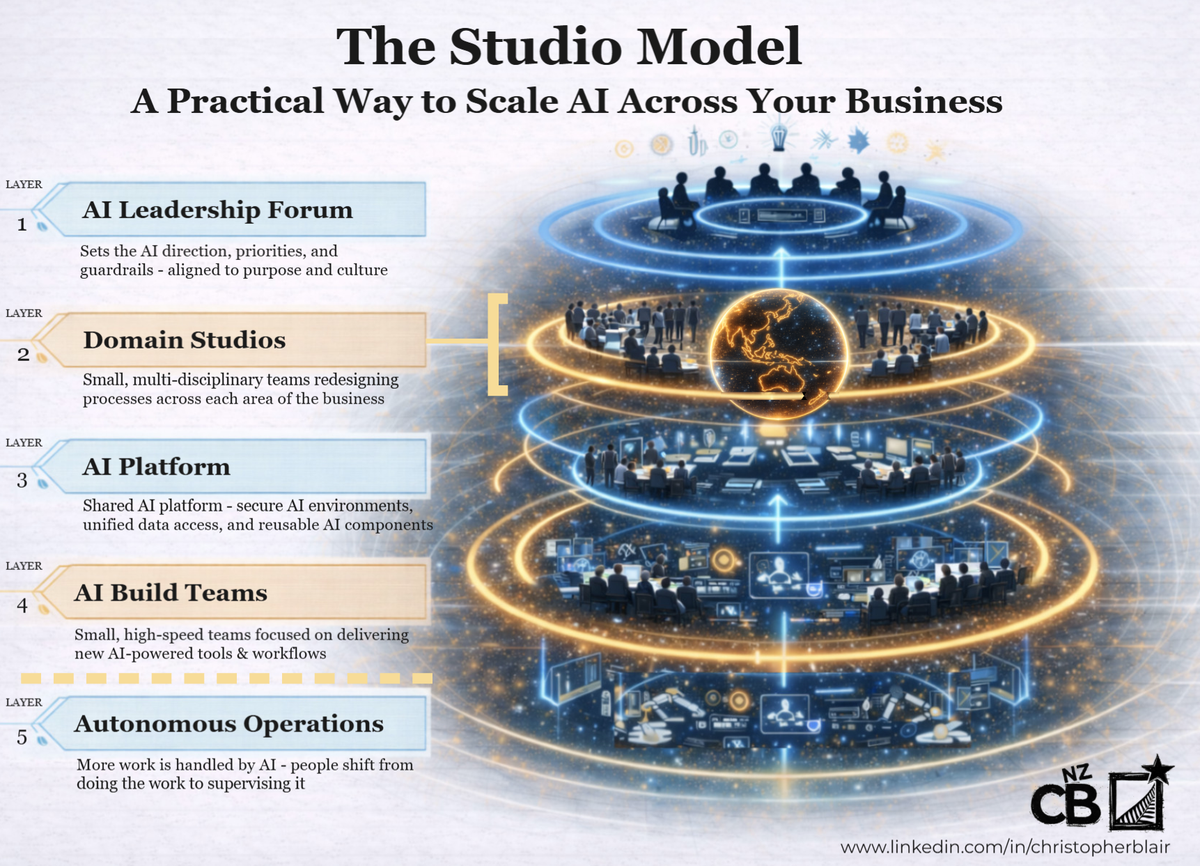
A simple structure for doing this is now starting to emerge. It’s not a large restructure. It’s a focused capability, built on five key layers.
This is a practical way to scale AI across your business - using a model that actually works.
The Studio Model
Layer 1 - AI Leadership Forum
This group sets direction, priorities, and guardrails - aligned to the business’s purpose and culture. It ensures AI efforts stay focused on real business value.
Layer 2 - Domain Studios
Small, cross-functional teams combining domain experts and technologists. Their role is to redesign processes using AI, and work alongside teams across the business in focused bursts to build AI capability. (Inspired by the Bauhaus movement - bringing disciplines together to reshape systems.)
Layer 3 - Technology Enabling Platform
The shared technology foundation that enables everything. Secure AI environments. A unified, governed data layer that connects the business. Reusable AI components.
Layer 4 - AI Build Teams
This is where ideas become reality. Small, high-speed teams focused on delivering new AI-powered tools and workflows. Each team typically around five people. Their job is simple: Build. Test. Validate. Deploy. [AI-Native Software Development Lifecycle]
Layer 5 - Autonomous Operations
Over time, this leads toward autonomous operations. People shift from doing the work to supervising and guiding it - acting as the human-in-the-loop within increasingly AI-powered processes.
Here's the uncomfortable part - and this shift matters:
Businesses need to move from delivering traditional digital and IT projects to designing how work gets done.
The businesses that succeed won’t just use AI tools. They will build something more powerful.
AI capability factories - powered by the 5-layer Studio Model.
Where new processes and new ways of working can be:
Designed. Tested. Deployed. Continuously improved.
The advantage is no longer just digital technology. It’s the ability to continuously evolve your processes and how your business operates.
#DoubleExportsBy2034
#TrueStructuralTransformation
#AIforReimaginingEntireWorkflows
How this connects
This framework defines how organisations build and scale AI capability:
The Studio Model
Organisational AI capability and execution
New Zealand Economic Operating System (NZ-EOS)
System-level design shaping New Zealand’s future
Related Essays
Scaling AI with the Dual Speed Model
AI-Native Software Development Lifecycle
Redesigning Systems in the Age of AI