
MI-ND
A systems model for understanding how intelligence, infrastructure, trust, capability, capital, platforms, and economic power are forming a new global operating environment.
Meshed Intelligence Network Dynamics
Framework by Chris Blair
Version 0.1 Beta — Emerging Systems Model
Updated June 2026 to reflect the development of WAVES, Value Dynamics, Trusted by Design, Human Capability and Adaptation, and the wider ChrisBlair.ai body of work.
Understanding the system forming around intelligence
The intelligence economy will change more than the technologies organisations use.
It will shape where new industries form, what kinds of work people do, how services are delivered, which countries and regions attract investment, who controls critical platforms and infrastructure, and where the resulting value accumulates.
Some people and organisations will gain access to new knowledge, capability, opportunity, and forms of contribution.
Some countries will build combinations of energy, compute, trust, capital, research, platforms, and industry capability that allow intelligence-era value to compound.
Others will provide energy, data, infrastructure, labour, natural resources, or market demand while retaining a smaller share of the value created above them.
MI-ND, or Meshed Intelligence Network Dynamics, provides a way to understand that emerging environment.
It describes the intelligence economy as a connected system of nodes rather than one flat global market.
These nodes include:
• countries and regions
• cities and industry clusters
• energy and transmission systems
• compute and data-centre ecosystems
• model and cloud providers
• trusted data environments
• identity and assurance systems
• research and education networks
• capital and ownership structures
• platforms and protocols
• sector and activity representatives
• intelligent organisations
• public institutions
• agent-mediated economic networks
The strength of a node does not depend on one asset alone.
It depends on how effectively infrastructure, intelligence, knowledge, trust, capital, human capability, platforms, institutions, and access to markets reinforce one another.
MI-ND asks a central question:
Where will intelligence-era capability, influence, and value be created, governed, coordinated, and retained?
What MI-ND is ultimately for
MI-ND begins with a systems and economic question, but its purpose is wider than economic power alone.
It helps explore how the emerging intelligence economy affects:
Human opportunity
Whether people can develop relevant capability, participate meaningfully, and find credible pathways into new forms of work and contribution.
Organisational capability
Whether businesses and institutions can move beyond using AI tools toward redesigning work, building trusted capability, and creating better products and services.
National prosperity
Whether countries and regions can build strong industries, retain ownership and knowledge, and share more fully in the value created through intelligence-era activity.
Trusted participation
Whether people, organisations, and institutions can interact through systems that provide clear identity, consent, authority, accountability, challenge, and redress.
Economic resilience
Whether countries and organisations have the infrastructure, skills, capital, trust, partnerships, and strategic options required to remain capable when global systems or commercial relationships change.
Human agency
Whether people remain meaningful participants in decisions and systems that affect their work, services, opportunities, identities, and lives.
The infrastructure and systems described by MI-ND are not the final outcome.
They are the machinery through which better human, organisational, economic, and national outcomes become possible.
The Core Idea
The central proposition of MI-ND is that intelligence-era value will not be distributed evenly.
It will concentrate around connected nodes.
A node may be:
• a country
• a region or city
• an infrastructure cluster
• a company or platform
• a research ecosystem
• a trusted jurisdiction
• an industry network
• a sovereign data environment
• a public institution
• an agent-mediated marketplace
• a system of connected organisations
Some nodes will primarily provide infrastructure.
Some will create models, platforms, intellectual property, or specialist capability.
Some will hold trusted relationships with people, industries, or institutions.
Some will coordinate transactions, identity, decisions, and access to markets.
The strongest nodes combine several of these positions.
A high-value intelligence-economy node connects:
• abundant and resilient energy
• scalable compute and connectivity
• trusted data and identity systems
• domain knowledge and applied intelligence
• research and commercialisation pathways
• human capability and adaptive institutions
• capital that recycles into local capability
• trusted governance and assurance
• platforms, interfaces, and market access
• organisations able to convert capability into outcomes
• ownership structures that retain value
• institutions able to coordinate across the system
The economic question is no longer simply:
Who uses AI?
The deeper question is:
Who controls and connects the conditions through which intelligence-era value compounds?
From the digital economy to the intelligence economy
The digital economy was organised around software, cloud services, networks, platforms, data flows, digital products, and online business models.
The intelligence economy builds on that foundation but changes the centre of gravity.
Data, compute, models, energy, domain knowledge, trust, and human judgement can now be combined to generate and apply intelligence across work, services, infrastructure, decisions, and markets.
This changes the role of infrastructure.
Infrastructure is not only a background enabler.
Energy, compute, connectivity, data environments, identity, assurance, and trusted operating systems become active components of economic capability.
It also changes the role of organisations.
The advantage does not come only from purchasing AI tools.
It comes from redesigning work, building reusable capability, developing trusted operating models, adapting roles and services, and converting technical activity into outcomes that matter.
It changes the role of platforms and intermediaries.
As personal agents, sector representatives, organisational agents, and economic networks emerge, control of discovery, identity, relationships, transactions, and coordination becomes a major source of value and influence.
It changes the role of countries.
National competitiveness depends on how well energy, infrastructure, capital, research, workforce capability, trust, institutions, industries, and access to markets are connected.
This is why the intelligence economy cannot be understood through an AI-adoption lens alone.
It needs to be understood as a meshed system of infrastructure, capability, trust, agency, platforms, institutions, and value.
A network of connected nodes
MI-ND describes nodes operating at several levels.
Global nodes
These include:
• hyperscale cloud providers
• frontier model companies
• semiconductor firms
• global digital platforms
• energy and infrastructure investors
• capital markets
• identity and trust networks
• international standards bodies
• global agent and transaction platforms
These nodes shape the technical, commercial, and governance conditions through which other participants access intelligence capability.
National nodes
These include:
• governments and public institutions
• regulatory and assurance systems
• national infrastructure operators
• research and education systems
• capital and investment networks
• trusted identity systems
• sovereign data environments
• economic development institutions
• sector and export ecosystems
• nationally significant platforms
These nodes influence whether a country can connect infrastructure and capability around a coherent economic position.
Regional and sector nodes
These include:
• cities and regions
• industry clusters
• iwi and Māori organisations
• universities and research organisations
• ports and logistics networks
• energy and manufacturing ecosystems
• food and fibre systems
• health and biotechnology clusters
• aerospace and deep-tech networks
• specialised digital and AI platforms
These nodes can connect local knowledge, relationships, resources, infrastructure, and industry capability.
Organisational nodes
These include:
• companies and public agencies
• boards and leadership teams
• Domain Studios
• technology enabling platforms
• AI Build Teams
• operational and service systems
• trusted data environments
• personal and organisational agents
• industry and customer interfaces
These are the environments in which intelligence capability becomes work, products, services, decisions, relationships, and operating performance.
Human and community nodes
People, whānau, communities, professions, and knowledge holders are also part of the system.
They contribute:
• judgement
• trust
• relationships
• lived experience
• local and cultural knowledge
• domain expertise
• creativity
• legitimacy
• accountability
• purpose
MI-ND should not be read as a system in which technology replaces the human layer.
It describes an environment in which human and machine capability become connected in new ways and in which questions of agency, authority, participation, and value become more important.
How value moves through the system
Infrastructure creates potential.
Capability turns that potential into activity.
Activity must still become capacity, stronger capability, meaningful outcomes, and retained value.
This is where MI-ND connects to Value Dynamics.
The value pathway can be expressed as:
Activity → Capacity → Capability → Outcomes → Retained Value
At each stage, value may strengthen, stall, move, or leak from the node.
A country may host data centres while the intellectual property, platforms, capital returns, and skilled decision-making remain offshore.
An organisation may deploy AI tools while failing to redesign work or convert time saved into stronger capability.
An industry may provide data and specialist knowledge while an external platform controls the customer relationship and captures the higher-margin return.
A workforce may use advanced systems while opportunities for learning, authority, and progression remain limited.
A public institution may automate services while weakening trust if identity, consent, accountability, and redress are not designed clearly.
MI-ND therefore asks more than whether activity is occurring.
It asks:
• where capability is being built
• where decisions are made
• who owns the infrastructure and intellectual property
• who controls customer and institutional interfaces
• where data and learning effects accumulate
• where skilled work and leadership remain
• where capital returns flow
• who sets the rules of participation
• who retains the resulting value
The strength of a node depends partly on its ability to keep more of this pathway connected.
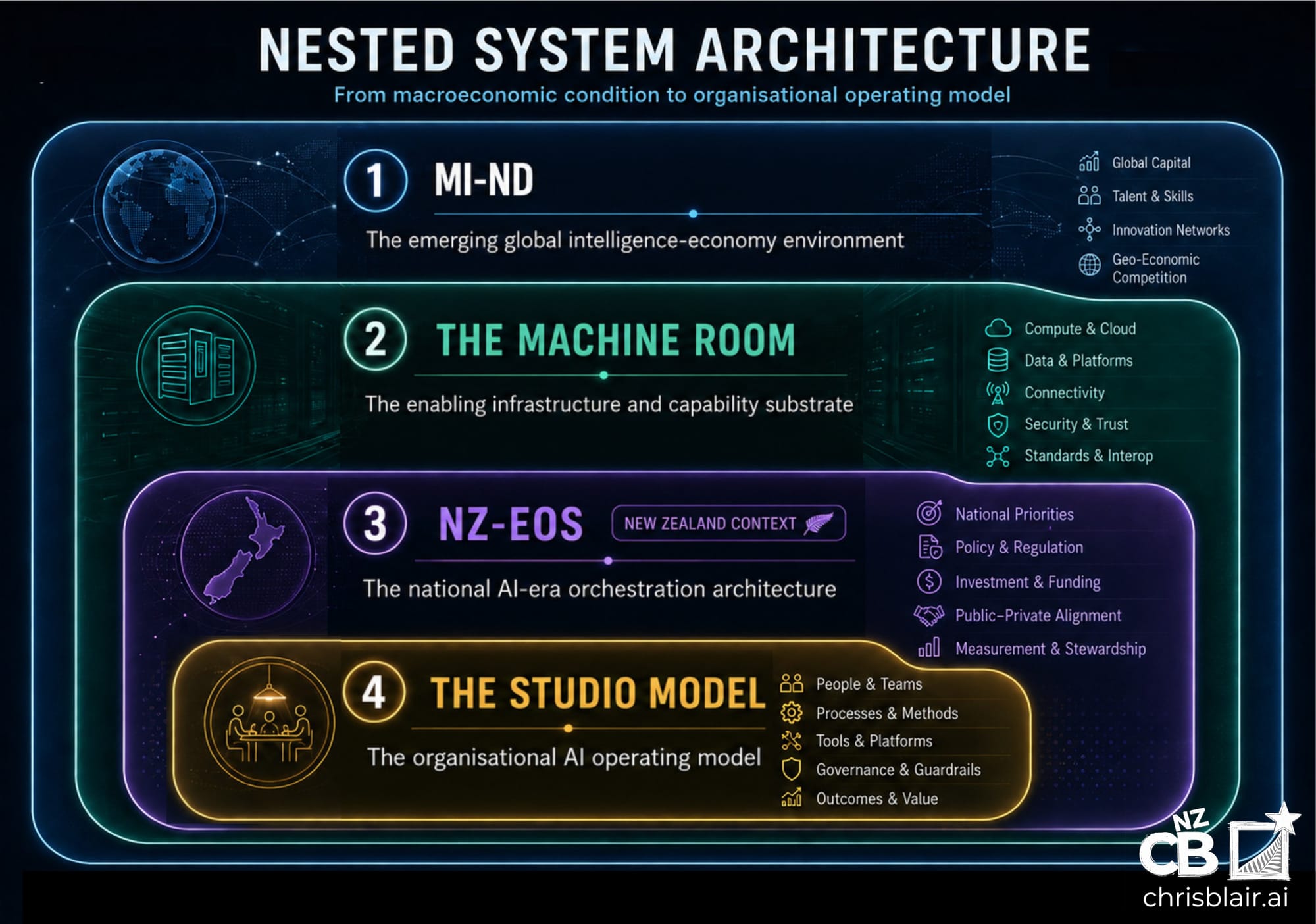
The Four Nested Systems
MI-ND sits at the top of a wider nested architecture across the ChrisBlair.ai body of work.
Each system explains a different level of the intelligence-era transition.
1. MI-ND
The emerging global intelligence-economy environment
MI-ND describes the macro-level environment now forming around AI, compute, energy, infrastructure, intelligence, capital, trust, and sovereignty.
It explains the emerging global pattern of value, power, infrastructure, and capability now forming around intelligence.
It asks how value, power, control, and capability are beginning to reorganise as intelligence becomes an economic input and infrastructure becomes strategically important.
This is the broadest system.
It is not specific to New Zealand, and it is not specific to one organisation.
It describes the environment that countries and organisations are now moving within.
2. The Machine Room
The enabling infrastructure and capability substrate
The Machine Room sits beneath the intelligence-economy environment that MI-ND describes.
It describes the deeper infrastructure and capability substrate that makes the intelligence economy possible.
This includes energy systems, compute infrastructure, data centres, transmission networks, cloud platforms, digital infrastructure, sovereign data systems, talent pipelines, research capability, capital formation, and institutional coordination.
The Machine Room is where the physical, digital, financial, and organisational foundations of the intelligence economy begin to connect.
It is the substrate beneath true value creation.
It asks:
What has to be built, connected, governed, and maintained before intelligence-era value can scale?
3. NZ-EOS
The national AI-era orchestration architecture
NZ-EOS applies this system logic to New Zealand.
It asks how New Zealand can organise energy, infrastructure, capital, research, sovereign data, AI capability, workforce development, boards, and industry strategy into a more coherent economic operating system.
Where MI-ND explains the global intelligence-economy environment, NZ-EOS asks how New Zealand should respond.
It is the national orchestration system.
It focuses on how New Zealand can move from fragmented activity toward a more deliberate system for AI-enabled competitiveness, export growth, and long-term value capture.
NZ-EOS is about national alignment and coordination.
MI-ND describes the wider global intelligence-economy system within which NZ-EOS must operate.
4. The Studio Model
The organisational AI operating model
The Studio Model applies the same system logic at the organisational level.
It asks how companies, agencies, and institutions move beyond isolated AI experiments into scalable AI capability.
It connects leadership direction, domain redesign, enabling technology platforms, AI build teams, and autonomous operations into one organisational operating model.
Where MI-ND describes the emerging global environment, and NZ-EOS describes the national orchestration challenge, The Studio Model describes how organisations build practical execution and operational capability inside that wider system.
It is the organisational aspect of the architecture.
How These Frameworks Fit Together
The four frameworks are connected.
They should not be read as separate frameworks competing with one another.
They describe different aspects of the same transition.
A human dimension also runs across each layer: how leaders, organisations, workforces, and societies adapt as intelligence becomes more distributed, external, and embedded.
MI-ND explains the emerging global intelligence-economy environment.
The Machine Room explains the infrastructure and capability substrate beneath that environment.
NZ-EOS explains how New Zealand could organise itself within the intelligence economy.
The Studio Model explains how organisations can build the capability to operate within it.
Together, they form a nested architecture:
Global environment, infrastructure substrate, national orchestration, organisational execution.
This is why the MI-ND framework is different from NZ-EOS and The Studio Model.
It is not a delivery model.
It is not a national framework.
It is the wider conceptual map.
From AI Tools to Intelligence Systems
The core change is from AI as a tool to intelligence as an economic system.
In the early phase of AI adoption, the focus was on individual use cases: writing, summarising, coding, search, automation, customer service, productivity, and workflow support.
The next phase is more structural.
AI begins to change where economic value forms.
It changes the demand for energy.
It changes the importance of data centres.
It changes the role of cloud infrastructure.
It changes how countries think about digital sovereignty.
It changes how companies think about workflows and decision systems.
It changes how capital markets value infrastructure, platforms, chips, models, data, and capability.
It changes what it means for a country to be competitive.
MI-ND provides a language for this structural change.
The value-capture problem
One of the central distinctions within MI-ND is the difference between participation and value capture.
A country may participate in the intelligence economy without occupying a high-value position within it.
It may become:
• a high-value intelligence node
• a trusted operating environment
• a platform or market orchestrator
• a specialist capability provider
• an infrastructure host
• an energy or data supplier
• a source of domain knowledge
• a customer and demand market
• a dependent participant
• a peripheral supplier
These positions are not equally valuable.
A country or organisation can contribute important inputs while another node controls:
• the models
• the platform
• the customer interface
• the transaction layer
• the identity system
• the intellectual property
• the data feedback loop
• the standards or protocol
• access to the market
• the terms of participation
The infrastructure may be local.
The data may be local.
The expertise may be local.
The higher-value economic return may still accumulate elsewhere.
The objective is not to own every layer.
It is to understand which layers are strategically important, where local ownership or control creates value, where trusted partnerships are appropriate, and how dependency can be managed deliberately.
Infrastructure is necessary but not sufficient
Energy, transmission, compute, cloud infrastructure, fibre, data centres, digital identity, trusted data environments, and connectivity are essential components of the intelligence economy.
They do not automatically create lasting advantage.
Infrastructure can attract activity.
Capability determines whether that activity becomes useful products, stronger industries, better public services, skilled work, organisational learning, export growth, and retained value.
Trust determines whether people, organisations, and institutions can participate with justified confidence.
Capital determines whether new capability can be built, scaled, and owned.
Institutions determine whether infrastructure, innovation, industry, skills, governance, and public purpose can be coordinated.
Human adaptation determines whether people are able to learn, contribute, exercise judgement, and move into new forms of work.
Value Dynamics determines whether these elements combine into meaningful and retained outcomes.
This distinction is especially important for smaller advanced economies.
A country can build or host parts of the Machine Room while remaining dependent on the platforms, models, capital, and market systems sitting above it.
The strongest national position connects infrastructure with:
• research and commercialisation
• applied industry capability
• local ownership and capital
• trusted data and identity
• skilled people and adaptive institutions
• organisational AI capability
• platforms and market access
• export pathways
• public legitimacy
• clear strategic coordination
Infrastructure creates the conditions.
Connected capability creates the opportunity to retain value.
Trust as operating infrastructure
Trust is not only a legal, ethical, or reputational issue.
Within the intelligence economy, it becomes operating infrastructure.
As AI becomes embedded in decisions, services, identity, infrastructure, transactions, and economic coordination, people and institutions need to know:
• who or what is acting
• who is being represented
• what authority has been delegated
• what information may be accessed
• how decisions are made
• who remains accountable
• how actions can be verified
• when human review is required
• how consent can be changed or withdrawn
• how decisions can be challenged
• what forms of redress are available
Trusted by Design provides the complementary design principle.
It holds that identity, consent, authority, provenance, assurance, accountability, oversight, challenge, and redress should be built into systems from the beginning.
This becomes especially important as economic coordination moves across organisational boundaries.
In Wave 1, trust supports responsible use of AI inside organisations.
In Wave 2, trust determines whether personal agents and specialised representatives can act across multiple businesses and public institutions.
In Wave 3, trust mechanisms become shared infrastructure through which agents, platforms, markets, and institutions recognise identity, credentials, permissions, provenance, and obligations.
Nodes that can govern these relationships well become more attractive places for high-value intelligence activity.
The nodes that matter will not only be those with the most compute.
They will also be those trusted to govern data, identity, models, authority, infrastructure, and decisions.
As agents become more capable, the strength of a node will also depend on its ability to govern participation.
This includes trusted identity, decision governance, delegated authority, provenance, assurance, accountability, data rights, and the ability to operate across platforms and jurisdictions without losing control of value or trust.
Work, agency, and economic coordination
WAVES adds an evolutionary dimension to MI-ND.
It describes how AI moves across three overlapping environments.
Wave 1 - AI inside organisations
AI supports people, tasks, workflows, services, decisions, and organisational capability.
Value comes from:
• better work
• released capacity
• improved quality
• faster service
• stronger decisions
• reduced risk
• new products
• organisational learning
• growth
The main challenge is converting AI activity into durable capability and meaningful outcomes.
Wave 2 - AI between people and organisations
Personal agents and specialised representatives begin to mediate relationships across organisations.
A person may use:
• an airline representative operating across multiple carriers
• a building or council representative coordinating approvals, inspections, utilities, and contractors
• a legal representative working across law firms, banks, insurers, trusts, wills, and estate records
• a health representative coordinating providers, records, appointments, and entitlements
• a business representative navigating finance, regulation, procurement, and professional services
Value begins to move toward those controlling:
• customer and citizen interfaces
• identity and delegated authority
• trusted data access
• recommendation and comparison
• service coordination
• transaction flows
• intermediary relationships
Wave 3 - AI across economic networks
Networks of agents, representatives, platforms, institutions, and organisational systems begin to coordinate activity across wider markets.
Value accumulates around:
• platforms
• protocols
• identity systems
• trusted networks
• transaction infrastructure
• market coordination layers
• model and data ecosystems
• compute and connectivity
• rules and standards
• access to customers and institutions
MI-ND provides the wider map in which these waves unfold.
It helps explain why platforms, representatives, protocols, trusted jurisdictions, infrastructure owners, and connected economic nodes become important sources of power and value.
Economic gravity in the intelligence era
Economic gravity forms where connected capability attracts more capability.
In previous eras, gravity formed around:
• ports
• manufacturing centres
• transport networks
• financial districts
• universities
• resource systems
• software ecosystems
• digital platforms
• cloud regions
In the intelligence economy, gravity forms around new combinations:
• energy and compute
• data and trust
• models and domain expertise
• capital and infrastructure
• research and commercialisation
• skilled people and adaptive institutions
• platforms and market interfaces
• trusted identity and authority
• organisations and delivery capability
• protocols and coordination networks
A strong node attracts:
• investment
• specialised talent
• infrastructure
• suppliers
• research partnerships
• customers
• trusted relationships
• further data and learning
• new companies
• policy attention
• additional capability
These reinforcing effects can make strong nodes stronger.
Nodes that remain fragmented find it harder to build momentum.
This is why system alignment matters.
Human capability and adaptation
The intelligence economy is not only an infrastructure or technology transition.
It is a systems transition that changes the environment in which people, organisations, institutions, and economies operate.
Adaptation describes how people and institutions respond within that transition.
People may experience changes in:
• tasks and roles
• professional identity
• access to knowledge
• authority and decision-making
• expectations of performance
• career pathways
• relationships with customers and institutions
• the meaning of expertise
• the value of different forms of contribution
Human Capability and Adaptation keeps these questions visible within MI-ND.
It asks whether people have:
• practical AI literacy
• access to relevant learning
• opportunities to participate in redesign
• confidence to use new systems
• authority to exercise judgement
• credible pathways into new roles
• ways to challenge decisions
• support through uncertainty
• meaningful influence over systems that affect them
• the opportunity to share in the value created
Adaptation is not only the responsibility of individuals.
It is shaped by:
• leadership
• organisational design
• education and training
• employment systems
• public institutions
• economic policy
• regional opportunity
• access to infrastructure
• culture and community
• trust and legitimacy
A high-value node is not only technically capable.
It is also capable of helping people and institutions adapt, participate, learn, and contribute.
The connected body of work
MI-ND sits within a wider body of work exploring the intelligence economy from different levels and perspectives.
These bodies of work are connected, but they do not perform the same role.
The Machine Room
The Machine Room describes the infrastructure and capability substrate beneath the intelligence economy.
It includes:
• energy
• transmission
• compute
• cloud and data centres
• connectivity
• cooling
• data environments
• identity and trust systems
• capital
• technical capability
• operating capability
• institutional coordination
MI-ND describes the wider global system.
The Machine Room describes the foundations that allow nodes within that system to function.
https://www.chrisblair.ai/concepts/
NZ-EOS
NZ-EOS is a national framework for connecting economic engines, innovation pathways, infrastructure, trust, capital, human capability, and institutional coordination in Aotearoa New Zealand.
MI-ND asks what global system is forming.
NZ-EOS asks how New Zealand could build a stronger position within it.
https://www.chrisblair.ai/nzeos/
The Studio Model
The Studio Model provides the organisational operating model for redesigning work, building governed AI capability, supporting human adaptation, realising value, and preparing for agent-mediated services.
MI-ND describes the wider environment.
The Studio Model helps organisations build the capability to operate within it.
https://www.chrisblair.ai/studio-model/
WAVES
WAVES describes how AI moves from work inside organisations, to relationships between people and organisations, and ultimately into wider networks that coordinate economic activity.
MI-ND describes the global system within which those waves develop.
https://www.chrisblair.ai/waves/
Value Dynamics
Value Dynamics examines whether technical activity becomes capacity, stronger capability, meaningful outcomes, and retained value.
Within MI-ND, it helps reveal why some nodes compound value while others provide important inputs but retain less of the return.
https://www.chrisblair.ai/concepts/
Human Capability and Adaptation
Human Capability and Adaptation explores how people, organisations, and institutions learn, participate, change, and retain agency as the systems around them evolve.
It provides the human adaptation layer that runs through infrastructure, organisations, national systems, and economic networks.
https://www.chrisblair.ai/concepts/
Trusted by Design
Trusted by Design examines how identity, consent, delegated authority, provenance, assurance, accountability, oversight, challenge, and redress can be built into intelligent systems.
Within MI-ND, it helps explain how trust becomes both operating infrastructure and a potential source of economic strength.
https://www.chrisblair.ai/trusted-by-design/
How the work connects
The connected architecture can be understood as follows.
MI-ND describes the global environment
It explains the meshed system forming around intelligence, infrastructure, trust, capital, platforms, capability, and economic power.
The Machine Room describes the substrate beneath it
It makes visible the physical, digital, financial, trust, and operating systems required for intelligence capability to function.
NZ-EOS describes a national response
It examines how New Zealand could connect industries, innovation, infrastructure, trust, capital, human capability, and institutions around shared and retained value.
The Studio Model describes the organisational response
It provides an operating model for redesigning work, building capability, learning continuously, and preparing for changing services and markets.
WAVES describes how coordination evolves
It explains how AI moves from internal work into agent-mediated relationships and wider economic networks.
Value Dynamics examines the conversion to value
It tests whether activity becomes capability, outcomes, and value that is sustained and retained.
Human Capability and Adaptation centres participation
It examines how people and institutions learn, contribute, adapt, and retain agency through the transition.
Trusted by Design establishes the conditions for confidence
It examines how identity, authority, consent, governance, assurance, accountability, and redress can be designed into the system.
Together, they provide a connected view across:
People → Work → Organisations → Markets → Countries → Infrastructure → Global Systems
They also describe a value pathway:
Technical capability → Capacity → Stronger capability → Better outcomes → Retained value
And an evolution pathway:
AI-assisted work → Agent-mediated relationships → Intelligent economic networks
Why MI-ND is strategically important for New Zealand
New Zealand is not outside the intelligence economy.
It already participates through:
• cloud and digital services
• global software and model platforms
• data-centre investment
• energy systems
• research and education
• food and fibre industries
• tourism and services
• public digital infrastructure
• capital and global markets
• international standards and regulation
The question is what kind of node New Zealand becomes.
New Zealand has potential strengths in:
• renewable energy
• trusted institutions
• food and fibre systems
• environmental knowledge
• public digital capability
• research
• Māori knowledge and data-governance leadership
• regional and sector expertise
• geographic and political stability
• specialised industries
• a reputation for trust
These strengths do not automatically become intelligence-era value.
They need to be connected to:
• infrastructure
• local capability
• capital
• ownership
• commercialisation
• workforce development
• trusted data
• industry pathways
• market access
• organisational readiness
• public legitimacy
• institutional coordination
WAVES adds a further national question.
As personal agents, sector representatives, and wider intelligent networks begin to mediate economic activity, who will own the interfaces and platforms through which New Zealanders and New Zealand businesses participate?
Will local organisations remain visible and selectable?
Will trusted identity, data, authority, and transaction systems reflect New Zealand’s needs and responsibilities?
Will foreign platforms control the relationships and learning effects while local organisations provide the underlying service?
Will New Zealand develop selected representatives, platforms, protocols, and specialist capabilities of its own?
NZ-EOS provides the national framework for considering these questions.
MI-ND provides the wider global map.
What MI-ND means for organisations
Organisations operate inside the global intelligence economy whether or not they describe themselves as AI organisations.
Their access to models, cloud services, infrastructure, platforms, data, capital, markets, and skills is shaped by the wider system.
AI adoption alone will not create durable advantage.
Organisations also need to consider:
• how work should be redesigned
• how released capacity will be used
• what capability should be built internally
• where external dependency is acceptable
• which data and relationships are strategically important
• how trust and accountability will be maintained
• how services can become accessible to authorised agents
• where new intermediaries may emerge
• how customer and institutional interfaces may change
• where value may move within the market
• what future role the organisation intends to occupy
A business may improve internal efficiency while losing control of customer discovery and choice to an external representative.
It may provide the underlying service while a platform captures the relationship, data, and margin.
It may build valuable domain capability while becoming dependent on infrastructure or models whose availability and terms are controlled elsewhere.
The Studio Model provides the organisational machinery for responding.
WAVES explains the changing environment organisations are preparing for.
Value Dynamics tests whether transformation activity becomes realised and retained value.
Trusted by Design establishes the trust conditions required for wider participation.
Human Capability and Adaptation supports people through the changes in work, authority, roles, and contribution.
Early principles of MI-ND
MI-ND remains an emerging systems model, but several principles are becoming clear.
1. Intelligence becomes a core economic input
Intelligence can be generated, scaled, embedded, and applied across work, products, services, infrastructure, decisions, and markets.
2. Compute becomes a strategic capability
Compute capacity becomes one of the foundations of economic participation alongside energy, data, capital, knowledge, and human capability.
3. Energy becomes economically visible
Energy becomes a strategic input into compute, infrastructure, industrial capability, and national competitiveness.
4. Trust becomes operating infrastructure
Identity, consent, authority, data governance, assurance, accountability, institutions, and sovereignty become part of the conditions for high-value intelligence activity.
5. Value compounds above infrastructure
Hosting infrastructure is not the same as retaining value.
Much of the return forms in the intelligence, platforms, protocols, intellectual property, workflows, relationships, and services built above it.
6. Capability converts infrastructure into outcomes
Infrastructure creates potential.
Human, organisational, commercial, institutional, and technical capability determines whether that potential becomes meaningful value.
7. Nodes compete through system alignment
Strong nodes connect energy, compute, data, capital, research, people, trust, institutions, platforms, industries, and access to markets.
8. Fragmentation weakens value retention
When infrastructure, policy, capital, research, industry, organisational capability, and human adaptation remain disconnected, value moves elsewhere.
9. The intelligence economy is networked rather than flat
Countries and organisations will occupy different positions.
Some will orchestrate value.
Some will own platforms and infrastructure.
Some will provide specialist capability.
Some will supply energy, data, labour, products, or demand.
Some will become dependent customers.
10. Interfaces become strategic
As agents and representatives mediate services and markets, control of discovery, identity, relationships, transactions, and coordination becomes an important source of influence.
11. Human agency remains central
More capable systems create new possibilities but also shift authority, responsibility, work, identity, and participation.
Nodes that support human agency and adaptation build stronger trust and capability.
12. Strategic positioning begins before market structures settle
Choices made while platforms, protocols, trust systems, and agent-mediated markets are forming shape long-term economic position.
What This Framework Is Not
MI-ND is not a prediction that every country, organisation, or sector will follow the same path.
It is not a technology roadmap.
It is not a conventional AI-adoption or maturity model.
It is not a national strategy by itself.
It is not an organisational implementation framework.
It does not assume that every country should own every component of the intelligence stack.
It is a systems model for understanding the environment within which strategic choices are being made.
MI-ND provides the broad map.
NZ-EOS provides a national framework.
The Studio Model provides an organisational operating model.
WAVES describes how work, agency, value, and coordination evolve.
The Machine Room describes the enabling substrate.
Value Dynamics examines whether capability becomes retained value.
Human Capability and Adaptation centres the human response.
Trusted by Design establishes the conditions for justified confidence.
Status and development
MI-ND is a living systems model.
Its core proposition is that the intelligence economy is forming as a meshed system of connected nodes and that value, capability, influence, and control will accumulate unevenly across that system.
The model will continue to evolve as the global environment becomes clearer.
Future development may expand:
• node types and relationships
• platform and protocol dynamics
• energy and compute geography
• trust and sovereign capability
• ownership and capital flows
• agent-mediated market structures
• interfaces and sector representatives
• agent-ready national positioning, including what smaller advanced economies such as New Zealand may need in order to remain trusted, visible, and competitive in agent-mediated global markets
• Value Dynamics across nodes
• human capability and adaptation
• national positioning patterns
• institutional and regulatory roles
• practical diagnostic methods
• diagrams and applied examples
The purpose of iteration is not to continually replace the model.
It is to test, clarify, and strengthen it as infrastructure, organisational practice, markets, institutions, and the wider intelligence economy develop.
About the Author
Chris Blair is an AI economy and organisational transformation strategist exploring how countries, organisations, and people can navigate the systems transition into an intelligence-enabled economy.
His work connects AI operating models, infrastructure, trust, capability, economic development, Value Dynamics, human adaptation, and the changing ways in which work, services, markets, and institutions are coordinated.
MI-ND forms part of a broader body of work examining how countries and organisations can build trusted capability, support human agency, participate in emerging economic systems, and retain more of the value they help create.
Versioning and Model Metadata
Model: MI-ND — Meshed Intelligence Network Dynamics
Author: Chris Blair
Version: 0.1 Beta
Status: Emerging Systems Model
Published: May 2026
Last Updated: June 2026
Model Type: Global Intelligence-Economy Systems Model
Geographic Focus: Global, with specific relevance to Aotearoa New Zealand
Scope: Intelligence + Compute + Energy + Infrastructure + Data + Trust + Capital + Platforms + Human Capability + Sovereignty + Agency + Economic Coordination + Value Dynamics
Primary Use Case: Helping leaders understand how capability, infrastructure, trust, platforms, economic power, and value are reorganising as intelligence becomes embedded across organisations, markets, institutions, and global systems
Related Work: The Machine Room + NZ-EOS + The Studio Model + WAVES + Value Dynamics + Human Capability and Adaptation + Trusted by Design
Update Model: Iterative Versioning
This is Version 0.1 Beta of a living systems model.
Future versions may refine the node architecture, system relationships, trust and agency layers, Value Dynamics, platform and representative models, national positioning patterns, and practical applications.
Citation
Blair, C. (May 2026).
MI-ND: Meshed Intelligence Network Dynamics.
Version 0.1 Beta.
ChrisBlair.ai
https://www.chrisblair.ai/mi-nd/