WAVES
How AI moves the centre of economic coordination from organisations to intelligent networks.
WAVES: Work, Agency, Value, and Economic Systems.
How AI shifts the centre of economic coordination from organisations to intelligent networks.
Version 0.1
Short Definition
WAVES is an AI value evolution model for understanding how AI changes work, agency, value, and economic systems.
It describes three overlapping waves.
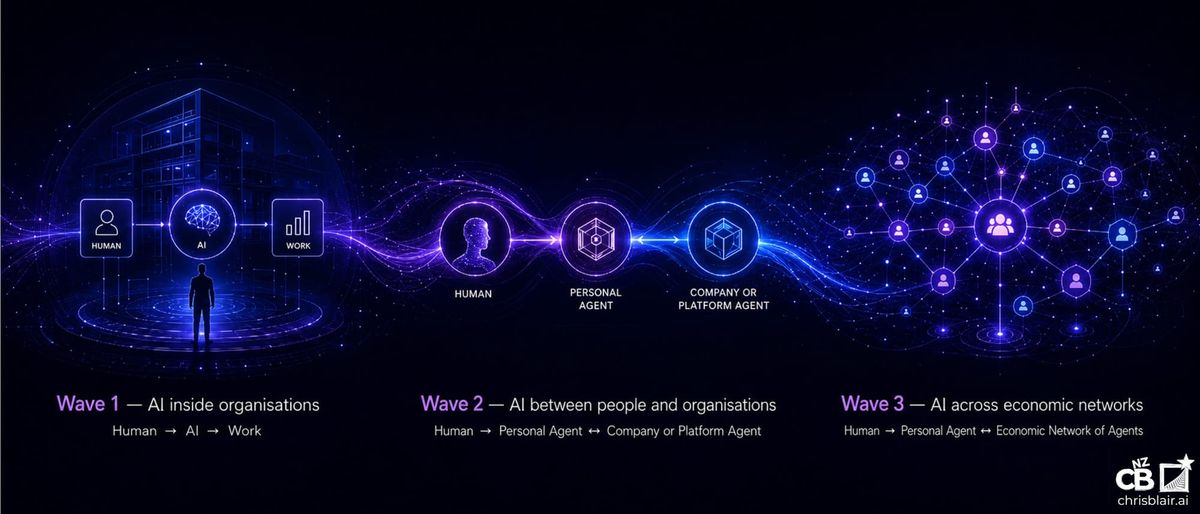
In Wave 1, AI operates primarily inside organisations, helping people improve work, decisions, services, workflows, and organisational capability.
In Wave 2, AI begins to operate between people and organisations. Personal agents, trusted representatives, organisational agents, and platforms help people discover, compare, access, purchase, and manage services.
Agent-Mediated Interaction, or AMI, describes the movement from people interacting directly with organisations toward people being supported, represented, or assisted by trusted digital agents and specialised representatives.
In Wave 3, AI participates within wider networks of agents, platforms, institutions, infrastructure, and markets that coordinate activity across many organisations at once.
WAVES is not a technology roadmap, a fixed prediction, or a rigid maturity model.
Organisations, industries, public services, and economies can experience several waves at the same time. The model helps leaders understand how the centre of coordination changes, where value moves, and what capabilities organisations and countries need to build in response.
A human-centred reading of WAVES
WAVES is a way to understand how AI changes the environment around people, organisations, services, and markets.
It does not describe a single fixed future.
It describes a set of changes that leaders, organisations, and institutions can still shape.
As AI moves from internal tools into services, interfaces, and wider economic networks, the question is not only what the technology can do.
It is also how these systems are designed around people, trust, accountability, and meaningful human agency.
In Wave 1, the aim is not to replace people with automation.
It is to redesign work so that AI can reduce avoidable effort, improve decisions, support better services, and release human capacity for judgement, relationships, creativity, innovation, oversight, and other higher-value contribution.
In Wave 2, the aim is not for AI to make untrusted decisions on a person’s behalf.
It is to explore how trusted personal agents, sector representatives, and organisational agents can help people navigate complex services while preserving human agency, consent, review, and control.
In Wave 3, the aim is not to create unmanaged autonomous markets.
It is to understand what capabilities, rules, institutions, infrastructure, and safeguards are needed as intelligent systems begin coordinating across many organisations at once.
WAVES therefore describes both an opportunity and a design responsibility.
The value of the model is that it makes these changes visible early, while there is still time to shape them around trust, accountability, human agency, institutional legitimacy, and public value.
Why WAVES is needed
Most conversations about AI adoption begin with tools.
They focus on how people can work faster, how organisations can automate tasks, and how existing processes can become more efficient.
That is where much of the immediate value is being created, but it is only the beginning of the change.
As AI systems become more capable, they do not remain confined to individual tasks or internal business workflows. They begin to operate between people and organisations, helping to discover services, compare choices, manage relationships, make recommendations, and carry out authorised actions.
Over time, these interactions extend into wider networks of personal agents, organisational agents, platforms, institutions, and infrastructure.
The central change is therefore not only from less capable AI to more capable AI.
It is a change in where intelligence operates, how agency is supported or delegated, how organisations connect with people, and where value is created and retained.
WAVES provides a way to understand this movement across three overlapping environments:
AI inside organisations
AI between people, customers, and organisations
AI across economic networks
Each wave changes the strategic questions leaders need to ask.
In the first wave, the focus is primarily on work, capability, productivity, and organisational value.
In the second, attention moves toward customer relationships, delegated authority, identity, trust, data, and control of the interface.
In the third, the larger questions concern platforms, market coordination, infrastructure, institutional participation, and where economic value accumulates.
WAVES helps make these changes visible before they are experienced only as disruption.
It allows organisations and countries to consider not just how they adopt AI, but how their position changes as AI becomes part of the environment through which work, relationships, and economic activity are organised.
This progression can already be seen in the movement from AI assistants, to task-specific agents, to collaborative agents, to agent ecosystems, and eventually to agentic interfaces.
WAVES provides a way to understand what this means for organisations, customers, platforms, public services, and national economic systems.
The three waves
Wave 1 — AI inside organisations
Human → AI → Work
Focus:
• productivity
• workflow redesign
• decision support
• custom AI systems
• organisational capability
• human and AI operating models
Primary value question:
Can AI-enabled activity be converted into sustained organisational value?
Human-centred design question:
How can AI release capacity and improve work without weakening human judgement, learning, accountability, or meaningful contribution?
Wave 2 — AI between people, customers and organisations
Human → Personal Agent ↔ Organisational Agent
This is the core environment of Agent-Mediated Interaction, where discovery, comparison, access, purchasing, service interaction, and relationship management are shaped by trusted agents and representatives acting between people and organisations.
Focus:
• discovery
• comparison
• purchasing
• service interactions
• identity and consent
• delegated authority
• agent-readable organisations
• changing customer relationships
Primary value question:
Who controls the interface, the relationship, the data, the decision rights, and the resulting margin?
Human-centred design question:
How can trusted agents support better choices while preserving human agency, consent, review, and control?
Wave 3 — AI across economic networks
Human → Personal Agent ↔ Network of Agents ↔ Organisational Agents
Focus:
• multi-agent coordination
• automated negotiation
• dynamic markets
• platform intermediaries
• resource allocation
• machine-readable trust
• institutional and national positioning
Primary value question:
Where does value accumulate when intelligent networks begin to coordinate the market itself?
Human-centred design question:
What rules, safeguards, institutions, and infrastructure are needed when intelligent systems coordinate across many organisations at once?
How the waves overlap
WAVES is not a rigid sequence or a maturity ladder.
The three waves describe overlapping environments in which AI changes work, relationships, and economic coordination. They do not suggest that every organisation, industry, or country will move through the same stages at the same speed.
A professional services firm may still be redesigning internal workflows in Wave 1 while beginning to interact with client agents in Wave 2.
A consumer may use a personal agent to compare services across several providers while continuing to deal directly with people and organisations in other parts of their life.
A public service may introduce AI into internal operations while also developing trusted digital channels through which personal, sector, or activity representatives can coordinate across multiple agencies.
The emergence of later waves does not make the earlier waves obsolete.
Wave 1 capability remains foundational. Organisations will still need well-designed workflows, reliable data, trusted systems, capable people, clear governance, and the ability to convert AI activity into sustained value.
What changes is that these foundations need to operate across organisational boundaries.
Wave 2 adds new requirements around identity, consent, authority, interoperability, trust, and agent-mediated service interaction.
Wave 3 extends those requirements into wider networks in which agents, platforms, institutions, infrastructure, and markets coordinate with one another more directly.
The waves therefore accumulate rather than replace one another.
Organisations need to strengthen internal AI capability, prepare services for agent-mediated interaction, and consider their future position within intelligent economic networks at the same time.
Trust, agency, and accountability
Human agency, trust, and accountability become more important as AI moves beyond internal tools.
In Wave 1, trust is mostly about how AI is used inside the organisation.
As agents become more capable, trust also becomes more operational.
It depends on whether agents can access the right information, act within clear authority, explain or evidence their actions, escalate uncertainty, and allow people to review, challenge, or reverse important decisions.
This includes data quality, human review, workflow redesign, governance, security, role clarity, measurement, and accountability.
In Wave 2, trust extends into the relationship between people and organisations.
For organisations, Wave 2 changes the customer question.
It is no longer only whether a website, app, call centre, or service channel works for a person. It is also whether the organisation can be understood, trusted, and acted upon by a personal agent working on that person’s behalf.
Personal agents and sector representatives can assist people, but they should operate within clear boundaries.
That means:
• verified identity
• explicit consent
• delegated authority
• clear permissions
• transparent recommendations
• validation loops
• human review and escalation
• auditability
• dispute and redress
• the ability to withdraw or change authority
In Wave 3, trust becomes a network-level issue.
The challenge is no longer only whether one model behaves safely. It is whether many interacting systems can remain predictable, accountable, secure, and aligned with human and public interests.
This is not about adding more trust layers. It is about making the foundations clearer, the connections more visible, and accountability easier to trace, challenge, and uphold as AI-mediated systems become more distributed.
This is why WAVES connects directly to Trusted by Design, Trust as New Zealand’s Economic Capability, NZ-EOS, MI-ND, and the Machine Room.
The later waves will not be made safe by AI capability alone.
They will require trusted systems, identity and authority infrastructure, assurance, cybersecurity, institutional readiness, interoperability, human oversight, legal accountability, data governance, Māori data sovereignty, public legitimacy, and practical mechanisms for review and correction.
How value changes across the waves
The form of value changes as AI moves across the three waves.
Value Dynamics provides a way to examine that change.
It asks whether AI-enabled activity is converted into usable capacity, stronger capability, better outcomes, and ultimately sustained and retained value.
That pathway is not automatic.
Time saved does not always become productive capacity. Capacity does not always become organisational capability. Capability does not always produce better outcomes. And improved outcomes do not always mean that value is retained by the organisation, community, or country that helped create it.
WAVES shows how these questions become more complex as the centre of coordination moves beyond the organisation.
Wave 1 - Value inside organisations
In Wave 1, value is created primarily through changes to work and organisational performance.
AI can reduce the time required to complete tasks, improve the quality or consistency of decisions, increase service capacity, support innovation, or enable new products and sources of growth.
The central challenge is converting these improvements into sustained organisational value.
Value appears through:
• increased capacity
• improved quality and consistency
• faster decisions and delivery
• reduced cost or risk
• stronger organisational capability
• improved customer or employee outcomes
• new products, services, or revenue
The strategic question is not simply whether AI makes an activity faster.
It is whether the organisation can convert that change into outcomes that matter and retain the resulting value.
Wave 2 - Value at the interface
In Wave 2, value begins to move toward the interfaces and representatives that connect people with organisations.
Personal agents, sector representatives, activity representatives, company agents, and digital platforms shape how people discover, compare, select, purchase, and manage services.
A representative may act across many organisations on a person’s behalf rather than connecting them directly with a single provider.
An airline representative may compare routes, prices, conditions, and loyalty benefits across multiple carriers.
A building or council representative may coordinate consents, inspections, contractors, utilities, and regulatory requirements across an entire project.
A legal representative may move between law firms, banks, insurers, trusts, estate records, and financial institutions to coordinate a person’s affairs.
In these environments, value depends on who controls:
• the customer relationship
• the point of discovery and decision
• identity and delegated authority
• access to data and context
• trust and assurance
• the rules governing participation
• the intermediary or representative layer
An organisation may deliver the underlying product or service while another party controls the interface, shapes the choice, and captures part of the value.
The strategic question becomes:
Who holds the relationship, influences the decision, and retains the value created through intermediation?
Wave 3 - Value within intelligent economic networks
In Wave 3, value accumulates within the wider systems that coordinate activity across markets.
Networks of agents, representatives, platforms, institutions, protocols, and infrastructure can negotiate, allocate, verify, and transact across many organisations at once.
Value therefore moves toward those that own or govern:
• coordination platforms
• trusted networks
• identity and verification systems
• protocols and standards
• data and model infrastructure
• compute, energy, and connectivity
• market access and orchestration layers
• the rules through which agents interact
The organisations producing a product or service may no longer occupy the highest-value position in the system.
A platform, protocol, trusted intermediary, or infrastructure provider may hold greater influence because it coordinates access, transactions, trust, and market participation across the network.
The strategic question becomes:
Where does value accumulate when intelligent systems begin to coordinate the market itself?
From activity to retained value
Across all three waves, Value Dynamics keeps attention on the full pathway:
activity → capacity → capability → outcomes → retained value
What changes is the number of actors involved and the distance between the original activity and the point at which value is finally captured.
In Wave 1, this pathway is largely managed inside the organisation.
In Wave 2, it crosses organisational boundaries and becomes shaped by agents, representatives, interfaces, identity, and trust.
In Wave 3, it extends across platforms, infrastructure, institutions, and economic networks.
This creates a larger strategic challenge.
Organisations and countries must consider not only how AI creates value, but where that value moves, who is positioned to capture it, and what capabilities are required to retain a meaningful share.
Organisational Implications
WAVES changes the purpose of organisational AI transformation.
The immediate task is to improve work inside the organisation.
Businesses need to redesign workflows, reduce avoidable effort, strengthen decision-making, improve services, and create the capability to innovate continuously.
But the longer-term aim is not simply to make the current organisation more efficient.
It is to prepare the organisation for an environment in which people are represented by personal agents, services are discovered and accessed through sector or activity representatives, and organisations participate in wider networks of intelligent systems.
This means that process redesign in Wave 1 should also create the foundations required for Waves 2 and 3.
Redesign work, not just individual tasks
AI can make isolated activities faster without changing the wider organisation.
The stronger opportunity is to redesign complete workflows, services, decisions, roles, and value pathways.
Organisations need to determine:
• where AI should assist people
• where it should recommend or generate
• where defined activities can be automated
• where authority can be delegated within clear boundaries
• where human judgement, relationships, creativity, and accountability remain essential
• how released capacity will be redirected toward higher-value work
The objective is not automation for its own sake.
It is better work, stronger services, greater organisational capability, and the capacity to keep learning and adapting.
Build continuous and governed AI capability
A small number of successful AI tools will not prepare an organisation for the wider transition.
Organisations need reusable technology, trusted data, clear governance, delivery capability, human participation, and mechanisms for learning from real-world use.
This is the role of the Studio Model.
Its leadership, domain, platform, delivery, and operational layers provide the organisational machinery through which AI opportunities can be identified, redesigned, built, governed, deployed, measured, and improved.
The result should be more than a collection of use cases.
It should be an organisation that can repeatedly convert new technical capability into better outcomes and respond as customer, market, and institutional expectations change.
Make services understandable to agents
In Wave 2, organisations need to serve people through trusted personal digital representatives.
A customer may still interact directly with a business, but their personal agent may also use an airline booking representative, a legal representative, a building or council representative, or another specialised service that coordinates across multiple organisations on their behalf.
This means products, policies, prices, terms, eligibility rules, processes, and service options need to become understandable to authorised machines as well as people.
Organisations need:
• machine-readable products, policies, and services
• structured and reliable information
• secure and well-governed interfaces
• transparent pricing, conditions, and decision criteria
• clear paths for human review and escalation
• verifiable records of decisions and transactions
Customer experience will remain important, but part of it becomes agent experience.
An organisation that is difficult for trusted agents to understand or interact with becomes less visible, less selectable, and less relevant.
Establish identity, consent, and delegated authority
Agent-mediated services require more than technical connectivity.
An organisation must know:
• who the agent represents
• what authority has been delegated
• what information the agent may access
• what decisions or transactions it may complete
• how consent can be verified or withdrawn
• when a person must review, approve, or intervene
• how actions can be explained, audited, and challenged
Identity, permissions, provenance, assurance, and accountability therefore become part of service and market design.
Trust cannot be added after the agent channel has been created. It must be designed into the way the organisation operates.
Decide what role the organisation wants to play
Waves 2 and 3 alter the position of organisations within their markets.
A business may continue to provide the underlying product or service while another organisation controls discovery, comparison, recommendation, customer access, or transaction flow.
Sector and activity representatives become valuable coordination layers because they can move across many providers on behalf of a person.
Wider platforms become more influential by coordinating agents, information, identity, trust, payments, and market access.
Organisations therefore need to decide whether they intend to be:
• a direct provider with a strong customer relationship
• an accessible supplier within another representative’s service
• a trusted sector or activity representative
• a platform or coordination provider
• a specialist capability embedded within a wider network
• an infrastructure, identity, assurance, or transaction enabler
These positions are not equally valuable.
Leaders need to understand where customer relationships, data, learning effects, influence, and margins accumulate as the market changes.
Protect against value migration
An organisation can become more efficient internally while losing strategic value externally.
It may reduce cost in Wave 1 but allow an intermediary to take control of customer discovery and choice in Wave 2.
It may provide a valuable service in Wave 3 while a platform, protocol, or coordination layer captures the relationship, the data, and the larger economic return.
Organisations should therefore identify:
• where value is currently created and retained
• which interfaces or relationships are strategically important
• where new intermediaries could emerge
• which capabilities should remain distinctive or controlled
• where partnership is more valuable than ownership
• how current investments strengthen or weaken future market position
This is where WAVES and Value Dynamics connect.
The question is not only whether AI improves performance. It is whether the organisation is building a stronger position as value moves across new interfaces, representatives, platforms, and networks.
Build for more than one wave at a time
Organisations do not need to complete Wave 1 before considering Waves 2 and 3.
They do need to make current decisions with the wider transition in view.
A redesigned workflow can also create cleaner data.
A shared platform can also provide reusable identity and authority patterns.
A new digital service can also become machine-readable.
A stronger governance model can also support bounded agent action.
A Domain Studio redesigning today’s customer journey can also consider how that journey may be navigated tomorrow by a personal agent or specialised representative.
The practical objective is to create value now while building the capabilities and strategic options needed for what comes next.
The Studio Model provides the organisational system for doing this.
WAVES explains why that system is needed.
National and Economic Implications
WAVES is not only an organisational model.
As AI moves from internal work into customer relationships, public services, markets, and wider networks, it begins to reshape national economic systems.
The central question is no longer simply whether businesses and government agencies adopt AI successfully.
It is whether a country can shape the systems through which intelligent activity is coordinated, participate in the highest-value parts of those systems, and retain a meaningful share of the resulting economic and public value.
Ownership of platforms and interfaces
In Wave 2, value shifts toward the interaction interfaces that shape how people discover, compare, access, and manage services.
These new interfaces include customers’ personal agents, sector representatives, activity representatives, marketplaces, or specialised platforms operating across many organisations.
An airline representative may coordinate across multiple carriers.
A legal representative may operate across law firms, banks, insurers, trusts, and government records.
A building or council representative may connect property owners with regulators, contractors, utilities, inspectors, and service providers.
If these representative layers are largely owned offshore, New Zealand organisations can still provide the underlying products and services while foreign platforms control customer access, data, recommendations, and transaction flows.
This creates a national value question:
Who owns the interface through which economic decisions are made?
A country that does not participate in these layers risks becoming a supplier into systems designed, governed, and monetised elsewhere.
Local versus foreign intermediation
New Zealand already depends heavily on global digital platforms for discovery, distribution, communication, commerce, and market access.
Agent-mediated markets can deepen that dependence.
The future intermediary will not simply display options. It will understand a person’s circumstances, make recommendations, negotiate terms, coordinate across providers, and complete actions on their behalf.
This can create significant convenience and new access to global markets.
It can also move influence and economic value away from local businesses, professions, public institutions, and communities.
The issue is not that every platform or agent must be locally owned.
The strategic objective is to ensure that New Zealand retains sufficient ownership, capability, bargaining power, trusted infrastructure, and market presence to participate on favourable terms.
That may include locally developed sector representatives, public-interest platforms, industry coordination services, trusted identity providers, specialised AI products, and New Zealand businesses able to scale into international markets.
Sovereign identity, authority, and trusted data
Agent-mediated systems depend on the ability to establish who an agent represents and what it is authorised to do.
This requires trusted mechanisms for:
• identity
• consent
• delegated authority
• permissions
• provenance
• verification
• revocation
• auditability
• dispute and redress
These are not only technical functions.
They determine whether people, businesses, and institutions can participate with confidence, and whether decisions made through intelligent systems are legitimate and accountable.
New Zealand will therefore need trusted identity and data arrangements that work across public and private services while respecting privacy, Māori data sovereignty, collective interests, and appropriate authority over knowledge and information.
Sovereign capability does not require isolation from global systems.
It requires maintaining meaningful control over critical decisions, relationships, information, and public responsibilities.
Compute and infrastructure
The later waves of WAVES will rely on physical and digital infrastructure.
Agent networks, intelligent public services, market platforms, real-time decision systems, and trusted data environments depend on:
• reliable, resilient, and sustainable energy
• compute capacity
• cloud and data-centre infrastructure
• high-quality connectivity
• secure data environments
• identity and trust infrastructure
• interoperable platforms and standards
• resilient operational systems
This is where WAVES connects directly to the Machine Room and MI-ND.
The apparently weightless world of intelligent agents still rests on energy, transmission, compute, connectivity, capital, and physical infrastructure.
Countries without access to these foundations may remain users of intelligence capability while paying others for the infrastructure and platforms on which it depends.
But hosting infrastructure alone is not enough.
National advantage depends on connecting infrastructure with local companies, research, skills, trusted systems, intellectual property, and access to markets.
Market access in an agent-mediated economy
Market access changes across the waves.
Today, New Zealand exporters often reach customers through distributors, digital platforms, marketplaces, search engines, professional networks, and direct sales channels.
In future, products and services will be discovered and selected by agents acting against defined preferences, rules, evidence, and trust signals.
This means New Zealand organisations need to become legible to machines as well as attractive to people.
Products, credentials, provenance, sustainability claims, regulatory status, availability, pricing, and service conditions need to be structured, verifiable, and accessible through trusted interfaces.
National market-access capability therefore includes:
• machine-readable export products and services
• digital credentials and trusted provenance
• interoperable trade and transaction standards
• cross-border identity and assurance
• agent-accessible public and commercial information
• trusted data-sharing arrangements
• representation within international platforms and protocols
Countries and industries that shape these standards early gain greater influence over how markets operate.
Those that arrive later have to accept rules designed around the priorities of others.
National value capture
WAVES makes the question of national value capture more urgent.
In Wave 1, New Zealand can gain from productivity, better services, stronger organisations, and new forms of work.
But some of that value can still flow offshore through software subscriptions, cloud infrastructure, foreign models, and imported platforms.
In Wave 2, more value moves toward those controlling customer interfaces, trusted representatives, identity, data, and transactions.
In Wave 3, value accumulates within platforms, protocols, compute infrastructure, coordination networks, and the institutions that establish the rules of participation.
A country can become more productive while still retaining only a limited share of the value created.
National strategy must therefore consider:
• where intellectual property is owned
• where companies are headquartered
• where platforms and representative layers are controlled
• where data and learning effects accumulate
• where infrastructure returns flow
• where skilled work and decision-making remain
• where tax, investment, and ownership benefits are retained
• whether local firms can reach the highest-value positions in emerging networks
This is where WAVES connects directly to Value Dynamics and NZ-EOS.
The national objective is not only to increase AI activity.
It is to convert that activity into capability, stronger industries, meaningful work, trusted institutions, export value, and prosperity that remains connected to New Zealand.
Institutional readiness
No single organisation can prepare a country for these changes.
The transition will involve government agencies, regulators, local government, businesses, iwi and Māori organisations, infrastructure providers, researchers, educators, investors, industry bodies, standards organisations, and communities.
Institutions will need to consider how existing rules apply when agents act across organisational and sector boundaries.
Questions will include:
• who is accountable when an agent acts incorrectly
• how delegated authority is recognised across services
• how personal and collective data rights are protected
• how competition is maintained when platforms control access
• how automated recommendations can be challenged
• how public services interact with trusted representatives
• how standards and protocols are established
• how local innovation can compete with global platforms
• how infrastructure and capability investments are coordinated
Institutional readiness does not mean predicting every future system in advance.
It means building the capability to observe change, coordinate across boundaries, test new approaches, establish trusted rules, and adapt as markets and public expectations evolve.
New Zealand’s strategic choice
WAVES presents New Zealand with a strategic choice.
The country can become primarily a user of agentic platforms, infrastructure, and coordination systems developed elsewhere.
Or it can build selected areas of local capability, trusted infrastructure, sector knowledge, institutional coordination, and market presence that allow it to shape and participate in the emerging system.
New Zealand will not own every layer.
Nor should it attempt to recreate every global technology domestically.
The task is to identify where local ownership, trusted governance, distinctive knowledge, infrastructure, sector strength, or public legitimacy creates strategic value.
This may include areas such as food and fibre, environmental systems, health, biotechnology, public services, identity, trusted data, legal and regulatory services, tourism, aerospace, advanced manufacturing, and specialised industry platforms.
NZ-EOS describes the national capabilities required to build and retain that value.
MI-ND describes the wider global system in which those capabilities will compete and connect.
WAVES helps explain how the location of coordination is changing, and why decisions about platforms, identity, infrastructure, institutions, and ownership need to be made before the new market structures become fixed.
How WAVES connects to the wider work
WAVES forms part of a wider body of work examining how AI is reshaping organisations, economic systems, infrastructure, trust, and the pathways through which value is created and retained.
Each model or concept addresses a different part of this transition.
The Studio Model
The Studio Model provides the organisational operating system for responding to the changes described by WAVES.
It helps organisations redesign work, build governed and reusable AI capability, support human adaptation, and develop the capacity to innovate continuously.
Its immediate focus is Wave 1, where organisations convert AI-assisted activity into better work, stronger services, and realised value.
It also helps prepare organisations for Waves 2 and 3 by making services accessible to trusted agents, establishing clearer authority and governance, and building the capability to participate in wider intelligent networks.
https://www.chrisblair.ai/studio-model/
AMI — Agent-Mediated Interaction
AMI gives a name to the Wave 2 interaction pattern described in WAVES.
It describes the change from people interacting directly with organisations toward people being supported, represented, or assisted by trusted personal agents, sector representatives, activity representatives, platforms, and organisational agents.
WAVES describes the broader progression across three waves. AMI focuses on the interaction layer where customer relationships, service access, delegated authority, trust, data, and value begin to move.
https://www.chrisblair.ai/concepts/
Value Dynamics
Value Dynamics examines how technical capability becomes meaningful and retained value.
It traces the pathway from time saved and effort reduced through to released capacity, stronger capability, better outcomes, and value that can be sustained or compounded.
Across WAVES, this pathway becomes more distributed.
In Wave 1, it occurs mainly inside the organisation.
In Wave 2, it crosses customer interfaces and intermediary relationships.
In Wave 3, it extends across platforms, infrastructure, protocols, institutions, and wider economic networks.
https://www.chrisblair.ai/concepts/#value-dynamics
NZ-EOS
NZ-EOS examines the national systems New Zealand needs to create, scale, and retain value in an AI-shaped economy.
WAVES helps explain why those national capabilities become more important as AI moves into customer relationships, markets, and economic coordination.
New Zealand will need more than organisational adoption. It will need trusted identity and data systems, infrastructure, capital, workforce capability, local platforms, institutional coordination, and pathways through which New Zealand businesses can participate in higher-value parts of emerging markets.
https://www.chrisblair.ai/nzeos/
MI-ND
MI-ND describes the wider global intelligence economy as a meshed system of compute, energy, infrastructure, capital, trust, capability, and intelligence.
WAVES describes how organisations and economies begin to operate within that emerging environment.
As activity moves from internal AI use toward agent-mediated relationships and intelligent economic networks, organisations become more directly connected to the global systems, platforms, infrastructure owners, and coordination layers described by MI-ND.
https://www.chrisblair.ai/mi-nd/
The Machine Room
The Machine Room describes the foundational infrastructure beneath the intelligence economy.
It includes energy, transmission, compute, cloud infrastructure, connectivity, cooling, data environments, trust systems, and the operational layers that allow intelligent systems to function at scale.
WAVES can appear to describe a progression toward more digital and autonomous activity, but every wave remains dependent on physical and institutional foundations.
As coordination becomes more distributed and continuous, the resilience, ownership, location, and governance of the Machine Room become more strategically important.
https://www.chrisblair.ai/machine-room/
Trusted by Design
Trusted by Design examines how trust must be built into AI systems, services, institutions, and infrastructure from the beginning.
This becomes especially important as WAVES moves beyond AI assisting people inside organisations.
In Waves 2 and 3, agents represent people, access sensitive information, make recommendations, coordinate across multiple organisations, and carry out authorised actions.
Identity, consent, delegated authority, provenance, accountability, assurance, human oversight, and redress therefore become part of the architecture of participation.
Trust is not a supporting layer added after these systems are created. It is part of what allows people, organisations, and institutions to use them with confidence.
https://www.chrisblair.ai/trusted-by-design/
Together, these bodies of work provide different views of the same transition.
The Studio Model describes how organisations build the capability to respond.
Value Dynamics examines whether that capability becomes realised and retained value.
NZ-EOS considers the national systems required to participate and compete.
MI-ND describes the emerging global environment.
The Machine Room reveals the infrastructure beneath it.
Trusted by Design establishes the conditions through which participation can remain legitimate, accountable, and worthy of confidence.
WAVES connects these layers by showing how the centre of coordination moves from work inside organisations toward relationships, markets, and wider intelligent economic networks.
Status and development
WAVES is a canonical living model.
It is intended to provide a clear way of understanding how AI may move from supporting work inside organisations toward mediating relationships and participating in wider economic networks.
The three-wave structure is not presented as a fixed prediction or a universal timeline.
Different industries, organisations, public services, and countries will experience these changes at different speeds and in different forms.
Some parts of the model are already visible through AI-assisted work, workflow redesign, personal agents, digital platforms, and emerging agent-enabled services.
Other aspects, particularly the emergence of trusted sector representatives and networks of coordinating agents, are still taking shape.
Future versions of WAVES will test, clarify, and strengthen the model as these patterns become clearer.
This may include further development of:
• the boundaries between Waves 2 and 3
• personal, organisational, sector, and activity representatives
• delegated authority and human agency
• trusted identity, consent, and assurance
• agent-to-agent transactions and coordination
• the changing role of platforms and intermediaries
• organisational readiness for agent-mediated markets
• national value capture and economic sovereignty
• practical examples across industries and public services
• the relationship between WAVES and Value Dynamics
WAVES will remain anchored in its central proposition:
AI begins as a capability used inside organisations, becomes an intermediary between people and institutions, and ultimately participates in networks that coordinate economic activity.
About the Author
Chris Blair is an AI economy and organisational transformation strategist exploring how countries, organisations, and people can navigate the systems transition into an intelligence-enabled economy.
His work connects AI operating models, infrastructure, trust, capability, economic development, Value Dynamics, and the human adaptation required as work, organisations, and institutions evolve.
WAVES is part of a broader body of work examining how AI changes work, agency, value, customer relationships, organisational boundaries, market structures, and economic coordination.
The model connects the immediate challenge of organisational AI transformation with the longer-term emergence of agent-mediated services and intelligent economic networks.
Versioning and Model Metadata
Model: WAVES
Full Name: Work, Agency, Value, and Economic Systems
Author: Chris Blair
Version: 0.1
Status: Canonical Living Model
Published: June 2026
Model Type: AI Value Evolution Model
Geographic Focus: Global
Scope: Work + Agency + Organisational AI Capability + Agent-Mediated Services + Sector and Activity Representatives + Value Dynamics + Economic Coordination + Intelligent Networks
Primary Use Case: Helping leaders understand how AI changes the location of work, agency, customer interaction, value creation, intermediation, and economic coordination across three overlapping waves
Update Model: Iterative Versioning
This is Version 0.1 of a living model.
Future iterations will expand the practical examples, sector applications, organisational implications, agent-mediated interaction patterns, trust and authority mechanisms, Value Dynamics, national economic implications, and the relationship between personal agents, sector representatives, organisational agents, platforms, and wider economic networks.
The model may also evolve as agentic technologies, organisational practice, public institutions, market structures, and the wider intelligence economy develop.
Citation
Blair, C. (June 2026).
WAVES: Work, Agency, Value, and Economic Systems. How AI Shifts the Centre of Economic Coordination from Organisations to Intelligent Networks.
Version 0.1.
ChrisBlair.ai.
chrisblair.ai/waves/