
White Paper: Trusted by Design
A Strategic Perspective on Trust and AI for Business and Public Leaders in the Intelligence Economy.

How New Zealand could build AI, data, and digital systems that people, communities, businesses, and the world can rely on
White Paper - Trust, Identity, Data Governance & AI Assurance
Chris Blair • Version 1.0 • June 2026
Executive Summary
Artificial intelligence is moving from a tool people use into part of the operating environment through which work, services, decisions, and economic activity are organised. For New Zealand, the central question is not only whether organisations adopt AI, but whether the systems around that adoption are worthy of people’s confidence.
Trust must be practical. People need to know how their information is used, when AI is influencing an outcome, who remains accountable, whether an automated or AI-supported decision can be understood and challenged, and whether essential services will remain available when providers or governments elsewhere change the conditions of access.
The immediate challenge sits inside organisations. Employees are already using AI to write, analyse, code, serve customers, automate workflows, and inform decisions. Human approval remains important, but it does not remove the need for sound data rules, clear accountability, assurance, workforce participation, and a deliberate approach to external dependency. Nor does the use of AI remove the organisation’s responsibility for how the system is selected, governed, and used. [2] [3] [5] [6] [7]
The next wave will carry trust across organisational boundaries. A person may authorise a personal AI agent to compare electricity plans, present a credential, or prepare a transaction. That agent may then interact with a company’s own system. Before such activity becomes routine, both sides will need reliable ways to establish identity, representation, authority, minimum necessary disclosure, provenance, auditability, human intervention, and recourse. [8] [9] [10] [27]
New Zealand already has parts of this trust environment: digital-identity legislation and accredited services, AI guidance for public and private sector leaders, government data stewardship, Māori data-sovereignty leadership, privacy rules for biometric processing and indirect data collection, local and hyperscale infrastructure, cybersecurity capability, and emerging sovereign-compute discussions. [4] [5] [10] [14] [15] [16] [18] [19]
This paper offers a strategic perspective on how New Zealand could strengthen its trust environment through eight connected areas of action: make the trust environment visible; classify sensitive workloads; develop usable Māori data-governance pathways; extend AI assurance into the wider economy; accelerate useful digital credentials; connect trust requirements with compute investment; design important systems for portability and continuity; and measure whether trust is becoming real.
The goal is not technological isolation or a single centralised system. It is a connected operating environment that gives people meaningful control, helps organisations innovate responsibly, recognises Māori authority, preserves national choice, and allows New Zealand to participate in the intelligence economy as a trusted and higher-value node.
What this paper argues
AI trust needs to work inside organisations and across the boundaries between people, organisations, platforms, and institutions.
As AI moves into Wave 2 and becomes embedded in services and decisions, identity, consent, delegated authority, human review, recourse, and accountability become central design requirements.
New Zealand already has many of the foundations for a trusted digital and AI environment, but they are not yet connected into one visible, usable trust environment.
Trusted by Design is not a call for more layers of bureaucracy, more credentials, or more trust theatre. The goal is not to add complexity on top of already-fragmented identity, data, assurance, and governance systems. It is to make the foundations clearer, the connections more visible, and the chain of authority, accountability, challenge, and redress easier to understand.
The opportunity is not for New Zealand to become an AI superpower. It is to become a trusted node in the global intelligence economy: a place where selected data, AI, identity, research, regulated services, Māori-governed data environments, and high-assurance digital activity can be built, governed, hosted, and taken to the world with confidence.
The argument in one line
Trust is moving from reputation to operating infrastructure: from AI inside organisations, to AI across organisational boundaries, to the identity, consent, authority, assurance, continuity, and accountability mechanisms needed for New Zealand to become a trusted node in the intelligence economy.
Who This Paper Is For
This paper is written for leaders who need to make practical decisions about AI and digital trust without becoming technical architects.
• boards and executive teams deciding where AI should be used, how it should be governed, and who remains accountable for its outcomes
• public-sector leaders shaping digital services, identity, data stewardship, procurement, and AI assurance
• iwi and Māori leaders working on data authority, stewardship, the protection of mātauranga Māori, and benefit sharing
• regulated industries managing sensitive information, consequential decisions, and operational resilience
• technology, risk, legal, privacy, security, and transformation leaders responsible for turning policy into working practice
• exporters and sector leaders considering whether trust could strengthen New Zealand’s international position
• infrastructure and investment leaders assessing the relationship between trusted workloads, cloud, compute, and national capability
What Trust Looks Like in Practice
Key idea: Trust becomes real when people can understand, rely on, question, and seek remedy from the systems that affect them.
A person should be able to use a digital service without wondering whether their information will be taken somewhere they did not agree to.
A patient should be able to benefit from AI-supported healthcare without losing confidence in who can access their most personal information.
A worker should know when an automated system is influencing a decision about them - and have a meaningful way to question it. [9] [20]
An employee should be able to use AI to improve their work without being left to guess what information can be shared, whether the output can be trusted, or who remains responsible for the result.
A customer should not be left without recourse because a company says that an incorrect recommendation, refusal, or decision was made by its AI system rather than by one of its people. [6] [9] [20]
An iwi or hapū should be able to participate in data-driven research and innovation without surrendering authority over knowledge, data, or the benefits that may result. [16] [17]
A New Zealand business should be able to tell an overseas customer not only that its technology works, but that its identity, data, AI, security, and governance practices can be relied upon.
These may appear to be different situations.
They are all questions of trust.
My companion essay, Trust as New Zealand’s Economic Capability, argued that trust may become one of New Zealand’s economic capabilities. [1]
This white paper goes one layer deeper.
Trust becomes meaningful when it shapes how systems operate: how identity is established, data is governed, decisions are explained, cultural authority is respected, sensitive workloads are protected, responsibility is carried, and essential systems remain available when conditions change.
That is the idea behind Trusted by Design.
It is not a claim that New Zealand is automatically trustworthy.
It is an ambition to build digital and AI systems that earn trust through their design, governance, relationships, and everyday behaviour.
For people, that means being able to participate with confidence. For organisations, it means innovating without outrunning their responsibilities.
For iwi and Māori organisations, it means recognising authority, rights, relationships, and stewardship from the beginning - not adding them after key decisions have been made. [16] [17]
For New Zealand, it could mean becoming a place where selected high-value digital and AI activity can be built, governed, hosted, and taken to the world with confidence.
Not trusted because we say so.
Trusted because the way the system works provides evidence.
Trust begins with people
Key idea: Trust is not only a future issue for more advanced AI systems. It begins with the tools, workflows, and decisions organisations are introducing now.
Trust is often discussed as an abstract quality. In everyday life, trust is much more practical. It is the confidence that a service will do what it says, personal information will be used fairly, and someone is who they claim to be. It means important decisions can be understood and challenged, people remain accountable when AI is involved, knowledge is not extracted without authority or benefit, institutions respond when harm occurs, and essential services remain available when they are needed. It also means new technologies strengthen people’s ability to participate rather than leaving them powerless inside systems they cannot see.
This is already an organisational challenge.
The first major wave of AI adoption is happening inside organisations. People are using AI to draft, analyse, develop software, support customers, process information, automate workflows, and inform decisions. [26] [27]
As more AI capability moves into laptops, workstations, mobile devices, and edge environments, organisations will also need to treat the employee endpoint as part of the trust environment. Poor-quality devices, weak security controls, or underpowered AI-capable hardware may limit not only productivity, but the safe and effective use of AI in everyday work. [30]
In most New Zealand organisations, people still initiate the work, review the result, and remain accountable. The organisation still decides which tools may be used, what information they can access, and where AI should influence a decision. Even at this stage, trust is essential. AI analysis can shape a manager’s judgement, a customer-service assistant can influence advice, a coding tool can introduce a vulnerability, and a productivity tool can expose sensitive information. Human approval does not remove the need to understand how AI influenced the work. [2] [3] [5] [6] [7]
Meaningful oversight also requires more than placing a person at the end of a process. That person must have the authority, information, time, and capability to question the system rather than simply approve its output. [6] [9]
Trust begins with the tools and workflows organisations are introducing now.
When these conditions are present, people and organisations are more willing to adopt services, share information, collaborate, and invest. Without them, even capable systems may fail to gain lasting acceptance.
A health provider may hesitate because data arrangements are unclear. An iwi organisation may reject a project because authority, consent, attribution, and benefit have not been addressed. A business may lose an international customer because it cannot demonstrate security, provenance, jurisdiction, or assurance. In each case, the technology may work, but the surrounding environment does not provide enough confidence to rely on it. [6] [7] [16] [18] [20]
Trust therefore cannot remain a policy statement, a compliance exercise, or a reputation inherited from the past. It has to become something people can experience in practice.
From a trusted reputation to trusted systems
Key idea: New Zealand’s trusted reputation is valuable, but future trust will depend on how digital, data, AI, identity, and infrastructure systems actually operate.
New Zealand often describes itself as a high-trust country. That reputation may help, but it is not enough.
Reputation is what others believe about us.
Design is how we shape what our systems make possible.
A country can have trusted institutions while relying on digital systems that are fragmented, difficult to understand, or dependent on arrangements outside its control.
An organisation can have a strong brand yet be unable to explain how its AI systems use data, influence decisions, or remain available.
A government can publish responsible-AI principles while citizens remain unsure where their information goes or who is accountable for an automated outcome. [2] [3]
A recent event exposed another dimension of this challenge. On 13 June 2026, New Zealand time, Anthropic said it was required to suspend access to Fable 5 and Mythos 5 after the United States government issued an export-control directive preventing access by foreign nationals, whether inside or outside the United States. [22]
The decision was made in the United States, but its effects crossed borders immediately. Organisations and users elsewhere lost access through no decision of their own governments and with little ability to influence the outcome.
The lesson extends beyond one company or government decision: an AI system can be reliable, commercially available, and embedded in organisational work, yet still be withdrawn when the state governing its provider changes the conditions of access.
This introduces another important question of trust:
Can we rely not only on how an AI system behaves, but on whether we will continue to be allowed to use it?
Trusted by Design therefore asks a more demanding question:
Can trust be built into the operating environment itself?
This does not mean creating one large, centralised national platform.
Nor does it mean that every data set, cloud service, or AI workload must remain physically inside New Zealand.
It means connecting the foundations that allow digital activity to occur with confidence:
• Digital identity and credentials
• Data rights, stewardship, and governance
• Māori data sovereignty and the protection of mātauranga Māori
• AI assurance, transparency, and accountability
• Cybersecurity and operational resilience
• Secure and sovereign compute options
• Continuity and the ability to move between providers
• Trusted institutions and clear regulation
• Practical pathways for businesses and public organisations
• International standards and interoperability
[6] [7] [10] [15] [16] [18] [19] [20]
The table below summarises these foundations in practical terms.
| Trust layer | What it helps establish | Why it matters for trust |
|---|---|---|
| Digital identity and credentials | Who someone is, what role they hold, or what they are authorised to do. | People and organisations can prove what is needed without repeatedly sharing more information than necessary. |
| Data governance | Who can collect, access, combine, reuse, retain, and benefit from data. | AI systems can be built on legitimate, explainable, and properly governed data use. |
| Māori data sovereignty | Authority, relationship, whakapapa, kaitiakitanga, consent, access, and benefit sharing. | Data and knowledge are not treated as extractable resources detached from people, place, authority, or obligation. |
| AI assurance | Testing, documentation, monitoring, review, accountability, and recourse. | Systems that influence important outcomes can be examined, challenged, and improved. |
| Security and resilience | Protection against misuse, failure, unauthorised access, and operational disruption. | People and organisations can rely on systems when they are needed. |
| Compute and infrastructure | The environments where sensitive data, models, services, and workloads are hosted and operated. | The sensitivity of the work can be matched to appropriate legal, technical, operational, and jurisdictional conditions. |
| Continuity and portability | The ability to continue, move, substitute, or recover important services and workloads. | Critical activity is not trapped inside one provider, model, platform, or foreign jurisdiction. |
| Standards and interoperability | Common ways for identity, data, assurance, and digital services to work across organisations and borders. | Trust can travel beyond one institution, sector, or country. |
New Zealand already has important parts of this environment. The opportunity is to make them more connected, visible, understandable, and usable.
The foundations are already forming
Key idea: New Zealand has many of the ingredients of a trusted AI and digital environment, but they are not yet connected into one visible and usable system.
New Zealand is not starting from zero.
The Digital Identity Services Trust Framework provides a legal foundation for accredited digital identity services. [10] That framework has now begun moving from legislation into operation. In January 2026, the Trust Framework Authority accredited New Zealand’s first provider and its first four digital identity services. The accredited services cover capabilities including identity verification, document and biometric checks, credential services, and support for customer-onboarding and compliance processes, with provider accreditation continuing until January 2029. [14]
RealMe remains an established part of the country’s identity infrastructure, while NZ Verify and wider digital-credential work point toward a future in which people and organisations can prove particular claims without repeatedly handing over more information than is necessary. [11] [12] The AML/CFT Identity Verification Code of Practice 2026 provides an early example of these foundations moving into practical use. It gives reporting entities a recognised pathway for electronic identity verification when verifying customers. [13]
New Zealand’s public service is also developing a more visible AI-governance layer through the Public Service AI Framework, responsible-use guidance, and the wider programme of work around AI-enabled public services. [2] [3]
In July 2025, the Government also released New Zealand’s first national AI Strategy alongside responsible-AI guidance for businesses. The strategy takes a light-touch, principles-based approach, working largely through existing technology-neutral law and aligning New Zealand’s direction with the OECD AI Principles. The accompanying business guidance extends the responsible-use conversation beyond government, although it remains voluntary rather than a binding assurance regime. [4] [5] [6]
That policy direction makes practical trust infrastructure more important, not less. A light-touch environment can support innovation, but it still depends on organisations being able to demonstrate how AI is governed, how identity and consent are managed, how decisions can be reviewed, how critical systems remain available, and who remains accountable when something goes wrong.
The Government Data Strategy and Roadmap connects the use of data with stewardship, public trust, Te Tiriti responsibilities, and Māori and iwi data interests. [15]
The privacy environment is also becoming more specific as automated systems collect, interpret, and exchange information about people. The Biometric Processing Privacy Code 2025 came into force for new biometric uses on 3 November 2025, with organisations already using biometric processing given until 3 August 2026 to align with it. The Code requires organisations to consider whether biometric processing is necessary, effective, and proportionate, to put appropriate safeguards in place, and to tell people when it is being used. [18]
A further change took effect on 1 May 2026. Information Privacy Principle 3A generally requires organisations to notify people when personal information about them is collected indirectly rather than directly from them, subject to specified exceptions. This becomes relevant as AI systems combine information from multiple sources and exchange it across organisational boundaries. [19]
Te Mana Raraunga, the Māori Data Sovereignty Network, has helped establish a deeper understanding of Māori rights and interests in data. Its work brings rangatiratanga, whakapapa, collective authority, kaitiakitanga, access, consent, and long-term benefit into the centre of digital governance. [16]
New Zealand is also developing local and hyperscale cloud infrastructure, sovereign-hosting options, cybersecurity capability, and the early foundations of more AI-ready compute environments. [4] [23] [24]
Around these formal systems sits a wider network of people and organisations: iwi and Māori data leaders, regulators, assurance specialists, technology providers, researchers, infrastructure operators, legal experts, public institutions, industry groups, and businesses building applied AI systems.
These developments show that New Zealand’s trust foundations are moving from principles and legislation into operational services, sector guidance, accreditation, and enforceable rules. But they do not yet operate as one easily understood trust environment.
What this means for leaders: The opportunity is not to wait for one perfect framework, but to understand which parts of the trust environment already exist and where their organisation still has gaps.
As AI begins to act for people
Key idea: As AI begins to act between people and organisations, trust must move from internal governance into identity, consent, delegated authority, auditability, and recourse.
For most organisations, the immediate task is still the first wave: using AI safely and effectively inside the organisation. But the next wave is easy to picture. [27]
Today, a person may use AI to draft an email, compare information, or prepare a question for a company. The person still carries information between systems and completes most of the coordination.
In time, that person may authorise a personal AI agent to act on their behalf within clear limits. They might ask it to find a suitable electricity plan, check eligibility, compare prices and terms, and prepare a recommendation. [8]
The personal agent may then connect with the electricity company’s own digital agent or service. The systems could exchange information, check credentials, interpret rules, and prepare a transaction for the person to approve. [8] [9] [10] [12]
This is the shift described in my WAVES model as Agent-Mediated Interaction, or AMI.
AMI describes the movement from people interacting directly with organisations toward people being supported, represented, or assisted by trusted digital agents and specialised representatives.
In Wave 2, trust becomes more important, not less. The aim is not for AI to make untrusted decisions on a person’s behalf. It is to explore how personal agents, sector representatives, organisational agents, and platforms might help people navigate complex services while preserving human agency, consent, review, and control. [27]
This is no longer only theoretical. Estonia has announced plans to introduce AI identity codes so agents can act on behalf of people, companies, or organisations within defined limits. The wider signal is clear: agent identity, bounded authority, auditability, and accountability are becoming practical design questions for digital government and digital services. [29]
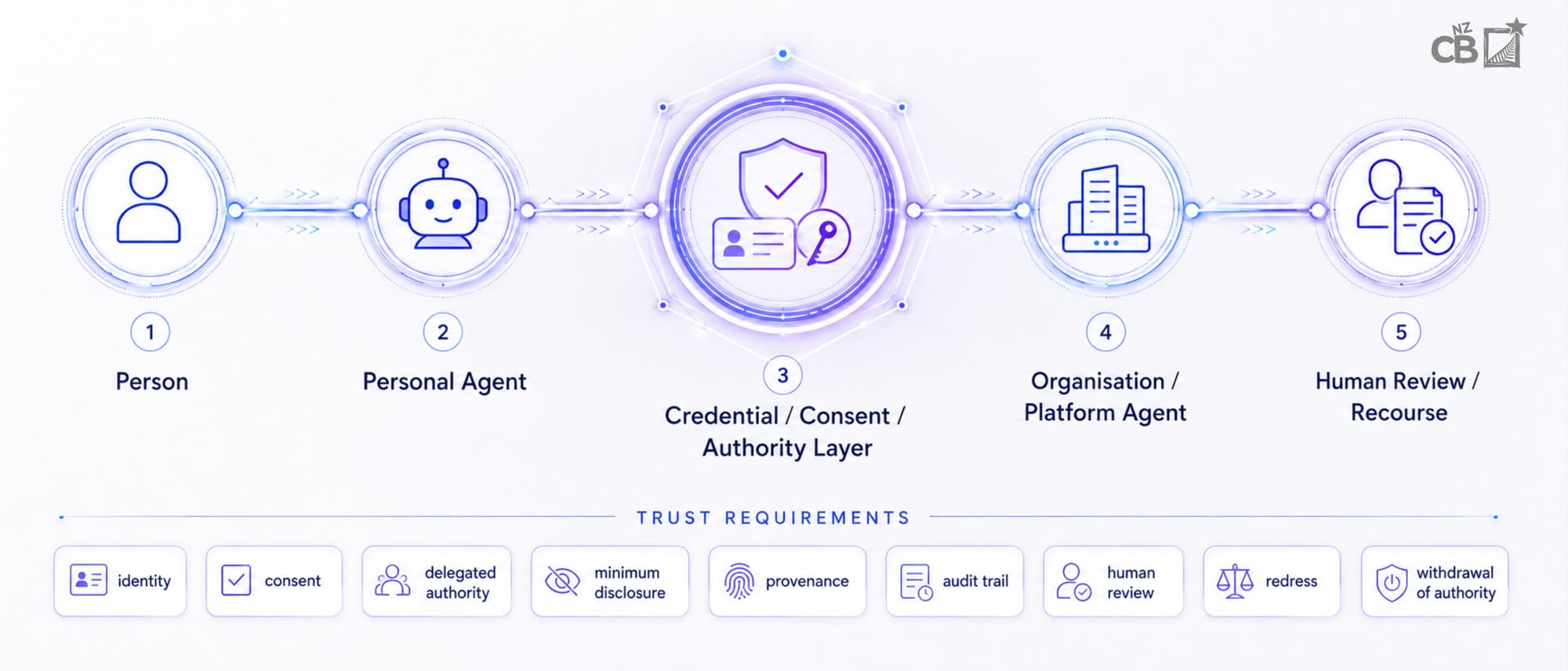
That simple interaction raises important trust questions:
• How does the company know that the agent genuinely represents the person?
• What has the person authorised the agent to see or do?
• How long does that authority last, and how can it be withdrawn?
• Which personal information is actually necessary?
• Can the company’s system trust the information and credentials it receives?
• Can the person understand why their agent recommended one option over another?
• Which organisation is accountable for each part of the interaction?
• How will responsibility be determined if the systems interact and something goes wrong?
• Can the interaction be reconstructed if the person challenges the outcome?
• When must a human step in?
[6] [8] [9] [10] [12] [13]
A simple risk scenario
A person asks a personal agent to recommend an electricity, insurance, banking, health, or government-service option. The agent compares available choices, uses information from different sources, and prepares a recommendation. The person accepts the recommendation because it appears reasonable.
Later, the person challenges the outcome.
The organisation cannot confirm what authority the agent had, what information was used, whether the recommendation was influenced by incomplete or biased data, which model or service shaped the result, whether the person understood the trade-offs, or who is accountable for the outcome.
In that situation, the problem is not only that the AI system may have made a poor recommendation. The deeper problem is that the surrounding trust environment was not designed well enough to reconstruct, explain, challenge, or remedy what happened.
That is the failure Trusted by Design is intended to prevent.
For this reason, trust becomes foundational when AI starts acting across organisations.
The systems are no longer only helping someone think or write. They are representing people, exchanging information, interpreting rules, and taking steps that can affect money, services, rights, and daily life.
Without clear identity, authority, data rules, accountability, and recourse, people will be asked to delegate important activity into systems they cannot safely understand or control. Those trust foundations need to be established before such interactions become routine. [6] [8] [9] [10]
Trusted design therefore needs to work inside organisations now and across organisations as new AI-enabled services emerge.
What this means for leaders: Organisations should start preparing now for a future in which customers, partners, employees, and citizens may be represented by trusted agents rather than only interacting through today’s websites, forms, apps, and service channels.
What a trusted national operating environment needs to do
Key idea: A trusted operating environment should make responsible digital and AI activity easier to design, govern, explain, and rely on.
Let people prove who they are without giving away more than they need to
Digital identity can help people prove a qualification, licence, entitlement, role, or authority without repeatedly submitting full identity documents.
It could support employment, education, licensing, health, financial transactions, business verification, delegated authority, regulatory reporting, and cross-border activity. [10] [11] [12] [13] [14] [31]
Identity systems must remain accessible, optional where appropriate, and designed to avoid creating new forms of exclusion. [2] [6]
Make the use of data understandable and legitimate
Data governance determines who can collect, access, combine, share, retain, license, and benefit from data. AI can find patterns, generate outputs, automate processes, and influence decisions at scale. Poor governance can therefore cause more than a privacy breach: it can create economic leakage, cultural harm, unfair outcomes, legal uncertainty, or loss of legitimacy. [15] [16] [18] [19]
Trusted data governance should make important questions easier to answer:
• Who has authority over this information?
• What was agreed when it was collected?
• Can it be used to train an AI model?
• Can it be combined with other data?
• Where will it be held?
• Who will benefit from the value it creates?
• How can consent be changed or withdrawn?
• What happens when the original purpose changes?
[15] [16] [18] [19]
These questions are not barriers to innovation. Resolving them creates the confidence needed for valuable uses of data to proceed.
As information begins to move between AI agents, platforms, data holders, and service providers, people may not always be the direct source of the information being used about them. Trusted design must therefore address not only what happens when information is first collected, but also how people are informed when it is obtained, combined, inferred, or reused elsewhere. [8] [19]
What this means for leaders: Data governance needs to move from a back-office control into a visible operating discipline that shapes how AI-enabled services are designed, explained, and trusted.
Recognise Māori authority within the system
Māori data sovereignty cannot be treated as a specialist branch of privacy or as a consultation step near the end of a project. [16] [17]
Māori data can be connected to people, whakapapa, whenua, culture, language, mātauranga, taonga, and collective identity. Authority may sit with iwi, hapū, whānau, Māori organisations, knowledge holders, or other appropriate groups - not simply with the institution holding a digital copy. [16] [17]
A trusted operating environment must therefore support practical ways to determine:
• Who has authority to approve the use of data or knowledge?
• What forms of consent and relationship are appropriate?
• What may be digitised or included in an AI system?
• Where can information be stored and processed?
• How will provenance and attribution be maintained?
• What protections are needed against unauthorised reuse?
• How will models trained on Māori data be governed?
• Who can access resulting systems or outputs?
• How will benefits be shared?
[16] [17]
Practical pathway: when Māori data or knowledge may be involved
When Māori data, mātauranga, whakapapa-linked information, iwi or hapū data, taonga, or culturally significant knowledge may be involved, teams should slow down before key design, procurement, data, cloud, or AI decisions are made.
The practical questions include:
- Who may hold authority over the data, knowledge, relationship, or context?
- What relationship is required before the work proceeds?
- What form of consent, mandate, or collective decision-making may be appropriate?
- What information may be digitised, analysed, shared, or used in an AI system?
- Where may the data be stored, processed, or accessed from?
- How will provenance, attribution, and context be protected?
- How will unauthorised reuse, model training, extraction, or onward sharing be prevented?
- Who should be able to access the data, model, system, or outputs?
- How will benefits, value, risks, and responsibilities be shared?
These questions do not replace engagement, tikanga, legal advice, or the authority of the appropriate iwi, hapū, whānau, Māori organisation, or knowledge holders. Their purpose is to bring authority, relationship, consent, storage, provenance, reuse, and benefit into the work early enough to shape the system itself. [16] [17]
This is not a distinctive New Zealand brand layered over conventional technology practice. Done well, it could also contribute to forms of governance with international relevance as indigenous peoples and communities confront similar questions about AI, data, knowledge, and authority. [16] [17]
Make AI systems open to examination
AI assurance is the practical ability to test, document, monitor, explain, challenge, and govern an AI system. It means understanding what a system is intended to do, what data it uses, where it may fail, how it is tested, what risks it creates, and who remains accountable. [2] [3] [5] [6] [7] [9]
For low-risk uses, simple documentation and monitoring may be enough. Systems influencing health, employment, finance, justice, public services, safety, or essential opportunities require stronger assurance. People affected by these systems should not be left facing a machine that no one appears able to explain. [6] [7] [9]
Trusted AI requires clear human responsibility. Someone must be able to answer:
• Why is this system being used?
• What role does it play in the decision?
• Which person or legal entity is ultimately accountable for the outcome?
• How was it tested?
• What information did it rely on?
• How are errors detected?
• Who can intervene?
• How can a person question or appeal the outcome?
[6] [7] [9]
Trust does not require every person to understand the internal mathematics of a model. It requires the institutions using that model to remain understandable and accountable.
That is especially important for automated or AI-supported decisions that affect people in practical ways. A person does not need to understand every technical detail of a model to deserve a clear explanation of how a decision was reached, what information was relied upon, who is responsible for the outcome, and how the decision can be questioned or reviewed. [6] [9] [20]
Regulators are beginning to make this responsibility more explicit. In March 2026, the United Kingdom’s Financial Reporting Council issued guidance on the use of generative and agentic AI in auditing. It emphasised that regulatory accountability for the deployment of AI and the quality of audit outputs remained unchanged: the human auditor remained accountable. [21]
The guidance applies specifically to audit firms, but the principle has wider relevance. When an organisation introduces AI into professional work or consequential decision-making, the technology should not become an accountability shield. Responsibility must remain visible within the people and institutions authorised to act, decide, and provide the service. [9] [21]
A similar signal is emerging in relation to AI-generated information. In 2026, a German court ruled that Google could be liable for false statements generated by AI Overviews, on the basis that the system produced new, substantive statements rather than merely displaying links to third-party content. Google has indicated that it will appeal the ruling, but the case reinforces the wider direction of travel: organisations that design, operate, and present AI-generated outputs may not be able to avoid responsibility simply by warning that AI can make mistakes. [28]
What this means for leaders: If an organisation’s AI system creates, recommends, summarises, or presents information that people may rely on, it needs governance, testing, monitoring, correction pathways, records, and clear accountability around that output.
Match the infrastructure to the sensitivity of the work
Not every digital workload requires the same conditions. Some services can safely use global cloud and AI platforms under standard commercial arrangements. Others may require stronger protection because of their legal, cultural, strategic, or public importance. [6] [7] [23] [24]
Health information, public identity systems, justice data, critical infrastructure, Māori-governed data, sensitive research, national-security workloads, and some regulated AI systems may require more deliberate choices about jurisdiction, access, operational control, resilience, and local capability. [6] [9] [16] [18] [20] [23]
Sovereign compute should therefore mean more than locating a data centre in New Zealand. It should mean having access to secure, governed, AI-capable environments operating under clear legal, cultural, technical, and assurance conditions. [23] [24]
The central question is not simply: Where is the server?
It is: Who ultimately controls the environment, which laws apply, who can access the workload, what external dependencies exist, and what happens when circumstances change?
AI platforms, models, cloud services, and specialised compute are becoming infrastructure on which organisations and countries depend. The Anthropic decision demonstrated how concentrated that dependency can become. [22] [23]
A foreign government did not need to disable New Zealand’s electricity, connectivity, or data centres to affect access to advanced intelligence capability. It could act at a single strategically important node: the jurisdiction governing the model provider. That decision moved through the network - from government authority, to technology company, to model access, to every foreign organisation and user relying on it. [22]
For New Zealand organisations, the lesson is not that all foreign AI services are inherently untrustworthy, or that every model must be built and hosted domestically. Critical systems should not become inseparable from a model or service that can be altered, restricted, repriced, or withdrawn by a provider or government beyond New Zealand’s control. [22] [23]
Trusted design must therefore include continuity and substitutability:
• Knowing which services and decisions depend on a particular model
• Understanding which jurisdiction ultimately governs access
• Retaining important data, prompts, evaluations, and intellectual property in portable forms
• Supporting more than one model or provider where the workload is critical
• Maintaining human and operational fallback pathways
• Considering local or open-weight models for appropriate workloads
• Ensuring that essential public or economic functions can continue when external conditions change
[6] [7] [22] [23]
The goal is not technological independence. It is enough diversity, portability, and domestic capability to preserve meaningful choice. Digital sovereignty is the ability to make deliberate choices, maintain credible alternatives, and protect essential interests when external conditions change. [23] [24]
What this means for leaders: Infrastructure decisions should be based on the sensitivity, consequence, dependency, and continuity needs of the workload, not only on cost, convenience, or vendor capability.
Allow New Zealand systems to connect with the world
A trusted New Zealand operating environment cannot become a closed domestic system. New Zealand’s identity credentials, assurance practices, privacy rules, cybersecurity expectations, and digital services need to work with international markets and standards. [6] [7] [9] [10] [12]
A qualification or licence may need to be recognised in another country. A health or research organisation may need to collaborate across borders. A digital service may need to operate across several jurisdictions while still protecting New Zealand-held data and responsibilities. [10] [12]
Interoperability allows trust to travel. Without it, New Zealand may build systems that work domestically but cannot support international participation.
The largest gap sits between the foundations
Key idea: The largest risk is not the absence of activity, but the gaps between identity, data governance, AI assurance, infrastructure, Māori authority, privacy, and continuity.
New Zealand does not lack activity. The challenge is that different parts of the trust environment have developed through separate mandates, institutions, professions, and timelines. Technology continuity and foreign dependency are often treated as procurement or architecture questions rather than matters of institutional and national resilience. [22] [23]
People experience the interfaces between these systems, not the organisational boundaries behind them. A person does not care which agency owns which component when a service fails.
A business cannot deploy a trusted AI product if identity, data rights, assurance, infrastructure, and continuity have been designed separately.
An iwi organisation cannot exercise meaningful authority if Māori governance is recognised in principle but disconnected from cloud contracts, procurement, model design, data access, or commercial arrangements. [16] [17]
A local infrastructure provider cannot invest confidently in higher-assurance environments if government, health, research, iwi, and regulated industries cannot signal the kinds of workloads they may need.
Fragmentation has a human and economic cost. It creates friction, repeated administration, slower adoption, weaker accountability, and situations in which no one appears responsible for the whole experience.
There is also a gap between rules addressing particular parts of the problem and a more complete framework for consequential automated decisions. New Zealand now has stronger protections in areas such as biometric processing and indirect collection of personal information. But as AI becomes embedded in services, employment, finance, healthcare, public administration, and other consequential settings, the question becomes broader: can people understand when an automated system has influenced an outcome, can they question it, and can an accountable institution explain what happened? The Privacy Commissioner has identified stronger protections for automated decision-making as a Privacy Act modernisation need, including risks associated with inaccurate predictions, discrimination, decisions that cannot be adequately explained, and lack of accountability. [18] [19] [20]
Privacy is only part of the challenge. Automated decision-making also affects confidence, accountability, transparency, and trust. If an AI-supported decision affects a person’s access, opportunity, treatment, money, work, services, or rights, trusted design should ensure human review, challenge, recourse, records, and institutional accountability are built into the system before it becomes normal operating practice. [6] [9] [20]
The answer is not to centralise every decision, but to make the relationships between these areas deliberate.
What this means for leaders: The hard work is not only adopting AI responsibly inside one organisation, but connecting identity, data, assurance, privacy, Māori authority, infrastructure, and accountability across the wider system.
What Trusted by Design could look like for New Zealand
Key idea: Trusted by Design should create practical pathways, not unnecessary bureaucracy.
Trusted by Design should make trust easier to achieve, not surround innovation with more paperwork.
In a light-touch AI environment, the goal should be practical pathways that help organisations act with confidence: clear identity, consent, assurance, accountability, continuity, and recourse where the consequences justify them.
1. Make the trust environment visible
New Zealand could create a practical map of its trust environment. It would show the relevant institutions, laws, identity services, Māori governance participants, assurance mechanisms, infrastructure providers, international standards, critical dependencies, and gaps. [6] [7] [10] [15] [16] [23] [24]
This would help leaders see where responsibilities sit, where relationships are weak, where dependencies are concentrated, and where people fall between parts of the system.
2. Define different classes of sensitive workload
New Zealand needs clearer ways to identify workloads that require stronger conditions. [6] [7]
A practical classification could consider the following dimensions.
| Dimension | What to ask | Why it changes the trust requirement |
|---|---|---|
| Data sensitivity and significance | Does the workload involve personal, health, financial, identity, Māori-governed, research, or strategically important data? | More sensitive or collectively significant data may require stronger governance, access control, storage, and assurance conditions. |
| Consequence of failure | What happens if the system gives the wrong answer, becomes unavailable, leaks information, or cannot be explained? | Higher consequence workloads need stronger testing, monitoring, human review, fallback, and recourse. |
| Legal and regulatory exposure | Does the workload involve regulated sectors, automated decisions, privacy obligations, safety, public services, or essential opportunities? | The organisation may need clearer records, accountability, auditability, review pathways, and evidence of due care. |
| Māori rights and interests | Are Māori data, mātauranga, whakapapa-linked information, iwi or hapū data, taonga, or culturally significant knowledge involved? | Authority, relationship, consent, provenance, access, storage, reuse, model training, and benefit sharing need to be addressed early. |
| External dependency | Does the workload depend on one model, provider, cloud platform, integration, data source, or foreign jurisdiction? | Concentrated dependency may require portability, substitutability, alternative providers, local capability, or fallback pathways. |
| Continuity need | Would public services, critical operations, customer access, safety, research, or economic activity be affected if the system became unavailable? | Important workloads should be designed so they can continue, degrade safely, or be moved when conditions change. |
| Assurance level | How much evidence is needed to show that the system is performing appropriately and can be governed? | Higher-impact systems need stronger documentation, testing, monitoring, independent review, and records of human judgement. |
[6] [7] [9] [16] [18] [20] [23]
This would turn broad claims about sovereignty into proportionate decisions about real workloads.
3. Develop repeatable Māori data-governance pathways
Strong principles need usable operating patterns.
These could include governance templates, consent and relationship processes, data-access agreements, licensing and benefit-sharing models, provenance requirements, cloud-decision protocols, audit expectations, and guidance for Māori data or mātauranga in AI systems. [16] [17]
Their purpose would be to bring the right questions, relationships, decision rights, and protections forward - while recognising that different iwi, hapū, organisations, data sets, and knowledge contexts require different approaches. [16] [17]
4. Extend AI assurance beyond the public service
The public sector is establishing valuable foundations, but the wider economy also needs practical assurance capability. [2] [3] Businesses should not need to invent an approach from scratch for every AI system. [5] [6] [7] [9]
Shared tools could include:
• AI system and model-use documentation
• Risk and impact assessments
• Data-provenance records
• Dependency and continuity assessments
• Procurement requirements
• Testing and monitoring guidance
• Independent review pathways
• Sector-specific assurance patterns
• Clear processes for people affected by automated decisions
• Named board, executive, professional, and operational accountabilities for consequential AI systems
• Evidence that human oversight is meaningful rather than procedural
[5] [6] [7] [9] [20]
The aim is assurance that supports responsible action - not documentation created only to demonstrate compliance.
Voluntary guidance can help organisations begin, especially in a light-touch policy environment. But consequential uses of AI still need clearer expectations about evidence, responsibility, independent scrutiny, human review, and recourse. The point is not to turn every AI use into a compliance project. It is to make sure systems that affect people, rights, access, safety, money, employment, public services, or essential opportunities can be examined and challenged when needed.
[5] [6] [7] [9] [20]
5. Accelerate useful digital credentials
Digital identity becomes national infrastructure when it solves real problems for people. The first accreditations under the Digital Identity Services Trust Framework show that this environment is beginning to operate, but its national value will depend on the usefulness, accessibility, interoperability, and adoption of the services that follow. Priority should go to reusable credentials that reduce repeated form-filling and document sharing across education, employment, professional licensing, business authority, finance, health, transport, and government services. [10] [11] [12] [13] [14]
Adoption depends on trust as well as technology. People must understand how credentials work, and organisations must be confident relying on them. People without suitable devices, documentation, connectivity, or digital capability must still be able to participate. [2] [6]
6. Connect trust requirements with compute investment
Higher-assurance infrastructure needs real demand. Government, health, research, regulated industries, iwi organisations, critical-infrastructure operators, and exporters should be able to signal the secure and sovereign environments they require. [23] [24]
As AI capability spreads across cloud, edge, and employee-device environments, this demand signal should include more than data centres and central platforms. AI-capable endpoints, secure local execution, device security, workforce capability, and trusted operating environments will also shape whether organisations can use AI safely and productively.
Aggregating that demand could support investment in local compute, specialist cloud environments, assurance services, cybersecurity, endpoint readiness, and operational expertise. It could also reveal where local or trusted regional alternatives are needed to reduce dependence on a single overseas provider or jurisdiction. [23] [24] [30]
Sovereign compute should not become an infrastructure project detached from the people and activities it is meant to serve. Its value lies not only in processing capacity, but in the confidence and continuity around it. [23]
7. Design important systems for portability and continuity
Organisations should identify where essential services depend on one model, cloud provider, platform, or jurisdiction. For high-impact workloads, critical data, evaluation methods, operating knowledge, and intellectual property should be portable between suitable providers. [6] [7] [22] [23]
This may involve common interfaces, independent data stores, documented fallback processes, support for multiple models, or locally operated alternatives. Where healthcare, public services, critical infrastructure, regulated decisions, research, or economically important activity is involved, continuity should be designed before disruption occurs. [6] [22] [23]
8. Measure whether trust is becoming real
Trust should not be measured only by the number of frameworks published or services accredited.
New Zealand should also examine whether:
• People understand and trust the digital services they use
• Identity systems reduce friction without increasing exclusion
• Organisations can explain and govern their AI systems
• Organisations can identify the person or entity accountable for consequential AI-supported outcomes
• Human reviewers have the authority and capability to challenge AI outputs rather than merely approve them
• Māori authority is reflected in real data and technology decisions
• Sensitive workloads have access to appropriate infrastructure
• Important systems can continue if an external provider becomes unavailable
• People can challenge consequential automated outcomes
• Businesses can demonstrate assurance to international customers
• Institutions coordinate more effectively across boundaries
• Trust is strengthening participation rather than merely protecting transactions
[2] [3] [5] [6] [7] [9] [16] [18] [19] [20]
These measures will be technical, legal, cultural, institutional, and relational. Trust is produced by the whole environment.
What leaders should do now
Trusted by Design does not require every leader to become a specialist in AI, identity, privacy, cybersecurity, cloud architecture, or data governance. It does require leaders to ask better questions earlier, connect decisions that are often made separately, and make trust part of how digital and AI systems are designed, funded, governed, and measured.
In a light-touch environment, leaders cannot rely on regulation alone to define what good looks like. They need operating disciplines that show how trust is being built into the systems their organisations use and provide.
Boards and executives
• Identify where AI is already being used in important work, decisions, customer interactions, and internal workflows.
• Make clear who is accountable for AI-supported outcomes, especially where decisions affect people, rights, access, safety, money, employment, or essential services.
• Ensure that consequential automated or AI-supported decisions have clear review, appeal, record-keeping, and accountability pathways.
• Ask whether human oversight is meaningful, or whether people are being asked to approve outputs they cannot properly examine, challenge, or explain.
• Review critical dependencies on AI models, cloud providers, platforms, data sources, and foreign jurisdictions before they become embedded in essential operations.
Public-sector leaders
• Treat digital identity, data stewardship, AI assurance, privacy, accessibility, Māori data governance, and service continuity as connected parts of public trust.
• Design AI-enabled public services so people can understand when AI is involved, how information is used, who remains accountable, and how decisions can be questioned.
• Make procurement, assurance, and architecture decisions reflect the sensitivity of the workload, not only cost, speed, or vendor capability.
• Work across agencies, regulators, iwi and Māori organisations, industry, and infrastructure providers so the trust environment becomes more visible and usable.
Business and technology leaders
• Build a practical inventory of AI systems, model use, data flows, prompts, integrations, vendors, and decision points.
• Classify AI and data workloads by sensitivity, consequence, regulatory exposure, cultural significance, and continuity risk.
• Put in place simple but repeatable assurance practices: documentation, testing, monitoring, review points, escalation paths, and records of consequential AI-supported decisions.
• Prepare for Wave 2 agent-mediated interaction by deciding how the organisation will verify personal agents, delegated authority, credentials, consent, audit trails, and withdrawal of authority. [27]
Infrastructure, iwi, and sector leaders
• Signal where higher-assurance cloud, compute, identity, data, and AI environments are needed for sensitive or strategically important workloads.
• Develop practical Māori data-governance pathways that address authority, consent, provenance, storage, access, reuse, model training, and benefit sharing from the beginning.
• Identify sector-level trust requirements that individual organisations cannot solve alone, including credentials, interoperability, assurance patterns, and continuity arrangements.
• Look for areas where New Zealand can create trusted capability that supports local needs while also strengthening export, research, regulated-service, and international partnership opportunities.
Questions for boards and executive teams
For boards and executive teams, the practical test is whether AI adoption is being matched by governance, accountability, human capability, and operating discipline.
Employees are already using AI to write, analyse, code, research, serve customers, prepare decisions, and automate work. Some organisations govern this formally; elsewhere it is emerging through individual tools, pilots, and informal experimentation. AI capability will not scale through tool adoption alone. It will scale when organisations redesign work, know where AI is being used, strengthen human capability, protect sensitive information, establish accountability, and create trusted environments for its use. [5] [6] [7] [26]
Access to powerful AI does not mean an organisation can use it safely in important work. Automation can improve speed while obscuring whether decisions are fair, or creating data, security, cultural, regulatory, dependency, and reputational liabilities. [6] [7] [8] [9]
Boards and executive teams should ask:
• Where is our most sensitive data held, and who ultimately controls it?
• What AI systems are being used in our operations and decisions?
• Can we explain what those systems do and where they may fail?
• Which people and organisations are accountable for how AI outputs are used and for the decisions that follow?
• Is human oversight meaningful, or are employees being asked to approve recommendations they cannot adequately examine or challenge?
• Are people told when AI is materially influencing a decision about them?
• Can affected people understand, question, and seek review of consequential automated or AI-supported decisions?
• Could we demonstrate the testing, monitoring, decision records, and human judgement behind a disputed outcome?
• Do we understand whether Māori rights or interests are connected to the data we hold?
• Are our identity and access arrangements proportionate and reliable?
• Does our infrastructure match the sensitivity of the workload?
• Are our employee devices, endpoint controls, and local AI environments capable enough to support trusted and productive AI use?
• Which critical processes depend on a single AI model, provider, or foreign jurisdiction?
• Could we continue operating, or move the workload elsewhere, if that access changed without warning?
• If customers or partners begin using AI agents to interact with us, how will we verify who those agents represent and what they are authorised to do?
• Could we demonstrate our practices to a regulator, customer, iwi partner, employee, or international buyer?
• Are we adopting AI faster than our governance and human capability can mature?
[5] [6] [7] [8] [9] [16] [18] [19] [20] [22] [27]
These questions reveal whether an organisation has built the conditions to move with confidence. Trusted organisations may move faster because key decisions, accountabilities, dependencies, and operating practices are already established. Trust reduces the friction created by uncertainty.
A distinctly New Zealand opportunity
Key idea: New Zealand’s opportunity is not to become the largest AI market, but to become a trusted node for selected high-value digital, data, AI, identity, and regulated-service activity.
New Zealand will not become the world’s largest AI market or outspend the largest technology powers. Its opportunity is different.
New Zealand has a combination that may become valuable:
• Relatively trusted public institutions
• A legislated digital-identity environment now moving into accredited operation
• Strong Māori data-sovereignty thinking
• Local and hyperscale digital infrastructure
• Renewable-energy potential
• Public-sector AI-governance capability and emerging business guidance
• Experience operating in regulated sectors
• Globally connected industries
• A country small enough for institutions and sectors to build meaningful relationships across the system
[4] [10] [14] [15] [16] [23] [24]
No single attribute is enough.
Together, they suggest New Zealand could become a trusted operating jurisdiction for selected data, AI, identity, research, regulated services, Māori-governed data environments, and high-assurance digital exports. [24] [25]
Not a general-purpose AI superpower, but a trusted node in a wider global network. [25]
A place where people can participate with confidence, cultural and collective rights are reflected in the foundations, and organisations can explain how important systems operate.
A place where sensitive work has appropriate infrastructure, essential functions are not tied to one foreign provider, and people can authorise digital systems without losing meaningful control.
A place where overseas partners can understand the jurisdiction, governance, standards, and assurance they are relying upon.
And where trust supports stronger institutions, safer participation, better services, and greater human agency - not only economic activity.
That is a more human and demanding ambition than simply becoming a good place to host data.
A trusted node needs operating proof: evidence that its systems can be governed, examined, protected, and sustained when conditions elsewhere change. [6] [7] [24] [25]
Trust is part of the future we are building
New Zealand’s AI future will not be defined only by how many organisations adopt AI tools.
The immediate work sits largely inside organisations. Over time, AI systems will also interact across organisational boundaries - presenting credentials, accessing services, exchanging information, and acting with limited authority for people and institutions. [8] [26] [27]
The deeper test is whether these systems strengthen people’s confidence and agency.
• Can people understand and challenge important decisions?
• Can businesses innovate while remaining accountable?
• Can organisations use more autonomous systems while keeping responsibility visible and enforceable?
• Can iwi and Māori organisations participate without losing authority over data and knowledge?
• Can a personal AI agent act for someone without exceeding its authority, exposing unnecessary information, or leaving the person unable to challenge the result?
• Can New Zealand retain meaningful choices over essential digital infrastructure and intelligence capability?
• Can public services and economically important activity continue when a foreign provider, government, or market changes the conditions of access?
• Is the value created from New Zealand’s people, data, research, culture, energy, and knowledge governed well and retained here?
[6] [8] [9] [16] [18] [19] [20] [22] [27]
These questions connect trust to the wider purpose of NZ-EOS. [24]
Energy determines what can be powered.
Compute determines what can run.
Capability determines what can be built.
Capital determines what can scale.
Trust determines what people are willing and able to rely upon.
[23] [24] [25]
Trust is not simply another technical layer. It is what gives people the confidence to participate, contribute, and belong - in their whānau, their communities, their country, and the wider world.
New Zealand already has many of the foundations. The task is to connect them so trust becomes visible in how services work, decisions are made, authority is respected, dependencies are managed, infrastructure is governed, and accountability is maintained. [4] [10] [14] [15] [16] [18] [19] [23] [24]
That is how a light-touch AI environment can remain practical without becoming passive: by making trust visible in the way systems actually operate.
Trusted by Design is not a slogan.
It is a commitment to building systems worthy of people’s confidence.
It is also a chance to show that progress in the intelligence economy need not come at the expense of agency, dignity, cultural authority, resilience, or public trust.
Designed well, these qualities can reinforce one another.
That may become one of the most important ways New Zealand builds a more capable, prosperous, resilient, and trusted future.
Short glossary
Agent-Mediated Interaction, or AMI
A shift from people interacting directly with organisations toward people being supported, represented, or assisted by trusted digital agents and specialised representatives.
AI assurance
The practical ability to test, document, monitor, explain, challenge, and govern an AI system so people and institutions can understand what it is doing, where it may fail, and who remains accountable.
Audit trail
A record of what happened in a digital or AI-supported interaction, including what information was used, what authority was given, what system or model was involved, and what decision or recommendation followed.
Consent
A person’s or group’s agreement for information, authority, or action to be used in a particular way. In some contexts, especially where collective interests are involved, consent may need to reflect relationships, mandate, tikanga, and appropriate authority.
Delegated authority
The permission given to a person, organisation, or digital agent to act within defined limits on someone else’s behalf. Trusted systems need to make clear what authority was given, what it allows, how long it lasts, and how it can be withdrawn.
Human review
A meaningful opportunity for a person to examine, question, correct, or override an AI-supported outcome. Human review requires more than a person being present; it requires authority, information, time, and capability to challenge the system.
Minimum disclosure
The principle that people should only need to share the information required for a specific purpose. For example, a person may need to prove eligibility, age, role, licence, or authority without handing over full identity documents or unrelated personal information.
Provenance
Information about where data, content, knowledge, model output, or a credential came from, how it has been changed, and whether it can be relied upon. Provenance helps people understand origin, context, integrity, and appropriate use.
Recourse
A practical pathway for a person or organisation to question, challenge, correct, appeal, or seek remedy for an outcome. Recourse is essential when AI-supported systems affect access, rights, services, money, employment, safety, or opportunity.
Sovereign compute
Secure, governed, AI-capable infrastructure that can support sensitive or strategically important workloads under appropriate legal, cultural, technical, operational, and jurisdictional conditions. It is not only about where a server is located; it is also about control, access, resilience, portability, and continuity.
Trusted node
A place, institution, sector, or system that others can rely on because its identity, data, AI, infrastructure, governance, accountability, and continuity arrangements are visible, credible, and usable.
References
[1] Chris Blair, “Trust as New Zealand’s Economic Capability.”
[2] New Zealand Government, “Public Service AI Framework.”
[3] New Zealand Government, “Responsible AI Guidance for the Public Service: Overview.”
[4] New Zealand Ministry of Business, Innovation and Employment, “New Zealand’s Strategy for Artificial Intelligence: Investing with Confidence.”
[5] New Zealand Ministry of Business, Innovation and Employment, “Responsible Artificial Intelligence Guidance for Businesses.”
[6] National Institute of Standards and Technology, “Artificial Intelligence Risk Management Framework and Generative Artificial Intelligence Profile.”
[7] International Organization for Standardization, “ISO/IEC 42001:2023 Artificial Intelligence Management System.”
[8] OWASP, “Top 10 for Agentic Applications 2026.”
[9] European Union, “Artificial Intelligence Act, Article 26: Obligations of Deployers of High-Risk AI Systems.”
[10] New Zealand Department of Internal Affairs, “Digital Identity Services and the Digital Identity Services Trust Framework.”
[11] New Zealand Government, “RealMe.”
[12] New Zealand Government, “Government App Programme and digital credentials.”
[13] New Zealand Department of Internal Affairs, “Identity Verification Code of Practice 2026.”
[14] New Zealand Department of Internal Affairs, Trust Framework Authority, “First Accredited Services Mark the Beginning of a More Secure, Privacy-Preserving Digital Identity System,” 21 January 2026.
[15] Government Chief Data Steward, “The Government Data Strategy and Roadmap.”
[16] Te Mana Raraunga, Māori Data Sovereignty Network, “Principles of Māori Data Sovereignty.”
[17] Te Mana Raraunga, “Submission on the Data and Statistics Amendment Bill,” April 2026.
[18] New Zealand Office of the Privacy Commissioner, “Biometric Processing Privacy Code 2025.”
[19] New Zealand Office of the Privacy Commissioner, “Information Privacy Principle 3A: Indirect Collection of Personal Information.”
[20] New Zealand Office of the Privacy Commissioner, “Annual Report 2024/25.”
[21] United Kingdom Financial Reporting Council, “AI in Audit: Generative and Agentic AI Guidance,” 30 March 2026.
[22] Anthropic, “Statement on the US government directive to suspend access to Fable 5 and Mythos 5.”
[23] Chris Blair, “White Paper: The Foundational Substrate Beneath the Intelligence Economy.”
[24] Chris Blair, “New Zealand Economic Operating System (NZ-EOS).”
[25] Chris Blair, “MI-ND - Meshed Intelligence Network Dynamics.”
[26] Chris Blair, “The Studio Model: An Operating System for Scaling AI.”
[27] Chris Blair, “WAVES - AI Inside Organisations, Between People and Organisations, and Across Agent-Mediated Networks.”
[28] WIRED, “A Court Has Ruled That Google Is Liable for False Statements Generated by AI Overviews.”
[29] Euronews, “Estonia creates AI ‘ID Codes’ to govern autonomous agents.”
[30] Schneider et al., "SoK: Hardware-Supported Trusted Execution Environments."
[31] Digital Identity New Zealand, "Digital Identity in Aotearoa."
About this Paper
This paper forms part of a broader body of work exploring how New Zealand can build trusted capability for the intelligence economy.
It connects NZ-EOS, MI-ND, The Machine Room, and the emerging WAVES model by examining the trust foundations needed as AI moves from supporting work inside organisations toward interacting across services, institutions, and markets.
Its focus is practical: how digital identity, data governance, Māori data sovereignty, AI assurance, infrastructure, accountability, and continuity can help people participate with confidence, organisations innovate responsibly, and New Zealand retain greater choice and agency in the systems it comes to depend upon.
Related Frameworks and Models
This paper connects the following frameworks and models:
MI-ND
MI-ND explores how intelligence, infrastructure, trust, capital, capability, and economic power are being reorganised through a connected global network of countries, companies, platforms, institutions, and technology systems.
It provides the wider global context in which New Zealand must decide where it participates, what it depends upon, and where value and influence may accumulate.
The Machine Room
The Machine Room describes the enabling infrastructure and operational systems beneath the intelligence economy.
It brings together energy, transmission, compute, cloud, connectivity, data, trust, security, and coordination capability - the often unseen foundations that determine whether organisations and countries can build and scale intelligence capability with confidence.
NZ-EOS
NZ-EOS explores how New Zealand can connect its economic engines, innovation pathways, infrastructure, trust, capital, institutions, and human capability into a more coherent national system.
Its purpose is to help New Zealand create stronger organisations and industries, retain more of the value generated here, and support a more resilient economy and better futures for people and communities.
WAVES
WAVES explores how AI adoption may move from supporting work inside organisations, to acting between people and organisations, and eventually to coordinating activity across wider networks of agents, platforms, institutions, and markets.
It helps explain why trust requirements expand as AI moves from assisting people within defined organisational boundaries toward representing them and acting across more connected economic systems.
About the Author
Chris Blair works at the intersection of AI, digital transformation, and innovation systems. His work explores how technology, infrastructure, trust, leadership, and human capability can be brought together to support stronger organisations, a more resilient New Zealand economy, and better futures for people and communities.
White Paper
Trusted by Design: A Strategic Perspective on Trust and AI for Business and Public Leaders in the Intelligence Economy
How New Zealand could build AI, data, and digital systems that people, communities, businesses, and the world can rely on
Document Type: White Paper
Author: Chris Blair
Published: June 2026
Citation
Blair, C. (June 2026).
Trusted by Design: A Strategic Perspective on Trust and AI for Business and Public Leaders in the Intelligence Economy
How New Zealand could build AI, data, and digital systems that people, communities, businesses, and the world can rely on
White Paper.
Available at: https://www.chrisblair.ai/trusted-by-design/