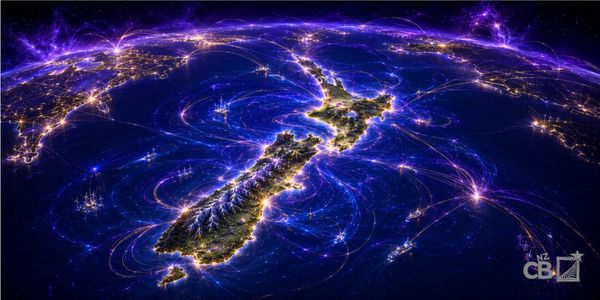
White Paper: The Foundational Substrate Beneath the Intelligence Economy
AI infrastructure is beginning to reshape New Zealand’s economic foundations. As energy, compute, and trusted operating environments converge, the question is whether New Zealand can move from hosting infrastructure to building compounding national advantage.

White Paper - AI Infrastructure, Capability & the Intelligence Economy
This white paper contributes to the infrastructure and capability layer beneath the emerging intelligence economy.
How energy, compute, trust, and sovereign capability may begin compounding into long-term national advantage.
Executive Summary
AI infrastructure is beginning to reshape the foundations of economic advantage.
For New Zealand, the question is no longer only whether more renewable generation, transmission infrastructure, cloud regions, data centres, and compute capacity can be built here. Those investments are significant. They may support regional development, digital resilience, energy demand growth, sovereign data capability, and new forms of international participation.
But infrastructure alone does not guarantee long-term value capture.
The more important question is whether New Zealand can connect the wider system around that infrastructure strongly enough for higher-order value to compound here over time. In the AI era, much of that value may form not only in the physical infrastructure itself, but in the layers that surround it: software ecosystems, trusted data environments, AI capability, research commercialisation, sovereign compute access, specialised services, capital formation, workforce concentration, institutional coordination, and export pathways.
This creates a strategic distinction.
New Zealand may become a place where AI-era infrastructure is hosted. Or it may become a trusted operating node inside the emerging global intelligence economy: a country able to combine energy, compute, trust, sovereign capability, data governance, institutional credibility, and applied AI capability into a more durable form of national advantage.
This distinction becomes significant because value in the global intelligence economy is likely to concentrate around places with the strongest surrounding operating environments. Compute workloads, capital, talent, data systems, AI capability, and trusted digital services will not simply follow infrastructure. They will cluster where energy, governance, assurance, capability, capital, and institutional confidence reinforce one another. Countries that only provide land, power, and infrastructure may capture some value. Countries that connect those foundations into capability systems may capture more of the compounding economic upside.
New Zealand has some of the early ingredients for this transition. Renewable energy potential, transmission planning, cloud and data-centre investment, digital public infrastructure, Māori data sovereignty frameworks, AI assurance work, sovereign data conversations, research capability, export ambition, and institutional trust all point toward a larger opportunity.
The risk is that these ingredients remain fragmented.
The opportunity is to treat them as parts of one connected national capability system.
This paper argues that New Zealand’s AI infrastructure conversation should therefore expand beyond data centres, energy demand, cloud adoption, and digital productivity alone. It should also ask how energy strategy, compute infrastructure, trusted operating environments, sovereign data capability, workforce development, local capital, research institutions, public-sector coordination, Māori data governance, and export systems can reinforce one another over time.
The prize is not simply to host more infrastructure.
The larger opportunity is to build the operating substrate beneath an intelligence-era economy: the connected layer of energy, compute, trust, capability, capital, institutions, and export pathways that could allow New Zealand to participate in the global intelligence economy as a higher-value, trusted, and strategically relevant node.
This paper is written for those shaping that transition.
Who This Paper Is For
This paper is written for a broader audience than the data-centre, cloud, and AI communities alone.
It is intended for leaders working across the wider system that will determine whether New Zealand captures more of the value forming around AI infrastructure, trusted data systems, sovereign capability, and the global intelligence economy.
It is especially relevant for:
• national strategy, economic development, and export leaders considering how New Zealand positions itself in the next phase of global value creation
• energy, transmission, infrastructure, and regional development leaders shaping the physical foundations beneath future compute and industrial capability
• cloud, data-centre, connectivity, and compute investors assessing where AI-era infrastructure may cluster and how higher-value ecosystems may form around it
• public-sector digital, data, and AI leaders working on trusted digital infrastructure, service modernisation, AI assurance, identity, and sovereign capability
• iwi, Māori data sovereignty, and trusted-data governance leaders shaping how data, identity, jurisdiction, tikanga, and assurance should operate in an AI-enabled economy
• exporters, industry bodies, and sector leaders considering how AI infrastructure, trusted data environments, and local capability could support higher-value international participation
• universities, research institutions, innovation ecosystems, and startup communities exploring how compute, talent, research, capital, and commercialisation pathways can reinforce one another
• boards, executives, and investors trying to understand AI not only as a productivity tool, but as a wider shift in infrastructure, capability, trust, and economic positioning
The central issue is not whether New Zealand should use AI.
That question is already being answered across organisations, sectors, and public institutions.
The deeper question is whether New Zealand can build the surrounding operating environment required to participate in the intelligence economy on stronger terms.
That means asking not only how AI is adopted, but where compute operates, how data is governed, how trust is demonstrated, how sovereign capability is developed, how capital is retained, how talent concentrates, how institutions coordinate, and how more of the resulting value can be converted into export growth and long-term national advantage.
When Energy, Compute, and Trust Begin to Converge
For years, New Zealand’s energy transition has largely been discussed through the lens of decarbonisation.
More renewable generation.
More electrification.
More transmission investment.
Lower emissions.
All of that remains necessary. But something larger now appears to be emerging beneath it.
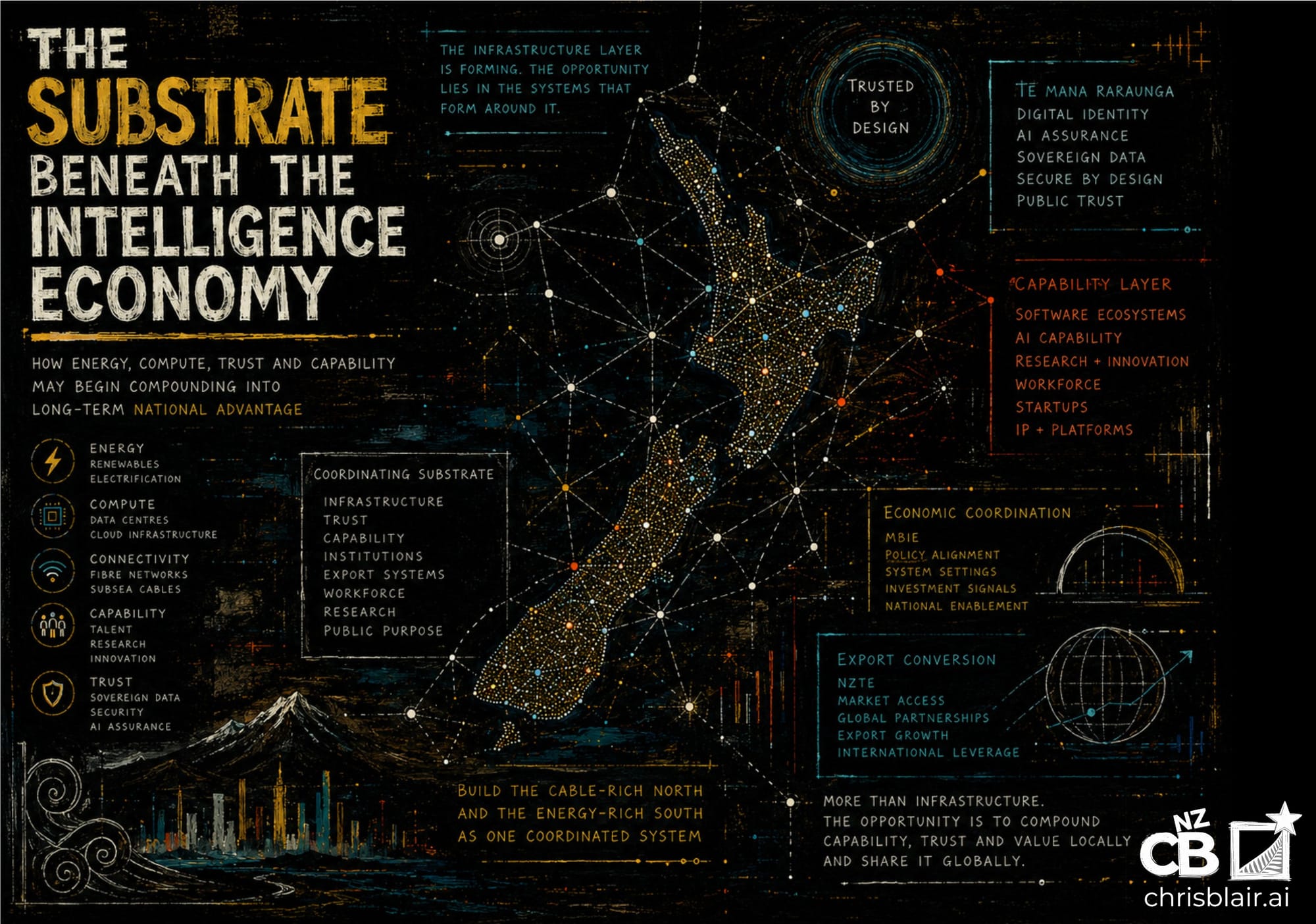
A new infrastructure substrate is beginning to form - one where energy systems, compute infrastructure, AI capability, sovereign digital systems, and trusted operating environments are starting to converge.
At first glance, many of these positive developments still appear disconnected.
Transpower’s Te Kanapu and Transmission Tomorrow work is expanding long-range future-grid planning across New Zealand. [7] [8]
Microsoft has opened a hyperscale cloud region in New Zealand, while AWS has launched its Asia Pacific (New Zealand) Region through three Availability Zones. [11] [12]
At the same time, New Zealand’s wider cloud and data-centre infrastructure layer is forming through a mix of hyperscale investment, local infrastructure providers, evolving delivery models, and growing industry recognition that data-centre infrastructure is becoming strategically important to New Zealand’s future digital economy. [11] [12] [13] [14] [15] [16] [17]
Data-centre infrastructure projects are now underway, and the wider strategic conversation is accelerating. [14] [15] [16] [17]
Datagrid’s Southland AI-factory proposal is one of the clearest current signals of this shift. The project is not yet fully proven through public hyperscaler commitments or completed construction, but recent resource-consent approvals suggest it has moved beyond a conceptual data-centre proposal and into a more serious infrastructure-development pathway. [32]
AI infrastructure demand is beginning to reshape how electricity demand, data-centre growth, and future grid capacity are being modelled and discussed. [18] [19] [20]
Sovereign-data discussions are evolving at the same time as digital identity, public-sector AI governance, and trusted digital infrastructure conversations. [18] [20] [21] [22] [24]
Individually, each development can still appear sector-specific.
Collectively, however, they are beginning to resemble the early formation of a much larger economic transition - one in which AI infrastructure is starting to change how advantage compounds within the global intelligence economy.
Historically, transmission infrastructure primarily enabled reliability, industrial development, and the coordination of electricity flows across the national grid. Now the grid is beginning to influence something else as well:
• where compute workloads operate
• where AI ecosystems cluster
• where digital capability accumulates
• and which countries become trusted operating environments - or strategic nodes inside the emerging global intelligence economy
That creates a strategic moment for New Zealand.
And potentially a more consequential one for Transpower.
Not because transmission infrastructure suddenly becomes “technology”, but because the future grid helps determine where compute, capability, and economic activity can cluster across the wider national system.
This is the kind of emerging system dynamic that MI-ND, or Meshed Intelligence Network Dynamics, is intended to help describe. The framework understands the emerging global intelligence economy as a meshed system of compute, energy, infrastructure, trust, capital, capability, and intelligence. [2]
In that context, the early question is not only whether New Zealand can build more infrastructure.
It is whether these developments are beginning to form something larger than the sum of their parts.
Energy systems, compute infrastructure, cloud regions, sovereign digital capability, trusted operating environments, workforce development, and export pathways are no longer separate conversations. They are beginning to interact as parts of the same emerging substrate.
That substrate is not purely global or purely national. It operates across both levels.
For New Zealand, the strategic task is to understand how its own national substrate can connect outward into the wider global system as a trusted, higher-value node, rather than remaining primarily a location where AI-era infrastructure is hosted.
Infrastructure Alone Does Not Create Value
The argument for building more renewable generation, transmission infrastructure, and data-centre capacity is well founded. These investments are foundational building blocks for New Zealand’s future economy.
They create:
• construction activity
• regional investment
• operational employment
• electricity demand growth
• foreign capital inflows
• digital capability uplift
The issue is not whether these investments create value. They do.
The deeper question is whether New Zealand can capture enough of the surrounding value that forms around them.
Countries can build renewable generation and still struggle to retain higher-value capability layers. Countries can host hyperscale compute infrastructure and still capture only a limited share of the wider intelligence-economy ecosystem forming around it.
The reason is simple: the largest pools of durable value often emerge above infrastructure rather than inside the infrastructure itself.
That includes:
• software ecosystems
• AI capability
• intellectual property
• specialised services
• research ecosystems
• workforce concentration
• trusted digital environments
• platform ownership
• export systems
• institutional coordination
The AI era may amplify this distinction significantly. Early signals across the global intelligence economy suggest that infrastructure can be built locally while higher-order value still compounds elsewhere - in the platforms, software ecosystems, AI capabilities, intellectual property, capital networks, and trusted operating environments that form around it. This is one of the core tension points the MI-ND framework helps make visible. [2] [27] [36] [37] [38]
The infrastructure layer powers workloads. But once ecosystem effects begin reinforcing one another, capability layers often compound faster than the infrastructure beneath them.
This is where the global “smile curve” dynamic becomes useful. The Global Value Chain Development Report 2017 describes the smile curve as a way to understand how value added is distributed across different production stages, with higher value often captured at the upstream and downstream ends of global value chains. [27]
Historically, countries that remained concentrated primarily in extraction or infrastructure layers often captured less long-term value than those that developed the surrounding systems of design, software, advanced manufacturing, services, finance, research, and intellectual property around them.
AI infrastructure may evolve similarly.
Electricity can still be sold.
Land can still be leased.
Compute workloads can still operate locally.
But much of the surrounding value may still accumulate elsewhere through:
• platform ownership
• AI model development
• software ecosystems
• data-network effects
• export leverage
• capital concentration
• ecosystem gravity
That is why the deeper strategic issue may no longer simply be:
Can New Zealand build more infrastructure?
The larger question may become:
Can New Zealand develop enough surrounding capability for more of the value forming around AI infrastructure to compound locally across longer economic horizons?
That distinction becomes significant because AI can accelerate infrastructure asymmetry - widening the gap between countries that primarily host the physical infrastructure and countries that build the surrounding capability systems needed to capture higher-order value from it.
How This Paper Complements Existing National Strategy
The perspective advanced in this paper is not intended as a rebuttal of New Zealand’s current AI and digital-strategy direction. In many ways, it is an attempt to build from that direction - extending the conversation from AI adoption and digital capability toward the infrastructure, trust, and coordination layers that may shape longer-term economic value.
The New Zealand AI Strategy, Digital Strategy for Aotearoa, digital public infrastructure discussions, and the Government’s Going for Growth agenda all help establish important foundations for New Zealand’s future digital and economic transition. [4] [5] [6] [24] [26]
These priorities remain necessary foundations:
• AI adoption
• productivity uplift
• digital capability
• innovation enablement
• public-sector modernisation
• and near-term economic growth and competitiveness
However, it is no longer only about whether local organisations and institutions can use AI more productively.
The deeper question is whether New Zealand can position itself inside the wider global intelligence economy forming around energy, compute, trusted data systems, sovereign capability, infrastructure, and applied intelligence.
Once AI begins scaling into infrastructure, energy systems, cloud ecosystems, sovereign digital capability, and trusted operating environments, the strategic question expands beyond:
How do organisations adopt AI?
toward:
How does a country position itself inside the wider global intelligence economy forming around AI infrastructure, trusted data systems, energy, compute, and sovereign capability?
That broader transition may require stronger coordination between:
• energy strategy
• transmission planning
• digital infrastructure
• sovereign capability
• trusted-data systems
• workforce transformation
• export-oriented economic positioning
Some early institutional signals may already point in this direction. The Government Chief Digital Officer function is shifting from DIA into the Public Service Commission alongside the creation of a Government Digital Delivery Agency - a subtle but potentially important shift that suggests digital capability is beginning to move closer to the centre of national coordination rather than remaining primarily a departmental technology function. [33]
Taken together, these layers may need to operate less as disconnected policy domains and more as coordinated components within a wider national capability system.
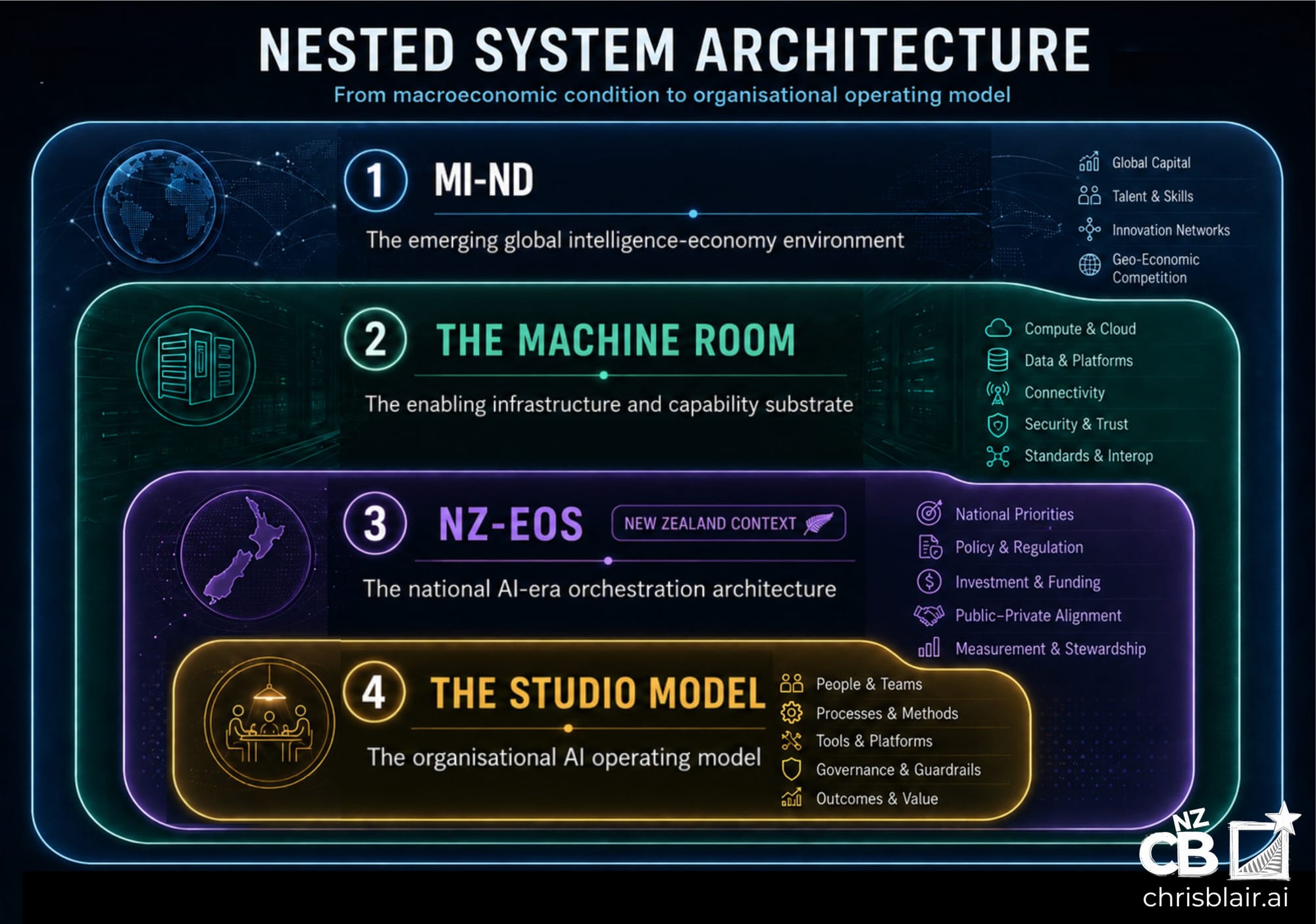
This paper should therefore be read less as an alternative strategy and more as an attempt to describe the emerging substrate beginning to form beneath New Zealand’s existing digital and economic transition - a substrate that connects The Machine Room, NZ-EOS, and MI-ND into one wider architecture of infrastructure, trust, capability, coordination, and value creation. [1] [2] [3]
The risk is not that New Zealand fails to build infrastructure. The risk is that it builds the infrastructure but fails to connect the higher-order value system that needs to form around it.
The Machine Room Beneath the Intelligence Economy
One of the strongest insights emerging across NZ-EOS and The Machine Room is that New Zealand often creates strategic ideas without fully building the operating substrate beneath them. [1] [3]
The point is not that ideas are unimportant. It is that, in the intelligence economy, ideas only become durable advantage when the underlying system is strong enough to turn them into capability.
In this paper, that substrate refers to the enabling layer now beginning to form across New Zealand: energy systems, transmission infrastructure, data centres, compute capacity, fibre connectivity, trusted digital systems, capital, talent, sovereign capability, and institutional coordination. [2] [3]
The Machine Room describes this enabling layer beneath the intelligence economy.
NZ-EOS connects that layer upward into the wider national orchestration system required to align infrastructure with research, workforce capability, sovereign data, local capital, industry strategy, AI-ready organisations, and export growth. [1] [3]
MI-ND connects the same question outward into the wider global intelligence economy. [2] [3]
New Zealand is rich in strategic concepts.
It has been less consistently strong at long-duration coordination.
In the AI infrastructure era, that familiar coordination challenge takes on new economic weight, because AI compounds clustering effects extremely quickly.
Once infrastructure, compute, talent, capital, research capability, and software ecosystems begin concentrating together in particular global locations, they can create self-reinforcing economic flywheels that become progressively harder for other countries to catch up with once those ecosystems begin consolidating at scale.
Compute capacity attracts workloads.
Workloads attract talent and specialised services.
Talent concentration accelerates software development, research activity, and startup formation.
Successful ecosystems attract more capital, more infrastructure investment, and more international relevance.
AI then accelerates many of those feedback loops simultaneously. Relatively small early advantages can eventually compound into much larger structural asymmetries through reinforcing ecosystem effects.
That makes timing consequential.
Coordination becomes a source of advantage.
Infrastructure sequencing starts to shape future economic geography.
And trusted operating environments may prove more significant than many countries currently realise.
This is why the machine room beneath the AI economy cannot be understood as one thing. It is the interaction between energy availability, transmission feasibility, compute economics, fibre connectivity, cloud ecosystems, sovereign data frameworks, capital formation, institutional coordination, export conversion systems, and trusted operating environments.
Generation capacity influences where large-scale compute can economically operate.
Transmission infrastructure influences where future industrial and AI workloads can realistically cluster.
Cloud and data-centre investment attract software ecosystems, specialised services, and AI capability formation.
Trusted sovereign-data frameworks influence where sensitive workloads, regulated services, and higher-trust digital systems can scale.
Export systems then determine whether capability formed locally can compound into durable international economic participation across longer horizons.
Most countries still discuss these layers independently. Few yet appear to be treating them as one connected economic-architecture problem inside the emerging global intelligence economy.
New Zealand has always faced coordination challenges across institutions, infrastructure horizons, investment cycles, and political timeframes. But the AI infrastructure era gives that familiar challenge new economic significance.
What is becoming visible now is not only the coordination gap, but the opportunity on the other side of it.
If energy, compute, trust, capability, capital, and export systems remain disconnected, New Zealand may still build important infrastructure without capturing enough of the higher-order value forming around it.
However, if those layers begin aligning more deliberately, they could become part of a national capability flywheel that compounds across longer economic horizons.
When Grid Infrastructure Becomes Strategic
For decades, electricity infrastructure largely sat in the background of economic strategy.
Necessary.
Foundational.
Important.
But mostly invisible.
That invisibility is starting to dissolve.
Compute infrastructure now includes cloud regions, data centres, high-performance computing capacity, AI training and inference environments, fibre connectivity, cooling systems, and the energy systems required to support them. It behaves less like traditional enterprise IT demand and more like industrial infrastructure.
That changes the strategic importance of the grid itself.
In this context, energy advantage is not only about total generation. It also depends on transmission capacity, firming, storage, demand response, flexibility, and the ability to support large, energy-intensive workloads without weakening wider system resilience.
Transpower’s work already appears to be moving in an important and constructive direction - toward a more system-oriented future-grid conversation through initiatives such as Te Kanapu, Transmission Tomorrow, long-range scenario modelling, electrification planning, future demand forecasting, and wider economic scenario analysis. [7] [8] [9] [10] [18]
Its public language has also moved noticeably toward economic positioning.
In October 2025, John Clarke, Executive General Manager Future Grid at Transpower, said:
“Electricity is a major enabler of economic growth, and the role electricity plays is only going to increase in the coming decades.” [28]
In April 2026, Transpower Chief Executive James Kilty said the HVDC link upgrade would:
“ensure Aotearoa can grow and electrify with confidence.” [29]
Those statements signal movement beyond narrow transmission framing toward wider economic positioning.
This becomes strategically significant because transmission infrastructure now shapes:
• where compute can scale
• where large workloads can operate
• where renewable-aligned infrastructure clusters form
• where industrial AI ecosystems emerge
• where future economic activity becomes geographically viable
This sequencing effect may become strategically decisive in the AI era.
Once energy availability, transmission feasibility, fibre connectivity, and compute infrastructure begin clustering together in particular regions, they can start attracting secondary layers of software capability, specialised services, research activity, and investment around them.
Datagrid’s Southland project shows how this clustering logic could begin to take shape in New Zealand.
Its emerging model brings together renewable electricity positioning, large-scale AI-oriented compute capacity, data infrastructure, natural cooling advantages, a long-duration power arrangement, and proposed trans-Tasman subsea connectivity.
If delivered at scale, that combination could help reposition Southland from an energy location into a potential infrastructure node - one capable of linking renewable electricity, compute capacity, data movement, and regional connectivity into the kind of platform from which higher-value digital services, AI capability, and export-oriented activity could eventually grow. [32]
Similar patterns are now emerging internationally as countries such as Finland, Norway, and Iceland position renewable energy, cooling advantages, subsea connectivity, and trusted operating environments as strategic foundations for large-scale AI and data-centre infrastructure within the emerging global intelligence economy. [36] [37] [38]
This is the type of global pattern MI-ND is designed to make visible: value begins to concentrate around nodes where energy, compute, trust, infrastructure, capital, capability, and intelligence reinforce one another. [2]
Eventually, infrastructure geography can begin shaping capability geography.
That is why modern data centres should not be viewed only as domestic digital infrastructure, or only through the older lens of hosting, storage, and enterprise IT capacity. In the right surrounding system, they may become part of New Zealand’s export-enabling infrastructure - supporting AI services, trusted digital products, research commercialisation, regulated workloads, and higher-value international participation.
This is no longer simply an electricity conversation. It is now becoming part of a wider infrastructure transition in which energy, compute, and national capability are beginning to converge.
The distinction here is subtle, but consequential.
Energy logic asks:
How do we supply future electricity demand?
National operating-system logic asks:
What wider economic value system becomes possible once energy, compute, capability, trust, and infrastructure begin aligning together?
Those are not the same question.
And the second question may ultimately become far more economically significant.
The Next Layer May Be Trust
The next phase of the AI infrastructure transition may not be driven by compute alone.
Trust may become one of its defining coordination layers.
Not simply cybersecurity.
And not generic AI ethics.
Something deeper across the substrate.
Trusted operating environments.
The countries that become strategically relevant in the intelligence economy may not simply be the ones with cheap power or abundant compute.
They may instead be the jurisdictions capable of supporting trusted operating environments for AI, data, and digital systems at scale.
In that sense, trust begins evolving from a governance conversation into part of the wider economic infrastructure layer.
In the AI era, trust may begin operating less like a soft institutional characteristic and more like a functional capability layer with interoperable components such as:
• digital identity systems
• sovereign data governance
• AI assurance and auditability frameworks
• cybersecurity and legal-jurisdiction standards
• regulated AI operating environments
• secure sovereign compute capability
• cross-border interoperability mechanisms
• trusted institutional coordination
• high-trust digital-service ecosystems
Over time, this may require a more deliberate sovereign compute capability layer: not simply domestic data-centre capacity, but trusted access to AI and high-performance compute environments that can support exporters, researchers, public-sector services, Māori data governance, health, and regulated industries.
Seen this way, trust becomes less about abstract ethics and more about whether governments, institutions, businesses, and international partners can reliably operate sensitive AI, data, and digital workloads inside a trusted national environment at scale.
This could become especially powerful in sectors where New Zealand already has credibility. Food and fibre, including dairy, meat, wool, forestry, horticulture and premium food; agritech and biosecurity; health, education, financial services and environmental systems; advanced manufacturing; public-sector capability; indigenous knowledge partnerships; regulated digital services; and emerging digital and AI exports across SaaS, platforms, and vertical AI could all be strengthened by a trusted operating environment that allows sensitive data, AI assurance, sovereign capability, and international confidence to work together.
The opportunity is not simply that these sectors use more AI. It is that they could build more trusted AI-enabled services, products, platforms, assurance models, and export propositions from New Zealand, because the surrounding operating environment gives customers, partners, regulators, investors, iwi, institutions, and international markets more confidence in how those systems are built, governed, and scaled.
This is where a national trusted operating environment could become a force multiplier for New Zealand. Not as one monolithic system, but as a connected architecture of trusted operating environments across sectors, institutions, data domains, compute environments, and regulated workloads. Regulated AI systems, sovereign workloads, digital public infrastructure, Māori data governance, research environments, and cross-border intelligence services may ultimately require places capable of demonstrating operational trust — not merely asserting it.
New Zealand may possess unusual structural advantages here.
Not because it is the largest market.
But because it has the potential to evolve into a highly trusted operating environment inside the global intelligence economy.
Important elements of this emerging trust layer are already beginning to exist across New Zealand’s institutional landscape.
That includes:
• Te Mana Raraunga and Māori data sovereignty frameworks [21]
• the Digital Identity Services Trust Framework [22]
• Digital Identity New Zealand’s trust, assurance, and identity ecosystem work [23]
• public-sector AI governance and assurance work [24] [25]
• government data-system strategy and stewardship [26]
• service-modernisation work across reusable components, identity, data, digital, security, and AI foundations [25]
Together, these do not yet constitute a fully integrated national trust architecture.
But they may represent the early foundations of a sovereign capability layer capable of supporting trusted participation inside the meshed global intelligence economy that MI-ND describes. [2]
At present, however, many of these trust and sovereign-capability conversations still remain only partially integrated into the wider energy-and-compute buildout now occurring across New Zealand - an emerging pattern explored earlier in The Edges of New Zealand’s AI Energy Blueprint Are Forming. [30]
The larger strategic opportunity may ultimately emerge from whether those layers can begin coordinating more coherently as the wider system matures.
Because trusted operating environments now influence:
• where sensitive workloads can operate
• where sovereign AI systems can scale
• where regulated digital services cluster
• which countries become trusted nodes within the wider intelligence economy
Infrastructure may power the system.
But trust may ultimately shape where the higher-order value accumulates around it.
The System Is Not Fully Connected Yet
Here in New Zealand, the edges of a new infrastructure layer are beginning to form.
Energy.
Transmission.
Compute.
Cloud infrastructure.
Trusted digital systems.
Sovereign capability discussions.
Long-range future-grid planning.
If you look closely, the early architecture of something larger is starting to become visible.
But this still does not yet appear to be a fully connected national system.
At present, many of these conversations continue to occur independently:
• energy planning
• digital strategy
• AI capability
• infrastructure investment
• sovereign-data governance
• export growth
• workforce transformation
That is why the next phase may require more than infrastructure delivery alone.
It may require a stronger coordination layer between the institutions already shaping different parts of the system.
The opportunity is not to centralise everything, but to make the key layers more visible, connected, and mutually reinforcing.
Transpower's strategic role is becoming more visible because future-grid infrastructure helps determine where large-scale electrification, compute demand, and energy-intensive capability can realistically form.
MBIE's role is significant because policy, innovation, infrastructure, digital capability, and growth settings need to become more closely aligned around the same long-term economic direction. [4] [6]
The Public Service Commission becomes relevant because the shift of the Government Chief Digital Officer function and the formation of a Government Digital Delivery Agency suggest digital capability is starting to move closer to the centre of public-sector coordination. Over time, that may influence how interoperable digital systems, AI governance, reusable platforms, identity infrastructure, and cross-agency capability formation evolve across the wider national system. [33] [34] [35]
NZTE has a particular role because national capability only becomes durable economic value when it can be connected to export systems, international relationships, market access, and scalable global participation. Its experience helping New Zealand firms grow internationally could become an important bridge between emerging national capability and the global markets where that capability needs to compete. In that sense, the infrastructure question eventually becomes an export question: what can New Zealand build, operate, govern, and sell into the world from the capability layer forming around AI-era infrastructure? [1] [6] [31]
The wider trust and sovereign-data layer is also central because sensitive AI workloads, regulated digital services, and sovereign capability will depend heavily on trusted operating environments — not simply available infrastructure. [21] [22] [24] [25] [26]
This is where the deeper opportunity begins to appear.
New Zealand is not only building parts of an energy transition.
It may also be laying parts of the foundational substrate beneath New Zealand’s future participation in the wider intelligence economy.
The challenge now is whether these emerging layers can become sufficiently interconnected for infrastructure, capability, trust, and economic value to begin reinforcing one another across longer horizons.
The deeper opportunity may therefore emerge less from any single infrastructure investment in isolation, and more from whether New Zealand can connect energy systems, compute infrastructure, trusted sovereign capability, workforce development, institutional coordination, and export conversion into a self-reinforcing national capability flywheel.
The countries that benefit most from the intelligence economy may not simply be the ones that build infrastructure. They may be the ones that build the surrounding systems strongly enough for capability, trust, talent, software, research, and export value to keep accumulating locally around AI-era infrastructure across extended economic cycles.
This becomes especially important as New Zealand orients around the ambition to significantly expand long-term export capacity, including the Government’s goal of doubling export value by 2034, while also positioning for the much longer economic transition now beginning to form around AI, energy, compute, and trusted digital infrastructure. [6]
Achieving these ambitions will likely require more than building infrastructure, capturing the direct economic uplift from data-centre construction and operation, or realising productivity gains as local organisations and institutions embed new AI tools into their work.
It will depend on whether New Zealand can coordinate the surrounding capability layer strongly enough for more of the value forming around AI-era infrastructure to be created, retained, and exported from here.
That may ultimately become the real distinction: whether New Zealand mainly hosts AI-era infrastructure, or whether it builds the surrounding capability system needed to turn that infrastructure into durable export value.
In New Zealand, the infrastructure transition is already underway.
The next task is to connect those emerging layers more deliberately - linking Transpower’s future-grid role, MBIE’s system-policy settings, NZTE’s export-growth mandate, the Public Service Commission’s evolving digital-coordination role, and the country’s emerging trust and sovereign-capability foundations into a more coherent national capability system.
New Zealand’s long-term opportunity may no longer sit only in building infrastructure for the intelligence economy.
It may ultimately sit in whether the country can become a trusted operating node capable of converting that infrastructure into compounding national capability, export growth, and long-duration economic advantage - before the wider global intelligence landscape hardens around us.
References and Signals
[1] Chris Blair - New Zealand Economic Operating System (NZ-EOS)
Framework outlining the national economic architecture for AI-enabled competitiveness, including energy, sovereign data and IP, local capital feedback loops, AI-ready workforce, custom AI software, and export positioning.
[2] Chris Blair - MI-ND: Meshed Intelligence Network Dynamics
Framework describing the emerging global intelligence-economy environment as a meshed network of compute, energy, infrastructure, trust, capital, capability, intelligence, and connected nodes.
[3] Chris Blair - The Machine Room
Emerging concept exploring the infrastructure and capability substrate beneath the intelligence economy, including energy, compute, data centres, digital infrastructure, capital, trust, talent, and operating capability.
[4] MBIE - New Zealand’s Strategy for Artificial Intelligence: Investing with Confidence
New Zealand’s AI strategy, released in July 2025, with an emphasis on AI adoption and application.
[5] Digital.govt.nz - Digital Strategy for Aotearoa and Action Plan
Digital Strategy for Aotearoa and Action Plan context for New Zealand’s digital transition.
[6] MBIE - Going for Growth: Promoting Global Trade and Investment
Source for the Government’s target to double the value of New Zealand’s exports by 2034.
[7] Transpower - Te Kanapu
Transpower’s future grid blueprint initiative for what the national grid may need to look like in 2050.
[8] Transpower - Transmission Tomorrow
Transpower’s strategic transmission-planning context and future-grid publications.
[9] Transpower - Whakamana i Te Mauri Hiko
Strategic work on New Zealand’s electrification and energy future.
[10] Transpower - Future Direction: Our Energy Scenarios
Te Kanapu scenario work describing potential future electricity needs and economic futures for Aotearoa New Zealand.
[11] Microsoft - New Zealand’s First Hyperscale Cloud is Open for Business
Source for Microsoft’s New Zealand hyperscale cloud region opening in December 2024.
[12] AWS - Now Open: AWS Asia Pacific (New Zealand) Region
Source for the AWS Asia Pacific (New Zealand) Region opening in September 2025 with three Availability Zones.
[13] Data Center Dynamics - AWS took NZ$45m hit over dropped data center in Auckland, New Zealand
Source for the latest reporting that AWS has shifted away from a planned Auckland greenfield data-centre build while continuing to invest in New Zealand through leased third-party data-centre capacity.
[14] BCG - Data Centres as Strategic Infrastructure: Unlocking Value for New Zealand
Source for the strategic-infrastructure framing of data centres and the potential NZ$70 billion opportunity.
[15] NZTech / CDC - Empowering Aotearoa New Zealand’s Digital Future: Our National Data Centre Infrastructure
Industry report on the role of data centres as crucial infrastructure for New Zealand’s digital economy.
[16] Datagrid - Datagrid Data Centre Park, Makarewa, Southland
Datagrid describes its Makarewa, Southland Data Centre Park as a major digital infrastructure hub located close to renewable baseload energy.
[17] Environment Southland - Datagrid NZ Partnership Limited Resource Consents
Environment Southland confirmed that resource consents associated with establishing and operating Datagrid’s datacentre near Makarewa were granted on 13 March 2026.
[18] MBIE - Electricity Demand and Generation Scenarios
Official New Zealand source for electricity demand and generation modelling out to 2050.
[19] MBIE - Electricity Demand and Generation Scenarios 2024 Report
Detailed EDGS 2024 report and scenario modelling.
[20] International Energy Agency - Energy demand from AI
Global reference on the interaction between AI, data-centre growth, electricity demand, and energy systems.
[21] Te Mana Raraunga - Māori Data Sovereignty Network
Source for Māori Data Sovereignty and the principle that Māori data should be subject to Māori governance.
[22] Digital.govt.nz - Trust Framework for Digital Identity
Source for New Zealand’s legal framework for accredited digital identity services.
[23] Digital Identity New Zealand - Digital identity, trust, and assurance ecosystem
Digital Identity New Zealand brings together Aotearoa’s digital identity, trust, and assurance community to advance an open, interoperable digital identity ecosystem grounded in governance, legal certainty, and public trust.
[24] Digital.govt.nz - Public Service AI Framework
Source for responsible AI use across the New Zealand Public Service.
[25] Digital.govt.nz - Service Modernisation Roadmap v2
Source for reusable digital components, data, digital and security foundations, AI reference architecture, and digital identity initiatives.
[26] data.govt.nz - Government Data Strategy and Roadmap 2021
Source for the refreshed Government Data Strategy and Roadmap for Aotearoa New Zealand, published by Stats NZ.
[27] World Bank / WTO / IDE-JETRO / OECD / UIBE - Global Value Chain Development Report 2017
Reference for global value chains, value-added distribution, and the smile-curve framing.
[28] Transpower - Feedback wanted on Aotearoa’s electricity needs in 2050
Source for John Clarke’s statement that electricity is a major enabler of economic growth.
[29] Transpower - Transpower receives draft approval for $1.1 billion HVDC upgrade
Source for James Kilty’s statement that the HVDC upgrade will help ensure Aotearoa can grow and electrify with confidence.
[30] Chris Blair - The Edges of New Zealand’s AI Energy Blueprint Are Forming
Prior essay in this body of work connecting energy, compute, trust, and New Zealand’s emerging AI infrastructure context.
[31] NZTE - Statement of Intent 2022–2026
NZTE’s Statement of Intent outlines how the agency plans to help New Zealand businesses grow internationally, including its strategy, operating model, organisational culture, and performance measures.
[32] IT Brief New Zealand - Datagrid signs 140MW deal to power Southland AI campus
Source for Datagrid’s 140MW, 15-year power purchase option agreement with Mercury, its planned AI-focused Makarewa data-centre campus, resource-consent milestone, and proposed Tasman Ring Network connectivity.
[33] https://www.beehive.govt.nz/release/digital-transformation-accelerates
Public Service Commission / NZ Government - Digital Transformation Accelerates
Source covering the transfer of the Government Chief Digital Officer function and establishment of the Government Digital Delivery Agency.
[34] https://www.digital.govt.nz/digital-government/strategy/digital-public-service-strategy/
Digital.govt.nz - Digital Public Service Strategy
Source outlining coordinated digital-government capability, interoperability, service modernisation, and public-sector transformation.
[35] https://x-road.global/
X-Road / Estonia Digital Infrastructure
Reference for how interoperable digital capability evolved into national infrastructure and long-term coordination architecture in Estonia
[36] https://nebius.com/newsroom/nebius-to-construct-310-mw-ai-factory-in-finland
Nebius - Nebius to construct 310 MW AI factory in Finland
Source on Finland’s development of large-scale renewable-powered AI infrastructure and compute capacity.
[37] https://www.reuters.com/technology/aker-nscale-openai-plan-1-bln-norway-ai-facility-2025-07-31/
Reuters - Aker, Nscale, OpenAI plan $1 billion Norway AI facility
Source on Norway’s renewable-energy-aligned AI gigafactory and sovereign compute positioning.
[38] https://observer.com/2025/11/iceland-renewable-ai-infrastructure/
Observer - Why Iceland Is Becoming a Model for Renewable-Powered AI Infrastructure
Source on Iceland’s emergence as a trusted renewable-powered AI and data-centre infrastructure location.
About this Paper
This paper forms part of a broader body of work examining how leaders, organisations, and countries can move beyond AI experimentation toward real, system-level value.
It connects The Machine Room, NZ-EOS, and MI-ND by focusing on the infrastructure, governance, trust, and capability layers required for New Zealand to participate more meaningfully in the emerging global intelligence economy.
Related Frameworks
This paper connects the following frameworks:
MI-ND
MI-ND explores how compute, energy, infrastructure, trust, capital, capability, and intelligence are forming a meshed global system that is reshaping economic power, value creation, and national advantage.
The Machine Room
The Machine Room describes the infrastructure and capability substrate beneath the intelligence economy, connecting energy, compute, data, trust, capital, and operating capability.
NZ-EOS
NZ-EOS is a national economic operating system exploring how infrastructure, capability, trust, capital, and coordination can shape New Zealand’s AI-era growth.
About the Author
Chris Blair works at the intersection of AI, digital transformation, and innovation systems, exploring how organisations and countries transition into more intelligence-native forms of capability.
His work connects AI, energy, compute, infrastructure, sovereign capability, trust, organisational transformation, and long-term economic value creation.
White Paper
The Foundational Substrate Beneath the Intelligence Economy
How energy, compute, trust, and sovereign capability may begin compounding into long-term national advantage
Document Type: White Paper
Author: Chris Blair
Published: May 2026
Citation
Blair, C. (May 2026).
The Foundational Substrate Beneath the Intelligence Economy: How energy, compute, trust, and sovereign capability may begin compounding into long-term national advantage.
White Paper.
Available at: https://www.chrisblair.ai/intelligence-economy-substrate