AI Is Becoming Core Infrastructure
AI is no longer just software. It’s becoming the infrastructure that economies will run on. As compute scales, the conversation shifts from tools and models to energy, systems, and economic capability - reshaping how growth is created and where value accumulates.

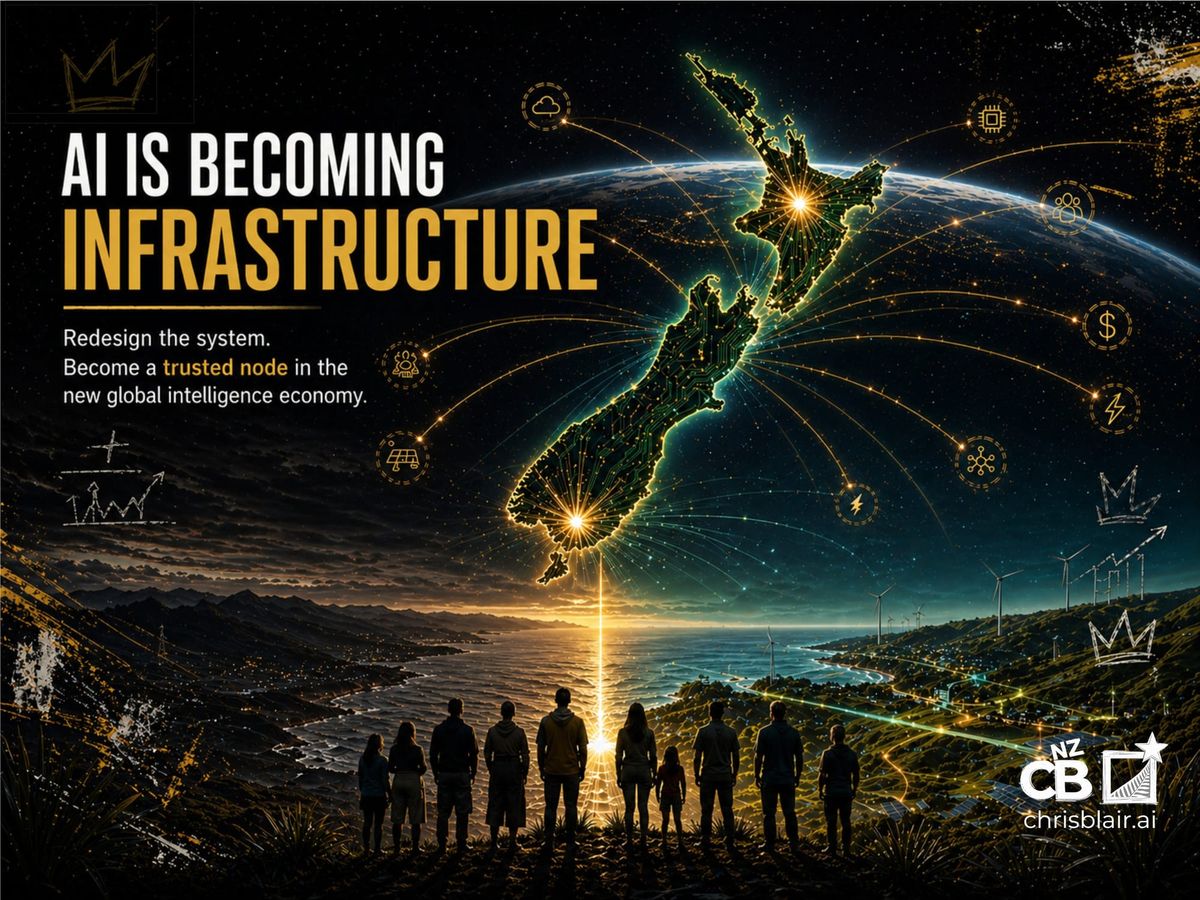
Part of a broader body of work on how AI, infrastructure, and capability are reshaping New Zealand’s future.
The global shift from software to infrastructure - and why it changes everything
A new pattern is starting to emerge.
If growth is really a system problem…
and infrastructure quietly determines what’s possible…
then something bigger is happening.
The infrastructure itself is changing.
Globally.
And it’s happening faster than most countries are prepared for.
The shift most people are still underestimating
AI is no longer just software.
It’s becoming physical infrastructure.
Datacentres.
Energy systems.
Specialised chips.
Global fibre networks.
Quantum computing.
Even compute in space.
This is starting to look less like IT…
and more like the industrial foundations of a new economy.
This is not theoretical anymore
The scale is no longer abstract.
Cloud companies are investing hundreds of billions into compute infrastructure.
Entire regions are being reshaped around data centres and energy supply.
And governments are starting to treat compute as a strategic asset.
This is not a future trend.
It’s an active global build-out.
Even Boston Consulting Group now frames data centres as strategic national infrastructure:
https://www.bcg.com/publications/2026/data-centres-as-strategic-infrastructure
This is one signal among many.
But data centres are not the system.
They are a visible entry point into something much larger.
What needs to be created is an interconnected architecture - where energy, compute, data, identity, capital, and capability operate as one.
That is the shift.
From isolated infrastructure bets…
to coordinated AI infrastructure systems that determine which nations can participate - and which cannot.
The uncomfortable truth
The next wave of economic advantage won’t come from who uses AI best.
It will come from who builds the infrastructure that powers an interconnected AI economic system.
And that changes the conversation again.
Because now this isn’t just about organisations.
It’s about nations.
Infrastructure is becoming the constraint
One of the clearest signals of this shift is not coming from AI companies.
It’s coming from energy systems.
In the United States, data centre demand has grown so quickly
that the grid itself is becoming a bottleneck.
AI compute demand is now colliding with physical grid limits.
This is already starting to surface in the real world - as highlighted in this recent reporting:
https://edition.cnn.com/2026/04/23/business/ai-compute-power-electricity-grid
This is where the constraint shows up first.
Because once infrastructure becomes constrained…
everything upstream becomes constrained.
The global pattern is forming
At the same time, other countries are moving deliberately.
Not just reacting - but designing for it.
Finland, for example, is aligning:
• Renewable energy
• Transmission investment
• Data centre strategy
• Sovereign compute capability
into a coordinated national system.
Here’s a view into how that is being planned and executed:
https://www.fingrid.fi/en/news/news/2025/updated-transmission-grid-investment-plan-creates-conditions-for-sustainable-growth/
That’s the difference.
Some countries are discovering the energy constraint.
Others are building ahead of it.
The shift beneath the shift
The deeper insight is this:
This is not fundamentally a software problem.
It’s a machine-room problem.
Power.
Transmission.
Cooling.
Land.
Capital.
Fibre.
Coordination.
If those layers don’t line up…
The economic system layer above them cannot scale.
New Zealand is positioned... but not yet aligned
This is where it gets interesting for New Zealand.
Because we're not starting from zero.
Transpower’s Whakamana i Te Mauri Hiko work points to a sharp rise in electricity demand - reinforcing that scaling renewable energy and system capacity must become a core focus for enabling growth:
https://www.transpower.co.nz/about-us/our-strategy/whakamana-i-te-mauri-hiko-empowering-our-energy-future
We have some real structural advantages:
• High renewable electricity share
• Expanding generation pipeline
• Cool climate (natural data centre efficiency)
• New hyperscale presence from Microsoft and Amazon Web Services
• Growing AI and digital infrastructure investment
Microsoft outlines the scale of this opportunity here:
https://msftstories.thesourcemediaassets.com/sites/433/2024/08/New-Zealands-Generative-AI-Opportunity.pdf
But at the same time:
Energy costs are rising.
The grid is under pressure.
Large new loads are emerging quickly.
And infrastructure decisions are not yet coordinated.
This creates a tension.
New Zealand has the ingredients to become
a green compute and AI infrastructure node in the global economy…
But it does not yet have the system design to fully realise it.
Why energy changes everything
Energy used to be invisible. Now it’s becoming strategic.
Because energy is:
• a direct input cost
• an embedded cost across every supply chain
• and now… a core dependency of AI and compute systems
When energy moves...
Everything moves.
And that shifts it from a cost conversation
to a competitiveness conversation.
The system is already starting to form
Looking across New Zealand, a pattern is starting to emerge:
• A connectivity and cloud corridor forming in the north
• Energy-rich regions emerging as compute frontiers
• Hyperscale infrastructure establishing locally
• Grid pressure beginning to surface
This is not fully coordinated yet.
But it is not random.
It's the early shape of a New Zealand AI infrastructure system.
The strategic question has changed
The question is no longer:
“How do we use AI?”
The question is:
“What role do we play inside the infrastructure that AI depends on?”
Because infrastructure determines:
• where value is created
• where value accumulates
• and where value ultimately stays
The risk most people in New Zealand miss
There is a version of the future where New Zealand:
• builds infrastructure
• supplies energy
• hosts compute
…but captures limited global value.
And there is another version where New Zealand:
• aligns energy, compute, data, and capability
• builds sovereign capacity
• connects infrastructure to export systems
…and becomes a trusted node in the global intelligence economy.
That difference is not technical.
It’s systemic.
This is where NZ-EOS becomes critical
This is exactly why I’ve been exploring
the idea of a New Zealand Economic Operating System (NZ-EOS).
Because once AI becomes infrastructure…
Growth becomes a system design problem.
Not an adoption problem.
Explore the full NZ-EOS framework:
https://www.chrisblair.ai/nzeos/
Energy, capital, data, capability, and infrastructure
have to be designed together.
Otherwise, infrastructure gets built...
but value leaks offshore.
How this connects
This essay is part of a broader body of work:
New Zealand Economic Operating System (NZ-EOS)
System-level design shaping New Zealand’s future
The Studio Model
Organisational AI capability and execution
Related Essays
New Zealand’s Missing AI Infrastructure
Redesigning New Zealand’s System for AI-Enabled Growth
The Invisible Pillar of AI