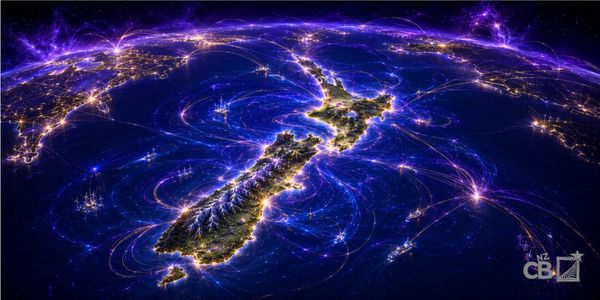
Trust as New Zealand's Economic Capability
Trust is becoming part of New Zealand’s economic capability. As AI, data, identity, assurance, and sovereign infrastructure converge, the question is whether New Zealand can connect these foundations into a trusted operating environment.


Part of a broader body of work on how AI, infrastructure, capability, and trust are reshaping New Zealand's future.
Why confidence, data governance, and AI assurance may shape New Zealand's AI advantage
New Zealand will not win the global AI race by being the largest.
It will not have the biggest domestic market. It will not build the greatest concentration of frontier-model compute. It will not outspend the United States, China, Europe, or the Gulf states on AI infrastructure.
But that does not mean New Zealand has no strategic position.
It means the position has to be different.
As AI moves deeper into economic life, the countries that become valuable may not only be the countries with the most compute. They may also be the countries where high-assurance data, AI, and digital work can be done with confidence.
Confidence in identity.
Confidence in data governance.
Confidence in jurisdiction.
Confidence in AI assurance.
Confidence in institutions.
Confidence in how people, communities, organisations, and systems relate to one another.
That is a different kind of capability. Less visible than data centres. Less dramatic than frontier models. But potentially more aligned with New Zealand's actual strengths.
This essay should be viewed as one pathway into the broader NZ-EOS architecture. It focuses on the trust layer: the part of the system that determines whether people, organisations, iwi, public institutions, investors, and international partners can rely on New Zealand as a place to build, govern, host, and scale AI-enabled activity.
It also sits alongside The Edges of New Zealand’s AI Energy Blueprint Are Forming. That essay explores the energy and compute foundations beginning to form beneath New Zealand’s AI economy; this one explores the trust layer that could make that infrastructure more valuable, more usable, and more internationally legible.
Trust is often treated as a value. In the AI economy, it may need to become an economic capability.
The hidden layer beneath AI adoption
Most AI conversations still begin with tools.
Which model should we use? Which platform should we buy? Which workflows can we automate? Which use cases can be delivered quickly?
These are useful questions, but on their own - they are not enough.
AI adoption only scales when the environment beneath it can support confidence. That environment includes data rights, identity systems, auditability, cybersecurity, legal jurisdiction, public legitimacy, Maori data governance, assurance mechanisms, and the ability to prove that sensitive workloads are being handled in ways people and institutions can trust.
Without that layer, AI remains fragile.
A company can build an impressive prototype, but struggle to deploy it across regulated operations.
A public agency can trial a model, but hesitate when questions arise about accountability.
A health provider can see potential in AI, but be constrained by data sensitivity.
An iwi can recognise the value of data-driven services, but reject systems that do not respect Maori governance.
An exporter can create a new digital product, but find that international customers require stronger proof of security, provenance, compliance, and assurance.
The technology may work.
The operating environment may not yet be trusted enough.
That is the layer that is often missed. Not because it is unimportant, but because it sits beneath the visible excitement of tools, models, pilots, and announcements.
The invisible layer is trust.
What trust means in an AI economy
Trust can sound soft. In strategy conversations, soft words are often treated as secondary.
Here, trust should be understood more concretely.
Trust means that people and organisations can know who they are dealing with. It means data can be shared under clear rules. It means sensitive information can remain within appropriate legal, cultural, and technical boundaries. It means AI systems can be tested, explained, governed, monitored, and challenged.
It also means Maori data is not treated as a generic resource, but as something requiring Maori governance, kaitiakitanga, consent, and benefit consideration.
It means infrastructure is not simply local, but locally accountable. It means international partners can understand the jurisdiction, standards, assurance mechanisms, and institutional environment they are relying on.
In the NZ-EOS context, this connects most directly to the Trust, Sovereign Data, Identity and AI Assurance layer. But it does not sit there alone. It connects outward into energy, compute, capital, workforce capability, innovation, export growth, and organisational AI execution.
That is because trust is not separate from growth. It is one of the conditions that determines what kinds of work can be done here in New Zealand.
It shapes whether sensitive data can be used, whether AI systems can be deployed, whether partners will participate, whether sectors can modernise, whether important workloads can remain in New Zealand, and whether international organisations will feel confident placing high-assurance work inside New Zealand’s trusted operating environment.
If AI is becoming part of the economic substrate, then trust becomes part of the operating environment that allows it to function safely, commercially, and legitimately at scale.
New Zealand is not starting from zero
One of the more interesting things about New Zealand's trust layer is that it is already partially forming.
It does not yet look like one integrated architecture. It appears more like a set of adjacent foundations: digital identity, public-sector AI governance, government data stewardship, Māori data sovereignty, sovereign hosting, regulatory guidance, cybersecurity expectations, service modernisation, and emerging AI assurance.
This is still significant. These foundations represent serious early work across the trust system, and they give New Zealand something real to build from.
The Digital Identity Services Trust Framework (DISTF) provides a legal structure for accredited digital identity services. RealMe remains an established identity anchor. NZ Verify points toward a future where digital credentials can be verified more easily in practical settings. Digital Identity New Zealand continues to convene the wider identity, trust, and assurance community.
The publication of the AML/CFT Identity Verification Code of Practice 2026 provides a further practical signal. The Identity Verification Code explicitly recognises verification through services accredited under the Digital Identity Services Trust Framework (DISTF), including defined levels of information assurance and binding assurance.
This begins to connect New Zealand’s digital identity architecture with real regulatory and commercial processes. Accredited identity services are no longer simply part of an enabling framework. The Identity Verification Code gives banks and other regulated businesses a recognised basis for relying on accredited digital identity services - including services beyond their own internal identity systems -when verifying customers, beneficial owners, and people acting on their behalf.
Although the Identity Verification Code applies specifically to organisations covered by New Zealand’s AML/CFT regime, it also shows how accredited identity services could support trusted transactions across a wider range of sectors and, over time, contribute to greater confidence in cross-border digital interactions.
Alongside this work on identity, New Zealand’s public service has begun building a more visible AI governance layer through the Public Service AI Framework, the Public Service AI Work Programme, cross-agency visibility of AI use, and practical guidance for responsible AI in regulatory settings.
The Ministry for Regulation’s Responsible AI in action guidance is a useful example of this next layer: helping regulators apply AI with confidence while maintaining human judgement, accountability, transparency, and responsible practice.
Those are not abstract signals. They show that AI is moving from possibility into operational use, and that assurance needs to develop alongside adoption.
The Government Data Strategy and Roadmap also matters because it positions data not merely as an administrative asset, but as something connected to stewardship, public trust, Te Tiriti responsibilities, iwi partnership, and Maori Data Sovereignty.
Then there is Te Mana Raraunga, the Māori Data Sovereignty Network.
This is one of the more distinctive parts of New Zealand’s emerging trust proposition. Te Mana Raraunga has helped give shape to a Māori data sovereignty lens that is highly relevant to digital trust, AI governance, and national capability.
If carried carefully into the wider trust environment, this could become part of what allows New Zealand to operate as a differentiated and sought-after trusted node in the global intelligence economy.
This differentiated value position should not be understated.
Many countries can talk about privacy. Many can talk about cybersecurity. Many can talk about responsible AI. Far fewer can point to an active indigenous data sovereignty tradition that asks deeper questions about authority, consent, whakapapa, collective rights, kaitiakitanga, and long-term stewardship.
Related work, such as Dr Karaitiana Taiuru’s Kaupapa Māori AI Framework, adds another useful signal: that AI in Aotearoa New Zealand should be understood through Māori concepts, not only through imported technical and regulatory categories.
The opportunity for New Zealand is not to overstate what already exists. It is to recognise that this work points toward a more distinctive trust layer: one where indigenous data sovereignty is not treated as an afterthought, but as part of the governance environment that could help New Zealand build a differentiated, and higher-value digital and AI economy.
If developed carefully and reflected across institutions, that could become a source of genuine differentiation for New Zealand.
Not as branding. As architecture.
The connection gap
Digital identity is developing in one track. AI assurance is developing in another. Data stewardship sits in another. Māori data governance is recognised, but not yet consistently embedded into operational practice. Sovereign compute and local hosting sit in another part of the system. Public-sector service modernisation is progressing through its own pathways. Commercial adoption is moving at a different pace again.
Each of these areas has value on its own. But the larger opportunity comes when they begin to reinforce one another.
That is not unusual. Most countries are in the same position. Institutions develop around mandates, funding lines, legal responsibilities, and historical delivery models. Coordination is difficult even when intent is strong.
But in the AI economy, fragmentation has a cost.
When the trust layer is fragmented, infrastructure investment may not translate into higher-value capability. When identity systems are not deeply adopted, digital services remain slower to modernise. When AI assurance is mostly public-sector focused, the wider economy lacks shared confidence mechanisms. When Māori data governance is recognised in principle but not yet consistently embedded in practice, the wider trust architecture remains incomplete.
And when sovereign compute is discussed without clear demand anchors, local infrastructure can struggle to justify higher-trust environments.
This is an important point. Demand anchors are the real workloads, sectors, customers, and institutions that would make trusted infrastructure investable. They are the users of the system, not just the builders of it.
For New Zealand, those anchors need to be both local and international. Locally, they might include government services, health, financial services, research, Māori data environments, primary industries, regulated sectors, critical infrastructure, and public-sector AI use cases. Internationally, they might include organisations looking for stable, trusted, renewable, high-assurance environments for sensitive data, AI systems, regulated workloads, model evaluation, or trusted hosting.
At present, those demand signals are not yet visible enough as one connected market. The principles are forming. The guidance is emerging. The infrastructure case is strengthening. But the pathway from trust principles to investable demand is still underdeveloped.
The pieces are beginning to form, but they are not yet connected into a trust environment that buyers, investors, agencies, sectors, and international partners can easily recognise, navigate, and use.
That is where the trust question becomes an NZ-EOS question.
The issue is not whether New Zealand has good intentions.
The issue is whether the right layers can become connected enough to create a trusted operating environment that is visible, usable, investable, and internationally legible.
From compliance to capability
For many organisations, trust is still treated as a compliance burden.
Privacy review. Security policy. Risk assessment. Legal approval. Governance checklist.
Those disciplines remain necessary. But the frame is too narrow.
In an intelligence economy, trust may become an economic capability.
A trusted environment can attract sensitive workloads. It can support regulated AI services. It can help health, finance, government, education, research, and critical infrastructure adopt AI with greater confidence.
It can strengthen digital exports. It can allow New Zealand firms to build AI products where provenance, assurance, jurisdiction, and governance are part of the value proposition. It can create the conditions for Maori-governed data environments to participate in AI-era value creation without losing authority over data.
This is the strategic reframe.
The question is not only:
How do we make AI safe?
The larger question is:
What kind of operating environment allows trusted AI, data, identity, and digital services to scale from New Zealand into the world?
That question changes the conversation.
It connects trust to capability. Capability to exports. Exports to long-duration economic positioning.
That is why the trust layer should not sit at the edge of the AI conversation. It should sit closer to the centre of New Zealand's economic architecture.
What leaders need to understand
For business leaders, this can feel abstract until it appears as a constraint.
A customer asks where data is hosted. A board asks how an AI system was tested. A regulator asks how decisions are explained. A partner asks whether identity claims can be verified. An iwi asks who governs data, who benefits, and what consent model applies. An international buyer asks whether the service meets assurance expectations.
At that point, trust stops being theoretical.
It becomes commercial.
The next phase of AI adoption will not only reward organisations that move quickly. It will reward organisations that can move with confidence.
That means building capability in several areas:
- Understanding what data is held, where it sits, who controls it, and what rights attach to it.
- Designing AI systems with auditability, human oversight, and clear accountability.
- Using identity and credential systems that reduce friction without weakening confidence.
- Treating Maori data governance as a design requirement where relevant, not a late-stage consultation issue.
- Working with infrastructure partners that can support sovereign, secure, and high-assurance workloads.
- Building governance practices that are practical enough to support innovation, but strong enough to maintain legitimacy.
This is not only for government.
It is a business issue.
The companies that understand this early may be better placed to build trusted AI-enabled services in sectors where New Zealand already has credibility: food and fibre, including dairy, meat, wool, forestry, horticulture and premium food; agritech and biosecurity; health, education, financial services and environmental systems; advanced manufacturing; public-sector capability; indigenous knowledge partnerships; regulated digital services; and emerging digital and AI exports across SaaS, platforms, and vertical AI.
The New Zealand opportunity
New Zealand's opportunity is not to claim that it is automatically trusted.
Trust cannot be declared.
It has to be designed, demonstrated, governed, measured, and renewed.
The opportunity is to build a trusted operating environment that brings several layers together: legal and regulatory clarity, digital identity and credentials, sovereign data governance, Maori data sovereignty and kaitiakitanga, AI assurance and auditability, cybersecurity and resilience, local compute and high-assurance hosting, public-sector digital capability, commercial adoption pathways, and international interoperability.
Individually, these are policy or technology domains.
Together, they may become a strategic position.
This is where New Zealand could differentiate.
Not by being the biggest AI market. Not by pretending to have limitless compute. Not by copying the scale strategies of larger economies.
But by becoming a well-respected and trusted operating node inside the global intelligence economy.
A place where high-assurance workloads can operate. Where data governance is embedded in practice. Where identity, assurance, and jurisdiction are clear. Where Māori data sovereignty is woven into the foundations of trust, governance, and value creation. Where low-carbon infrastructure, sovereign compute, and trusted digital capability can recursively reinforce one another.
That is a more credible path. It is also harder than it sounds. Because it requires coordination.
The next strategic question
New Zealand has many of the early ingredients.
The risk is that they remain ingredients.
A trust framework here. A data roadmap there. An AI assurance model in one part of government. A sovereign hosting investment somewhere else. A Māori data governance principle recognised, but not always operationalised. A digital identity system available, but not yet deeply embedded across the economy.
The next step is not another slogan.
It is system connection.
New Zealand needs to make the trust layer more visible as an economic architecture: something leaders can understand, institutions can coordinate around, investors can recognise, iwi can shape, exporters can build from, and international partners can rely on.
That matters because the opportunity is not only domestic adoption.
A trusted operating environment could also help New Zealand attract international workloads that might not otherwise come here: high-assurance data, AI, research, regulated-sector, model evaluation, trusted hosting, and compute-intensive services that require confidence in jurisdiction, governance, energy, security, and assurance.
In that sense, trusted compute becomes part of the export story. The value is not only the processing capacity inside a data centre. It is the trusted environment around that capacity: the rules, institutions, infrastructure, energy profile, data governance, and assurance mechanisms that allow higher-value work to be placed here with confidence.
That will not happen through one agency, one platform, one law, or one company.
It will require a coordinated operating environment.
And that may be the real test of NZ-EOS.
Not whether New Zealand can describe the future.
Whether it can connect the layers that make the future possible.
Trust may be one of those layers.
If New Zealand can coordinate and connect it deliberately, trust could become one of the ways the country plays above its weight in the global intelligence economy: not by being the largest, but by becoming one of the more credible, differentiated, and trusted places to build, host, govern, and export high-assurance AI, data, compute, and digital services.
That is part of how New Zealand builds a more capable, prosperous, and trusted economy.
The question is whether New Zealand can design it deliberately enough before the global intelligence economy hardens around other nodes.
Selected References & Signals
New Zealand Economic Operating System - Chris Blair
A systems-level framework for New Zealand’s long-term growth, AI-enabled competitiveness, and national economic capability.
White Paper: The Foundational Substrate Beneath the Intelligence Economy - Chris Blair
White paper on the infrastructure, energy, compute, trust, and sovereign capability foundations beneath the intelligence economy.
Digital Identity Services Trust Framework - New Zealand Government
Legal framework for accredited digital identity services in Aotearoa New Zealand.
Public Service AI Framework - New Zealand Government
Framework supporting responsible AI use across the New Zealand Public Service.
Public Service AI Work Programme - New Zealand Government
A two-year programme of AI initiatives to improve public services and modernise government.
Te Mana Raraunga - Māori Data Sovereignty Network
Māori Data Sovereignty Network advocating for Māori rights and interests in data.
Digital Identity New Zealand
Industry and policy community advancing trusted, interoperable digital identity in Aotearoa New Zealand.
AML/CFT Identity Verification Code of Practice 2026 - Department of Internal Affairs
Connects accredited digital identity services with practical customer-verification requirements, allowing banks and other regulated businesses to rely on services beyond their own internal identity systems.
Responsible AI in Action - Ministry for Regulation
Practical AI guidance for regulators, focused on confident use, human judgement, accountability, transparency, and responsible practice.
Government Data Strategy and Roadmap - data.govt.nz
Shared direction and plan for the government data system of Aotearoa New Zealand.
Related Essays
The Edges of New Zealand’s AI Energy Blueprint Are Forming
Building AI Advantage on Sovereign Data and Trust
The Structural Shift in New Zealand
Redesigning New Zealand’s System for AI-Enabled Growth