Scaling AI with the Dual Speed Model
Most organisations improve work with AI. Few redesign it. The Dual-Speed Model balances operational stability with rapid capability generation - forming the foundation for scalable AI transformation.

Part of a broader body of work on how AI is reshaping organisational capability, execution, and performance.
Most organisations improve work with AI - few redesign how work gets done
Most organisations are currently using AI to improve existing work. The real opportunity is redesigning the work itself
As I speak with senior leadership teams, it’s clear that most organisations are now well underway with secure AI tools for staff - copilots, internal GPT environments and experimentation sandboxes.
That’s a good first step.
But a bigger question is emerging:
How do we build an internal capability that continuously redesigns how work actually happens?
AI isn’t just about productivity tools. The real opportunity is re-architecting processes themselves - using AI, automation and agent systems.
This likely requires a new type of team inside organisations: small groups specifically focused on redesigning operational processes for the AI era.
Interestingly, this challenge isn’t new.
Across my career from art and architecture through to technology and organisational transformation - I’ve either researched or worked within a series of small-team operating models designed to rethink systems.
Some examples:
• The Bauhaus movement (1919) [What Steve Jobs Learned From Bauhaus]
• Andy Warhol’s Factory
• Skunk Works teams
• The Scrum framework
• The Spotify Model (2015)
Different era.
Same pattern.
Small interdisciplinary teams redesigning systems.
Now AI is pushing organisations into the next evolution of this pattern.
Large technology companies are beginning to operate in dual-speed organisational models. Gartner described this concept as “Bimodal IT” in 2014. Its new form is beginning to take shape as follows:
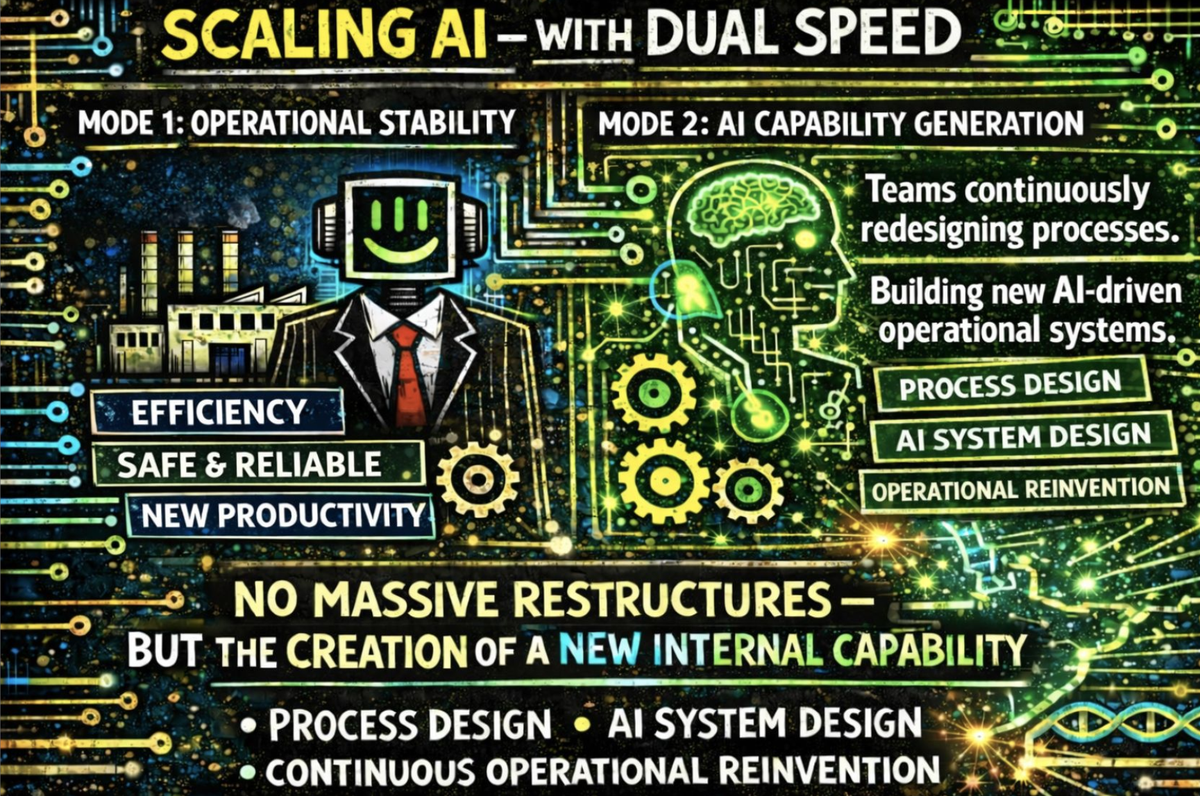
Mode 1: Operational Stability & Efficiency
Running the existing business safely and reliably with additional productivity.
Mode 2: AI Capability Generation
Teams continuously redesigning processes and building new AI-driven operational systems.
Companies like Microsoft, Palantir and Amazon are already moving in this direction - combining AI infrastructure platforms, modern development environments and small product teams capable of generating new operational capabilities.
There is an uncomfortable truth here: AI transformation is not just a technology rollout. It will require structural change inside organisations.
Not massive restructures - but the creation of a new internal capability focused on:
• Process design
• AI system design
• Continuous operational reinvention
Without this, AI will tend to remain as a productivity tool within the organisation, rather than becoming a true strategic advantage.
New Zealand is also beginning to recognise the scale of this opportunity.
Microsoft estimates generative AI could double New Zealand’s GDP by 2038 if adopted effectively. [Microsoft - Report - Generative AI expected to more than double New Zealand’s productivity by 2038]
But capturing that value will depend less on the tools themselves and more on how organisations redesign their capability to use them.
#DoubleExportsBy2034
#TrueStructuralTransformation
#AIforReimaginingEntireWorkflows
How this connects
This essay is part of a broader body of work:
The Studio Model
Organisational AI capability and execution
New Zealand Economic Operating System (NZ-EOS)
System-level design shaping New Zealand’s future
Related Essays
Studio Model (Primary Essay)
Redesigning Systems in the Age of AI
Intervention Points for AI Impact