
Building AI Capability That Lasts
AI Knowledge Architecture – from AI experimentation to AI-enabled organisations that learn, adapt and improve.


The progress we're seeing
Over the past few years, I've been working with people across different New Zealand organisations, exploring how AI might change the way their businesses operate.
One of the encouraging things has been watching people discover new ways to work. Tasks that once took an afternoon can sometimes be completed in minutes. People are experimenting with AI assistants, building their own agents and sharing ideas with colleagues. You can see the enthusiasm as they begin to imagine what else might be possible.
But follow the work a little further through an organisation and you can find a different picture.
The information still needs checking. Someone moves it into another system. Another team combines it with material from somewhere else. Many of the same approvals, decisions and handovers continue.
An individual task has become faster, while the wider workflow may remain largely unchanged.
I've been thinking about the opportunity that sits between those two experiences.
The progress people are making with AI is valuable. How can organisations build upon that progress to improve the way the whole business functions?
And how can they develop capabilities that continue to be useful as the technology changes?
Start with the work and the people who do it
My background in systems thinking has taught me to look beyond individual tasks and understand how different parts of an organisation work together.
Consider something as familiar as responding to a customer request. Information might come from several systems, move between teams and require decisions from people with different responsibilities.
AI could help prepare a response or retrieve information more quickly. But understanding the wider opportunity requires looking at the complete experience: what the customer needs, where information comes from, how decisions are made and why particular steps exist.
In sensitive or regulated environments, we also need to consider what makes a decision trustworthy. Where did the information come from? Can it be relied upon? Who has authority to use it, and who remains accountable for the outcome? These questions of provenance, governance and human judgement need to be part of redesigning the workflow from the beginning, something I've explored further in Trusted by Design.
Some of the most useful knowledge won't appear in a process diagram.
People understand the exceptions, the workarounds, the relationships and the small decisions that keep things moving. They know when something looks unusual, when more information is needed and when an established process could be improved.
Bringing those perspectives together can reveal opportunities that aren't obvious when we examine one task at a time.
Perhaps several handovers could disappear. Perhaps the information needed for a decision could be brought together earlier. Or perhaps AI makes a completely different service possible.
The starting point is understanding the work, the people involved and the value we're trying to create. People closest to the work need to be part of exploring the opportunities, challenging familiar assumptions and helping design what comes next. From there, we can work out where AI and other technologies could make a difference.
Building the capability to keep adapting
As organisations explore these opportunities, another challenge begins to emerge.
How do you move from individual experiments to a coordinated way of improving the business?
This is where many of the disciplines we've developed through continuous improvement, innovation and organisational transformation become particularly useful.
One of the challenges I've seen is connecting strategic ambition with the practical work of transformation. Leaders might have a clear direction for AI, but that direction needs to translate into changes in how services are delivered, how teams work and how decisions are made. Just as importantly, what people discover through that work needs to inform the next round of strategic decisions, investment priorities and improvements to the operating model.
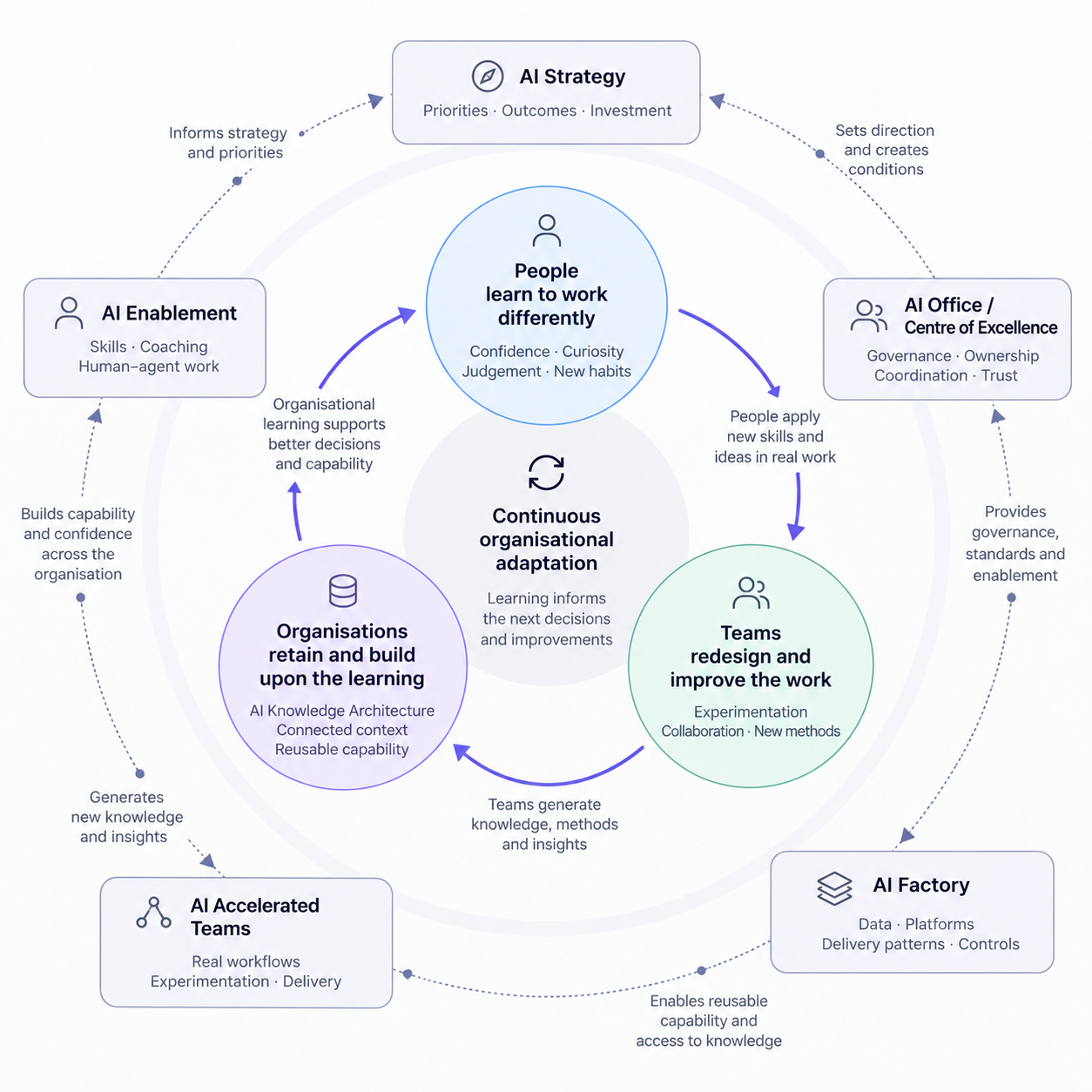
An AI strategy provides direction. Leaders need to understand where AI could create value, which opportunities deserve investment and how success will be assessed. Those priorities also need to evolve as the organisation learns more about what works.
An AI Office or Centre of Excellence helps bring the different parts of the organisation together. Business leaders, technology teams, risk specialists and people responsible for workforce development all have a role. Clear ownership, shared standards and practical governance allow teams to experiment with confidence while managing the consequences of their decisions.
For example, shared guidance on data access, risk and approvals can help teams resolve common questions without starting the discussion again each time. A central group can support that consistency while leaving responsibility for outcomes with the people closest to the work.
Then there are the teams doing the work.
AI-accelerated teams bring together people who understand the business, those who use its services, and specialists who can design and build solutions alongside them. Working together allows the team to explore real problems, test ideas against everyday constraints and refine new approaches as they learn what works.
Supporting those teams requires shared foundations.
As more teams begin building AI-enabled solutions, they shouldn't have to solve the same technical problems each time. How will they access the right information? Which AI models should they use? How will security, costs and ongoing maintenance be managed?
An AI Factory provides shared foundations for answering these questions, making it easier for teams to develop and maintain solutions without creating a collection of disconnected systems.
I've explored how these capabilities can work together through my Studio Model, an organisational framework for scaling AI. It connects leadership direction, teams redesigning work, shared technology foundations, delivery teams and ongoing operations. The aim is to create a repeatable way for organisations to design, test, deliver and improve AI-enabled capabilities, while learning from each cycle.
I've also been exploring these ideas through AI prototypes and small applications I've built over the past few years, from scripts and workflow experiments to a more substantial cloud-hosted application. That more recent work has involved practical challenges such as capturing and connecting knowledge, managing access and permissions, and tracing AI-generated answers back to their supporting evidence.
In my cloud-hosted AI application, one area I've been exploring is the architecture for working with different AI models. Rather than tying the application to a single provider, I've been developing a routing approach where the application can determine when AI is needed, what information it can use and what controls apply. Different models, including open-weight alternatives, could then be evaluated and introduced without rebuilding the entire application.
The prototypes are still evolving, but working through these decisions has given me a more grounded understanding of what AI makes possible and the wider implications for organisations. That practical experience informs my approach to AI strategy, transformation and adoption, helping me connect technical choices with business priorities, how work needs to change, where human judgement belongs, and the capabilities people and organisations need to develop.
I've also started developing a Continuity Decision Record (CDR) system to preserve the reasoning behind important decisions as work moves between people and AI agents. A useful handoff needs to carry more than the latest output. It should preserve why a decision was made, the evidence behind it and what still needs attention, so the next person or agent can build on that work without having to reconstruct the thinking.
And running through all of these activities is AI enablement.
People need opportunities to develop the confidence, skills and judgement to work effectively with AI. Over time, they learn how to organise information so AI can work with it, ask better questions, evaluate what comes back and recognise when their own experience and judgement should take the lead.
This kind of learning develops through practice, coaching and experimentation in everyday work.
I've been thinking about this as a continuous AI mindset: people becoming more comfortable exploring new possibilities, adapting their methods and learning alongside the technology.
The same thinking needs to extend across teams and into the organisation itself. When a new AI model or tool arrives, teams should be able to test what it offers against workflows, methods and safeguards they've already developed, rather than beginning again.
Building and testing my own AI applications has also deepened my understanding of what makes AI trustworthy in practice.
I've found a useful distinction between Law – the rules governing permissions, authority, evidence and human decisions – and Physics, the technical controls that enforce those rules.
Law tells the system what should happen. Physics constrains what can happen. Evaluations (evals) help demonstrate what actually happens.
These aren't simply technical considerations. They inform how we redesign workflows, where human judgement needs to remain, and what organisations need to consider as AI becomes part of everyday work.
Connecting what we learn: AI Knowledge Architecture
There's another dimension to building these capabilities that I've been exploring.
When a team experiments with AI, the useful discoveries can go well beyond whether a tool works. People may uncover unexpected dependencies between teams, challenge assumptions about a decision and learn which methods produce better outcomes.
Imagine a team redesigning how a business assesses customer applications. As they test the new workflow, they discover which information is genuinely useful, where human judgement is essential and which steps can be simplified.
The finished solution might capture the new workflow. But what happens to everything the team learned while developing it?
Why were certain decisions made? What alternatives were considered? Which assumptions proved incorrect? What would the team recommend to someone approaching a similar challenge?
Some of that understanding will remain with the people involved. Other parts may be scattered across AI conversations, meeting notes, project documents and different systems.
When another team encounters a similar problem, much of the discovery may need to happen again.
This question has led me to develop a body of thinking around AI Knowledge Architecture (AKA).
At its simplest, AKA explores how organisations can connect the knowledge, context, decisions and working methods that emerge through everyday work and transformation, making valuable learning easier to retain, share appropriately and build upon.
The idea draws on familiar disciplines such as knowledge management, systems thinking, organisational design and continuous improvement. AI introduces new possibilities for connecting and working with knowledge across different people, processes and systems.
A useful way to think about AKA is through the organisational capabilities we've already explored.
When developing an AI strategy, organisations can retain the evidence and reasoning behind investment decisions, allowing leaders to revisit their assumptions as new information emerges.
An AI Office or Centre of Excellence can help establish ownership, standards and practices for sharing useful knowledge across teams.
An AI Factory can provide reusable technical foundations, alongside governed access to the knowledge and context that different AI solutions need.
And as AI-accelerated teams experiment and redesign workflows, they can consider what others might learn from their discoveries and how successful approaches could be reused.
The human dimension remains central to AKA. People bring experience, judgement and an understanding of the work that AI may not have. They need to help shape how knowledge is used, which decisions remain with people, and how new ways of working are developed. Trust, provenance, ownership and appropriate permissions become even more important as knowledge moves between people, systems and AI agents.
We also need to be selective. Capturing every conversation or creating another layer of documentation could make the work harder. The opportunity is to preserve the knowledge that helps people understand, decide and improve, without losing the context that gives that knowledge meaning.
My longer-term vision for AKA goes beyond connecting and retaining organisational knowledge. As AI agents become embedded in everyday workflows, I see an opportunity for them to help organisations learn from their own experience – connecting decisions, evidence, actions and outcomes as work happens, and making that learning available to inform what happens next.
Imagine a team redesigning a customer workflow. Rather than documenting everything afterwards, AI could help connect the changes made, the reasoning behind them and what the team learns from the outcomes. Similar opportunities could emerge within development environments using tools such as GitHub Copilot, where the thinking behind a solution could remain connected to the work itself.
As these capabilities develop, agents could also help recognise when new evidence challenges an earlier decision, or connect lessons from one team's experience to a similar challenge elsewhere in the organisation.
People would still play a central role in interpreting those findings, questioning assumptions and deciding how the organisation should respond. The aim is to make organisational learning a more natural and continuous part of everyday work, rather than another activity people need to remember to complete.
I'm still developing AKA as an architectural approach, particularly how organisational knowledge, human judgement and AI agents could work together. But the central idea is becoming clearer: organisational learning should be designed into our AI capabilities from the beginning, allowing organisations to continuously build upon their own experience as they evolve.
From organisational capability to managed intelligence
Another development I'm watching is the emergence of managed intelligence services, where technology providers help businesses adopt and manage AI assistants, agents and increasingly sophisticated workflows.
This could be particularly important for smaller organisations. Not every business will have the people, technical expertise or resources to build and operate its own AI systems.
But making intelligence easier to access is only one part of the opportunity.
Businesses still need to understand where AI can create value, how their work might change, what knowledge these systems need, and how important decisions remain trustworthy.
As these services become more widely available, I think AI Knowledge Architecture becomes even more relevant.
Organisations will need ways to retain their own knowledge, context, decisions and learning, even when the underlying technology is delivered and managed by external providers.
There is also a wider connection here.
In my WAVES framework, I explore how AI moves from improving work inside organisations to supporting interactions between people, businesses and eventually wider economic networks.
Agent-Ready New Zealand examines what businesses and institutions may need as those interactions become mediated by intelligent agents.
Together, these developments suggest an opportunity for New Zealand: making sophisticated AI capabilities accessible to more businesses while helping them build their own expertise, knowledge and distinctive value.
The technology may be shared or externally managed. The organisational capability and learning it enables should continue to develop within the businesses themselves.
An organisation designed to keep learning
Bring these ideas together and a different picture of AI transformation begins to emerge.
People develop new habits and the confidence to work differently.
Teams use that experience to experiment, redesign workflows and discover better ways of delivering value.
The organisation retains useful knowledge from those experiences, making it available to inform future decisions and opportunities.
And the learning continues.
An AI strategy can become more informed by evidence from real work. An AI Office can refine its guidance as new risks and opportunities appear. Delivery teams can draw upon methods developed elsewhere. People joining the organisation can build on earlier experience rather than starting from the beginning.
This is the kind of organisational capability I've become interested in building.
The underlying AI models and platforms will continue to change. Many of the same technologies will be available to businesses around the world.
But organisations have their own people, expertise, relationships, knowledge and understanding of the customers and communities they serve.
The ways they connect and develop those capabilities can create distinctive value.
For New Zealand, I see a significant opportunity in approaching AI through this wider organisational lens. We can use powerful technologies developed elsewhere while building our own knowledge, methods, services and capabilities around them.
Over time, those capabilities can support better businesses, better experiences for customers and new opportunities that may previously have been difficult to imagine.
Perhaps one of the most useful questions we can ask as we explore AI is a simple one:
What are we learning, and how will that learning make our organisation more capable tomorrow?
Further reading
- Gartner – Gartner Says CHROs Must Become an Enterprise Leader of How Work Should Change in the AI Era (27 October 2025). Research on the value of redesigning workflows and new ways of working, beyond task-level AI adoption.
- Chris McKee – AI Instinct: The Human Framework for Working with AI. A perspective on the habits, judgement and confidence people develop through working with AI, published through the Microsoft AI Decision Framework project.
- Microsoft Cloud Adoption Framework – Establish an AI Center of Excellence. Guidance on coordinating AI governance, organisational enablement, shared standards and reusable assets.