The AI-Native Software Development Lifecycle
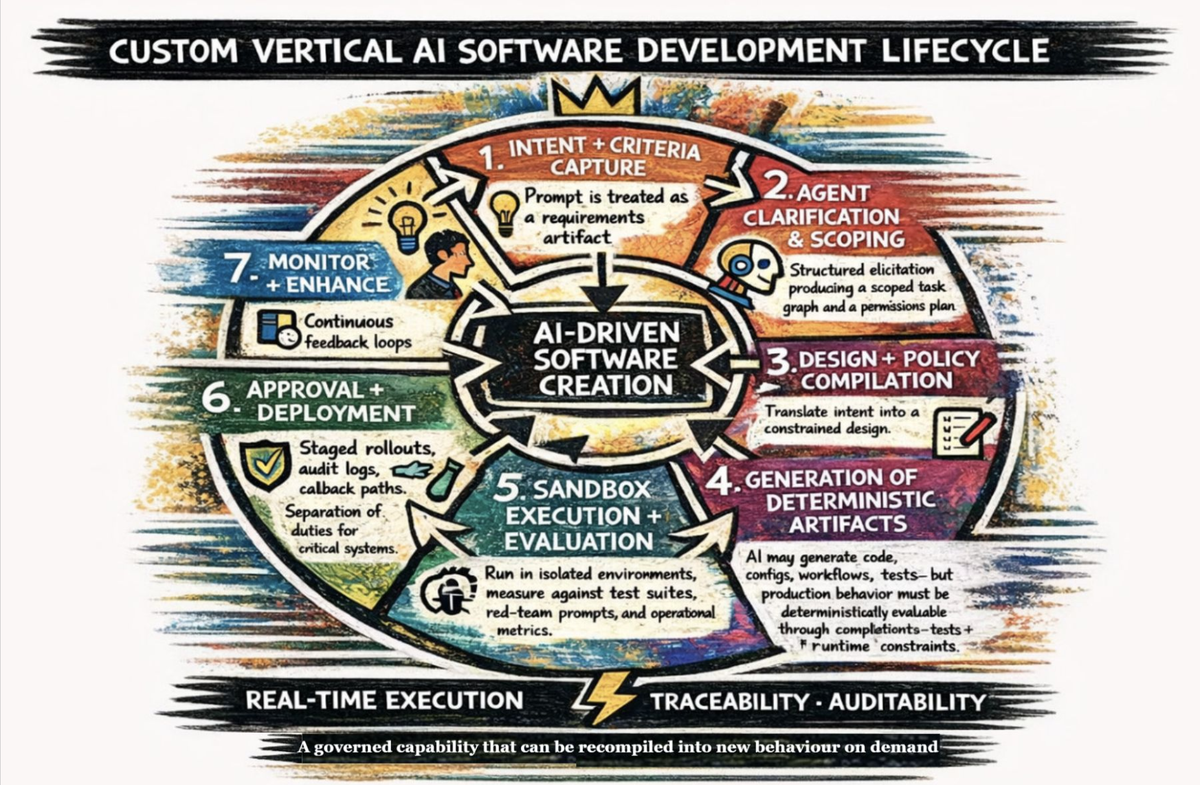
The shift isn’t just AI products - it’s how they’re built. AI-native development systems are defined by rapid iteration, evaluation, and deployment, forming the delivery backbone of the Studio Model.

Part of a broader body of work on how AI is reshaping organisational capability, execution, and performance.
The advantage is shifting from software products to AI-native capability systems
Creating the next wave of business value: Custom AI Vertical Software
But the real opportunity may not be the AI software product itself.
It may be the capability systems current organisations and new start-ups build around the AI
For the past decade SaaS has been the dominant model for delivering digital value - and it is now a meaningful part of New Zealand’s export economy. Technology exports generate $15B+ in exports annually (around 11% of NZ exports), with software and ICT services one of the fastest-growing segments. [TIN - Report - New Zealand tech exporters generated NZ$20 billion in revenue in FY2025]
But that model is now being challenged from two directions:
• Agent platforms capable of executing tasks and decisions
• Internal AI “app factories” that can generate software inside organisations
This creates a very different future.
As I discussed in my previous post, [NZ-EOS Framework (Primary Essay)] if New Zealand’s capability layer evolves successfully, our export advantage may not simply be SaaS products.
Instead it could be something far more powerful - a repeatable institutional capability that combines:
• governed agent platforms
• AI-ready workforces
• innovation systems that convert research and domain expertise into deployable software
In other words: The advantage is no longer just “we have digital tools.”
It becomes: “We can reliably generate, verify, deploy, and audit change.”
This shift introduces many entirely new roles and disciplines inside our organisations.
Agentic Software Development Life Cycles (SDLCs) are not just faster DevOps. They require new approaches to evaluation, governance, cost control and safety.
And the “product” itself begins to change.
Instead of static SaaS workflows, the exportable asset becomes:
A governed capability that can be recompiled into new behaviour on demand.
This is the signal that marks the beginning of a shift from traditional “systems of record” toward AI-driven systems of action.
Gartner predicts that 40% of enterprise applications will include task-specific AI agents by end of 2026 (up from <5% today) [Gartner Predicts 40% of Enterprise Apps Will Feature Task-Specific AI Agents by 2026]
Which raises a slightly uncomfortable question:
Are most companies actually running their businesses on workflows that were either based on manual admin processes or designed for the limitations of static software they have installed over the years - rather than the potential of AI?
If AI can continuously redesign and optimise processes…
Then the real opportunity may not be replacing software.
It may be rebuilding how organisations operate.
Which of your company’s core processes would you redesign if the software could evolve with the business in real time?
#DoubleExportsBy2034
#TrueStructuralTransformation
#AIforReimaginingEntireWorkflows
How this connects
This essay is part of a broader body of work:
The Studio Model
Organisational AI capability and execution
New Zealand Economic Operating System (NZ-EOS)
System-level design shaping New Zealand’s future
Related Essays
Studio Model (Primary Essay)
Scaling AI with the Dual Speed Model
Redesigning Systems in the Age of AI