
National Ambition: The Choices That Will Shape New Zealand
The choices we make now will shape what New Zealand can build by 2034 - and what we build by 2034 will shape what becomes possible next.

The choices we make now will shape what New Zealand can build by 2034 - and what we build by 2034 will shape what becomes possible next.

New Zealand can build more from what we already have - renewable energy, strong research, skilled people and ambitious businesses. By being more deliberate about what each success leaves behind and how it is reused, the next opportunity can start further ahead - building momentum for what comes next

New Zealand already has many of the foundations needed for the intelligence economy. The opportunity lies in connecting energy, research, trust, infrastructure, capital and organisational capability so knowledge, ownership and future choice can remain and compound here.

AI is beginning to sit between people and the organisations they rely on. Agent-Ready New Zealand examines how businesses, public services, exporters and institutions can remain visible, understandable, trusted and correctable as AI becomes part of discovery, choice and service access.
A Strategic Perspective on Trust and AI for Business and Public Leaders in the Intelligence Economy.

Trust is becoming part of New Zealand’s economic capability. As AI, data, identity, assurance, and sovereign infrastructure converge, the question is whether New Zealand can connect these foundations into a trusted operating environment.
AI infrastructure is beginning to reshape New Zealand’s economic foundations. As energy, compute, and trusted operating environments converge, the question is whether New Zealand can move from hosting infrastructure to building compounding national advantage.
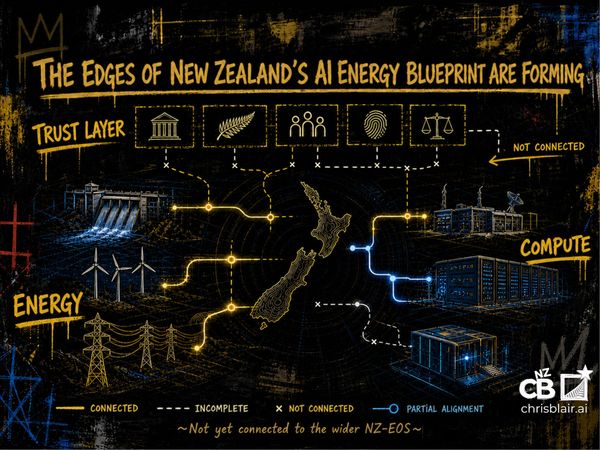
AI is becoming infrastructure - but infrastructure alone doesn’t create value. As energy, compute, and capital begin to align, a new architecture is forming beneath the surface of the economy. The question is whether New Zealand can connect it fast enough to capture new global value.
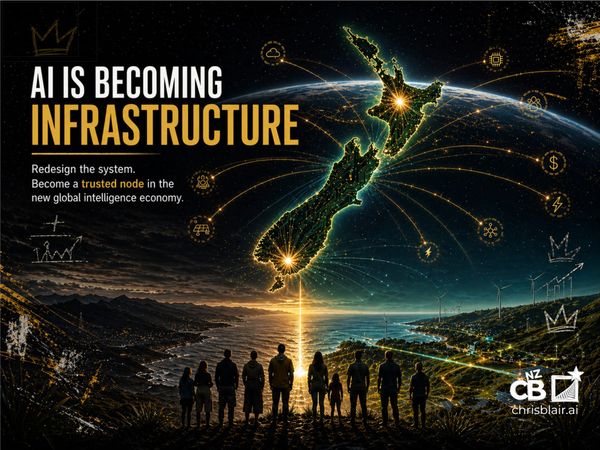
AI is no longer just software. It’s becoming the infrastructure that economies will run on. As compute scales, the conversation shifts from tools and models to energy, systems, and economic capability - reshaping how growth is created and where value accumulates.
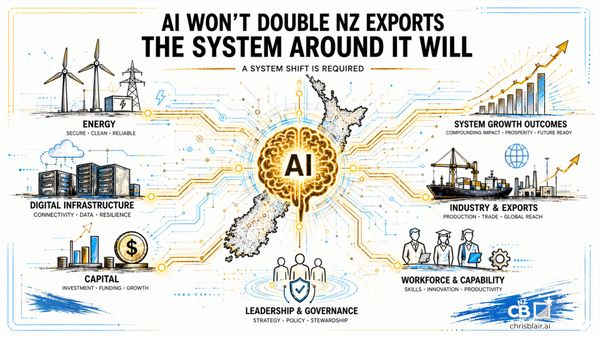
AI isn’t the answer - it’s a force multiplier. New Zealand’s future growth depends on redesigning the system around it - aligning infrastructure, capability, and capital to turn that force into sustained national advantage.
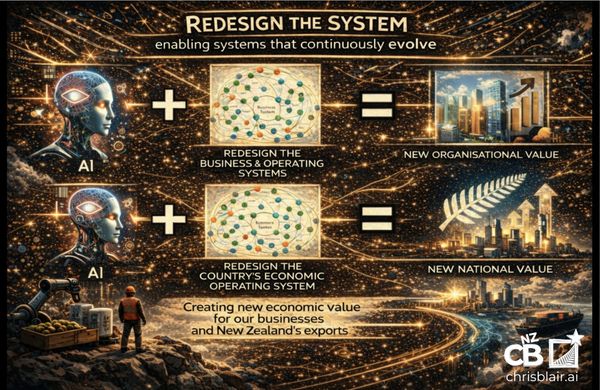
AI won’t scale in New Zealand without the right systems. The real gap isn’t AI models - it’s infrastructure: energy, connectivity, and capability - the foundations that determine whether growth and export potential can actually scale.
As AI and innovation move into the core of organisations, leadership needs to evolve from sponsoring isolated initiatives to shaping coordinated, system-wide capability and transformation.
Essays
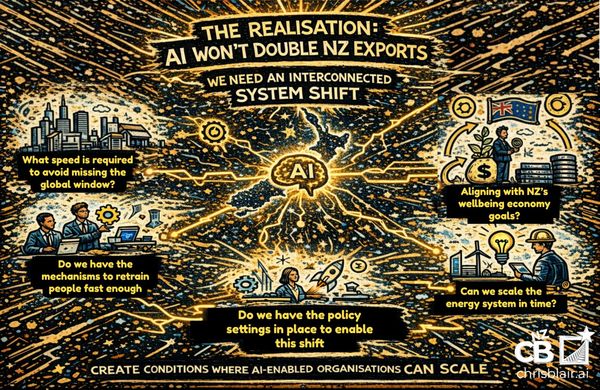
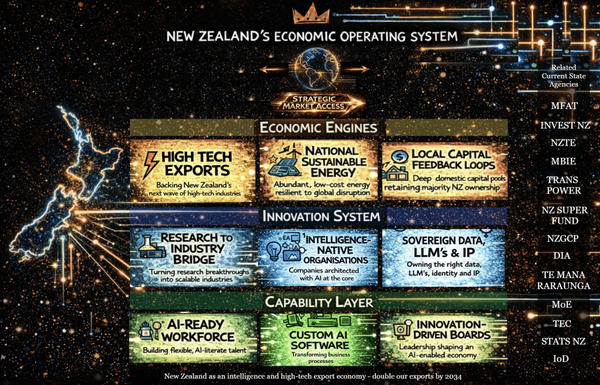
What would it take for New Zealand to double exports? AI alone isn’t enough to drive export growth. Growth depends on coordinated systems across energy, infrastructure, capital, and capability - forming the foundation of the New Zealand Economic Operating System.
Essays
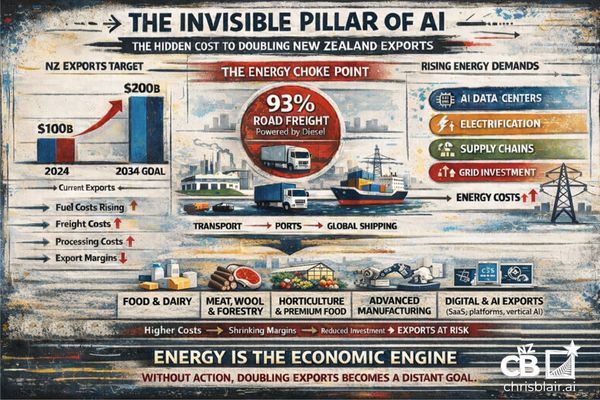
Energy is becoming a defining constraint in the AI economy. Cost, availability, and infrastructure now shape competitiveness and export scale - positioning energy as a core pillar of the New Zealand Economic Operating System.
Essays
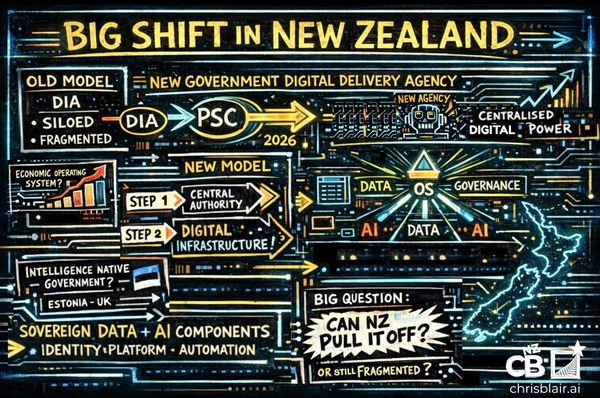
Digital capability is moving to the centre of government. Coordination, interoperability, and infrastructure are becoming critical to national scale - reshaping how New Zealand operates in an AI-enabled economy.
Primary Essays
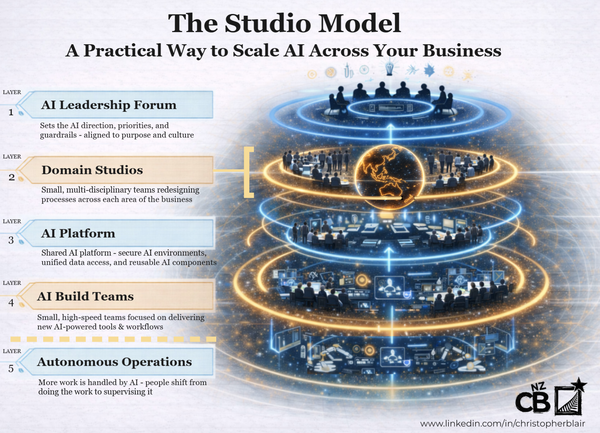
Most organisations are experimenting with AI - few are scaling it. The Studio Model defines an operating system for turning fragmented activity into continuous AI capability across the business.
Essays
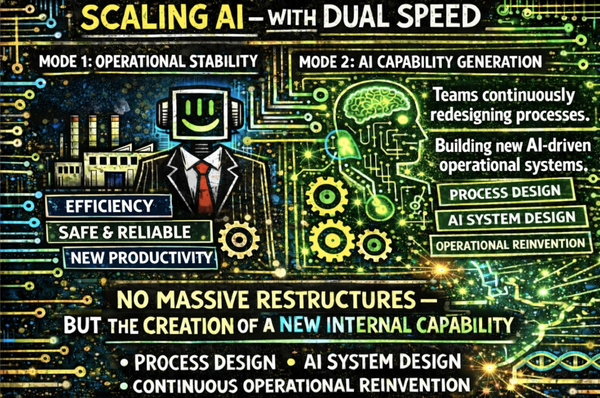
Most organisations improve work with AI. Few redesign it. The Dual-Speed Model balances operational stability with rapid capability generation - forming the foundation for scalable AI transformation.
Essays
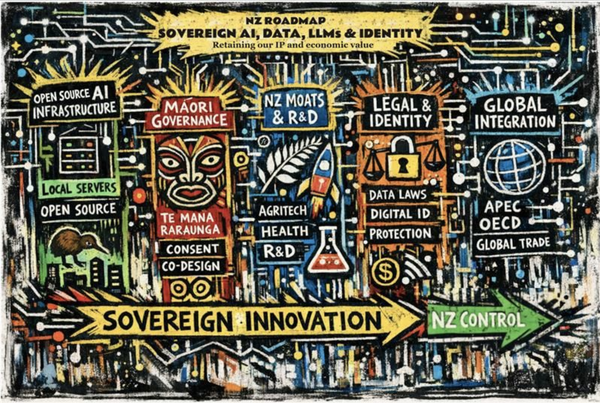
In an AI economy, trust becomes infrastructure. Sovereign data, identity, and governance create long-term advantage - linking national capability with scalable organisational systems.
Essays
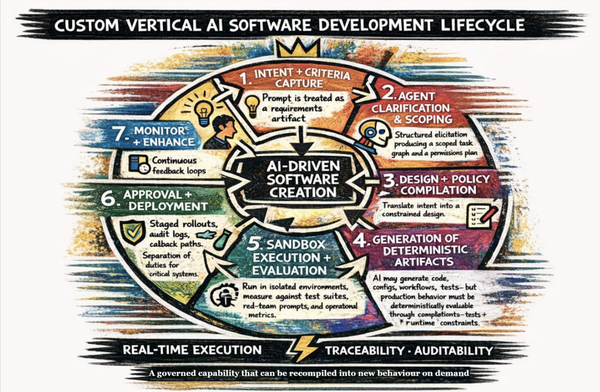
The shift isn’t just AI products - it’s how they’re built. AI-native development systems are defined by rapid iteration, evaluation, and deployment, forming the delivery backbone of the Studio Model.
Primary Essays
New Zealand’s growth challenge isn’t an AI problem - it’s a system design problem. The New Zealand Economic Operating System reframes growth as alignment across energy, infrastructure, capital, and capability.
Essays
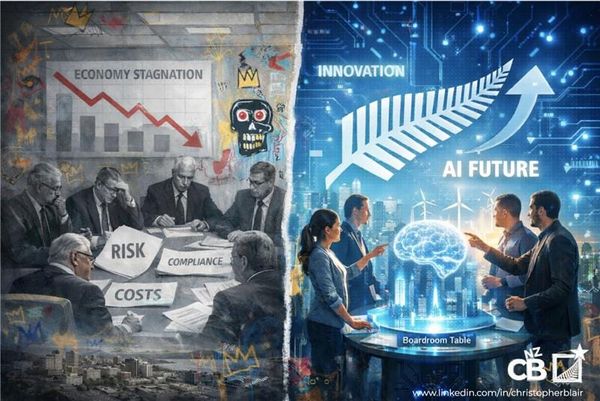
If AI is to shift economic outcomes, where should we intervene? The highest-leverage points sit across boards, infrastructure, and capability - defining where system redesign creates the greatest impact.

Essays
Many organisations say they are redesigning systems. Most are accelerating old ones. The gap between optimisation and true redesign defines whether AI drives transformation - or reinforces existing constraints.